
Undergraduate education in the UAE is scaling faster than ever. Institutions are expanding their student base, welcoming highly diverse cohorts, and operating under rising expectations for transparency, consistency, and measurable student outcomes. But as universities grow, the real challenge is no longer just academic excellence, it is institutional clarity.
Because leading undergraduate education at scale requires more than strong curriculum design or faculty strength. It demands robust governance, structured decision-making, and alignment across admissions, academics, student support, and policy frameworks, ensuring that growth does not compromise fairness, rigor, or quality.
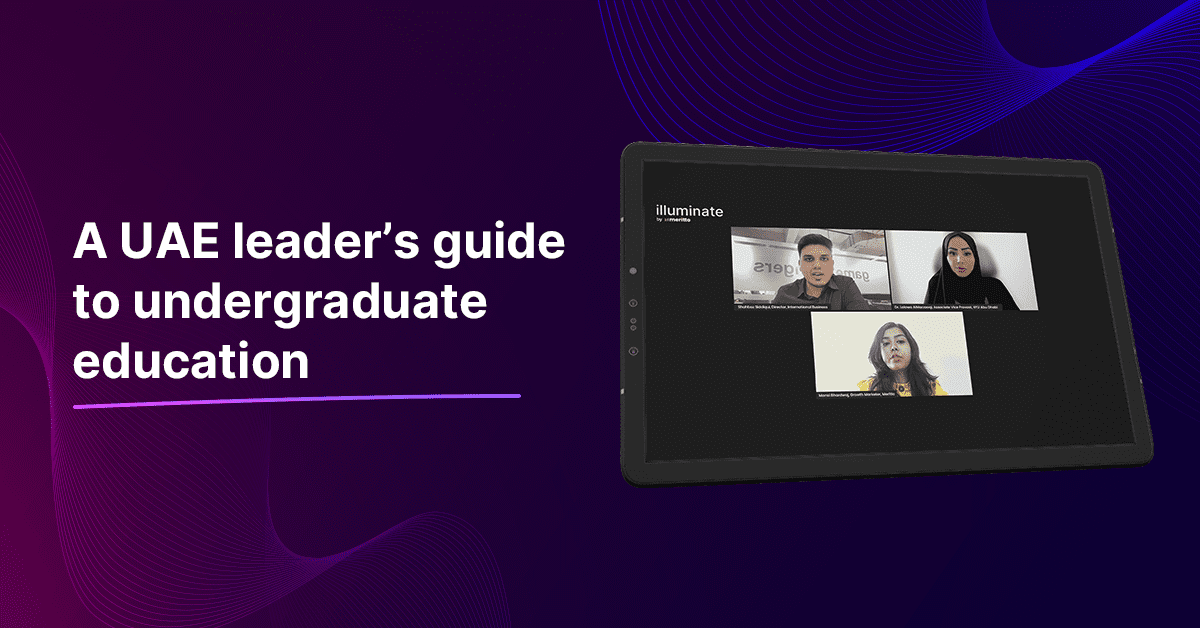
To explore what it takes to lead undergraduate education in this new era, we hosted a special edition of #EducationCircuitByMeritto featuring Dr. Lolowa AlMarzooqi, Associate Vice Provost for Undergraduate Education at New York University Abu Dhabi. In this conversation, we discussed the toughest leadership decisions universities face today, why governance becomes critical as institutions grow, how inclusion must be designed intentionally, and what questions higher-ed leaders must ask before adopting AI at scale.
Here are the biggest insights and takeaways from this powerful episode.
1. The toughest leadership decisions universities face today
For Dr. Lolowa, the toughest decisions universities face today are not purely academic. They are institutional decisions that determine how effectively a university grows while maintaining consistency.
As UAE universities expand and embrace technologies like AI, leadership becomes a careful exercise in ensuring that innovation is supported by clear governance. At NYU Abu Dhabi, where over 2,000 undergraduate students come from more than 115 countries, diversity is a defining strength, but it also demands intentional systems that ensure fairness across student experiences. She emphasized that even small inconsistencies in academic processes can quickly escalate if the right procedures are not in place.
“The hardest call to make isn’t about whether to innovate,” she explained. “It’s when to do both and make sure we are maintaining a cohesive and coherent educational experience for our students.”
2. What’s changing in today’s undergraduate landscape
For Dr. Lolowa, the biggest shift in undergraduate education is how quickly everything is changing. What once evolved gradually now moves in real time.
Students today arrive with global perspectives from day one. They think about careers earlier, expect personalized learning experiences, and demand transparency from universities. At the same time, governments increasingly expect institutions to demonstrate measurable outcomes, while AI continues to reshape how students learn and engage with information.
At NYU Abu Dhabi, this shift has been especially visible. Since welcoming its first class in 2010, the university has built a global alumni community of over 3,000. With growth and diversity accelerating, she emphasized that universities are no longer simply awarding degrees, they are managing an evolving ecosystem that requires leaders to adapt continuously.
“As a leader, you have to be comfortable with that constant motion and be ready to adapt,” she shared.
3. Why strong academic governance is the foundation of scale
Dr. Lolowa emphasized that governance is not bureaucracy, but “a foundation of trust.” She explained that informal systems may work when institutions are small, but they break down as complexity increases. At scale, universities need a “clear, transparent, and structured process” to ensure consistency across programs and student experiences.
At NYU Abu Dhabi, she highlighted how well-defined procedures for academic integrity and grading appeals remove confusion and ensure fairness. She also linked governance to measurable outcomes, noting that the university has “a 98% first-year retention rate and 96% sixth-year graduation rate.” For her, these outcomes reflect the clarity governance creates: “when a student really understands the process, they trust the system more.” She added that governance does not restrict academic freedom. Instead, “it actually protects institutions, when you are operating at a large scale.”
4. The governance questions universities must ask before implementing AI
As AI expands into admissions, assessment, and student support, Dr. Lolowa emphasized that adoption must be guided by discipline and governance, not excitement. She pointed out that many institutions are already dealing with fragmented tools and disconnected data, making responsible AI implementation even harder.
Before adopting AI at scale, she urged leaders to ask four fundamental questions: What decision is the AI influencing? Who is accountable for the outcome? How will outputs be audited for fairness and accuracy? And does the technology align with institutional values?
“We cannot afford automation without human oversight,” she said. “AI should enhance our judgment, not replace us.”
For her, the real challenge is not the power of AI, but whether institutions have the ethical and governance maturity to use it responsibly.
5. The institutional capabilities universities must build for long-term resilience
To remain resilient and future-ready, Dr. Lolowa outlined three institutional capabilities universities must build.
First, leaders must strengthen data literacy, not to become data experts, but to interpret insights critically and ask the right questions. Second, institutions must develop governance maturity, where clear policies support consistency as complexity grows. Third, universities must break down internal silos by ensuring collaboration across admissions, advising, faculty, IT, and student life.
“When departments work in isolation, institutions become fragile. When they are integrated, we build resilience.”
For Dr. Lolowa, future readiness is less about adopting new tools and more about building institutional coherence that can adapt over time.
6. The mindset shift leaders must embrace
One of Dr. Lolowa’s strongest takeaways was the need for leaders to shift from reactive decision-making to anticipatory leadership.
“In the past, we could react to change because it happened slowly. Now, we must anticipate what is next.”
She emphasized that this requires a culture of continuous learning, willingness to experiment, the confidence to challenge assumptions, openness to calculated risk, and stronger collaboration across the UAE’s education ecosystem.
For her, leadership in the AI era is defined by preparation, not response.
Final thoughts & next steps
Undergraduate education in the UAE is not only expanding, it is becoming more complex. As institutions scale, diversify, and adopt AI across decision-making systems, strong governance and institutional alignment will become essential to maintaining fairness, rigor, and student outcomes.
Dr. Lolowa reinforced a key insight: future-ready universities will not be defined by technology alone, but by the strength of their frameworks, the clarity of their processes, and the leadership discipline to manage change responsibly.
The institutions that build these capabilities now will set the benchmark for undergraduate education in the region.
About Meritto
Meritto is a unified, AI-powered, modular and automated platform purpose built for educational organizations enabling them to attract, engage, and enroll students. It is built with modular architecture that allows institutions to adopt the platform based on their specific requirements, operational scale, and digital maturity.
About #EducationCircuitByMeritto
#EducationCircuitByMeritto is Meritto’s thought-leadership podcast series that brings forward honest, high-impact conversations with education leaders shaping the future of the industry. From shifting student expectations to smarter recruitment and enrollment strategies, each episode dives into the real challenges institutions face today.
- How UAE universities can future-proof undergraduate education | An expert’s take on Meritto’s podcast
- How Voice AI Agents scale student engagement and lead nurturing
- The 3P framework for predictable student enrollment growth in 2026
- What’s shaping student recruitment, retention, and reputation in the UAE
- Inside the UAE’s shift toward AI-driven higher education