
Higher education in the UAE is entering a decisive phase. As the country strengthens its position as a global education hub, universities are no longer competing only on programs or infrastructure. They are competing on clarity, credibility, and continuity of experience, from first inquiry to graduation and beyond.
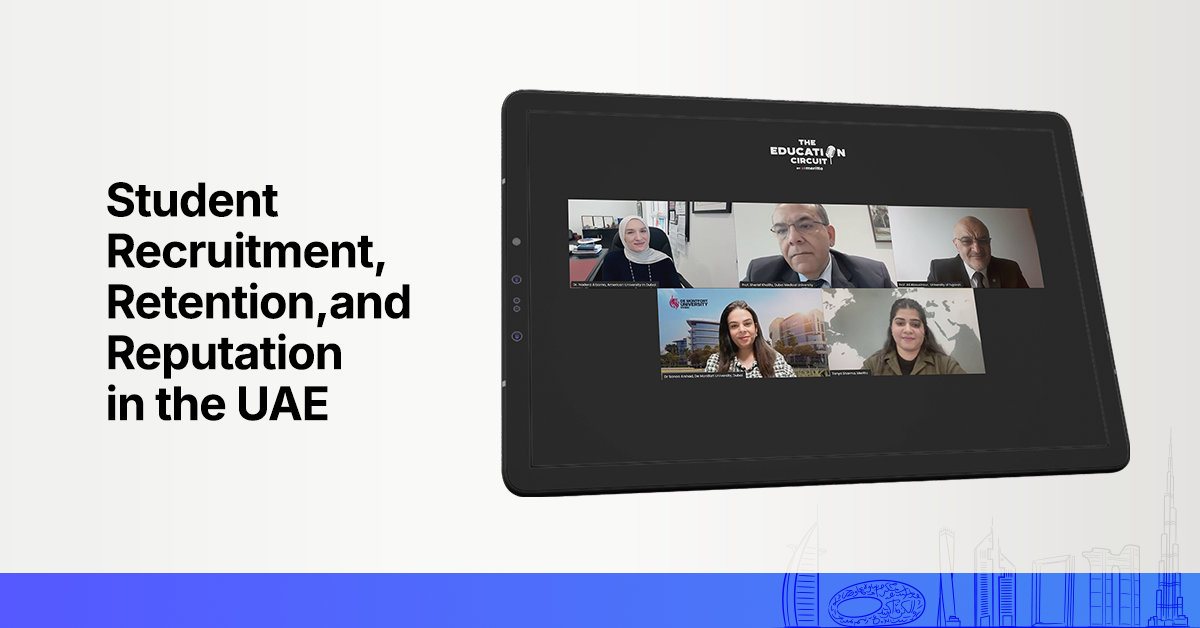
In this edition of #EducationCircuitByMeritto, leading academic voices from across the UAE came together to examine how student recruitment, retention, and institutional reputation are being reshaped in a rapidly evolving landscape. The conversation explored not just what students choose today, but why they choose, when they disengage, and how institutions can build trust that lasts. Click here to watch this episode.
At the center of the discussion was a shared realization: these three pillars can no longer operate independently.
Here are the key ideas and takeaways from this landmark episode:
1. How student choice in the UAE is fundamentally shifting
As student choice in the UAE becomes more intentional, universities are being evaluated on far more than academic programs alone. Today’s globally aware students assess institutions based on quality of life, the overall campus experience, and the clarity of career outcomes, making long-term value central to recruitment.
“Students are not only looking for a qualification; they are looking for non-negotiable quality across life, learning, and employment,” said Prof. Ali Abouelnour, eminent Gulf higher education leader. “The UAE offers a strong environment to study, live, and work, which is increasingly shaping student decisions.”
Here’s how Dr. Nadera Alborno, Dean & Professor of Education at the American University in Dubai, expanded on what influences students at the earliest stage of consideration:
“Flexibility and structured advising are critical. Students and parents want to know how institutions support changing interests and career pathways, and whether the promises made at admission are carried consistently through the student journey.”
2. What truly shapes students’ shortlist decisions in the UAE
At the shortlist stage, reputation and academic credibility remain decisive, but they are increasingly judged through a lens of long-term fit and outcomes. Families look beyond popularity to assess whether an institution is setting students up for success from day one.
As Prof. Sherief Khalifa, Vice Chancellor- Academic Affairs at Dubai Medical University, shared: “Reputation often draws initial interest, but institutions have a responsibility to admit students where there is a true alignment between ability, program, and future career.”
Dr. Sanaa Arshad, Academic Faculty, School of Business & Law, De Montfort University Dubai, added: “Students today are informed and ROI-conscious. They evaluate academic rigor, industry relevance, and whether what is promised at admission is consistently delivered.”
Together, these insights highlight a shift in shortlisting decisions, from surface-level recognition to trust in academic integrity and realistic pathways to success.
3. Building trust beyond rankings
The panel highlighted that institutional trust today extends beyond rankings. While reputation remains influential, students and parents increasingly look for tangible indicators of academic quality, including international accreditations, faculty credibility, and learning experiences that translate into real outcomes.
“International accreditation brings fresh perspectives that help institutions strengthen quality over time,” said Prof. Sherief Khalifa, Vice Chancellor – Academic Affairs at Dubai Medical University. “Students and alumni play a key role in validating whether that quality is truly delivered.”
This reflects a broader shift in how trust is built, through consistent standards, respected faculty, and authentic student advocacy, rather than reliance on rankings alone.
4. Innovating academically while strengthening institutional identity
Innovation is essential, but the panel was clear: innovation without coherence can weaken trust.
The panel highlighted that academic innovation is a gradual, outcome-driven process, shaped through continuous feedback rather than rapid change. Institutions that focus on steady improvement are better positioned to strengthen both quality and credibility over time.
“Collaboration is essential to meaningful innovation,” said Prof. Ali Abouelnour, eminent Gulf Higher Education Leader. “Working closely with universities and industry partners, across program design, delivery, and assessment, helps ensure learning remains relevant and aligned with real-world outcomes.”
This reflects how structured collaboration and technology-enabled feedback can support academic progress while reinforcing long-term institutional trust.
5. How can universities strengthen student engagement
Student persistence is closely linked to a sense of belonging and purpose. When students feel recognized as part of the institution, and see how they contribute to it, they are more likely to remain engaged.
As Dr. Nadera Alborno, Dean & Professor of Education at the American University in Dubai, noted: “Students need to feel heard and included, especially in culturally diverse environments like the UAE.” She emphasized that structured support, innovative learning pathways, and strong industry and global connections help students continue growing throughout their university journey.
This reflects how inclusive environments and clear growth pathways play a critical role in sustaining student engagement and long-term success.
6. What true personalization looks like
True personalization goes beyond customized messages to focus on belonging, clarity, and consistent support throughout the student journey. When students and parents clearly understand learning pathways and expectations, confidence in the institution grows.
As Dr. Sanaa Arshad noted, “Proactive engagement and continuous feedback allow universities to respond meaningfully to student needs. Structured support and visible progress help institutions demonstrate care and strengthen long-term engagement.”
This reflects how thoughtful personalization turns interaction into sustained trust and commitment.
7. When recruitment, reputation, and retention work as one
When recruitment, reputation, and retention are managed as one connected system, institutions are able to deliver consistency across the entire student journey. Alignment between policies, procedures, quality assurance, and transformation efforts ensures that what is promised externally is reinforced internally.
As Prof. Ali Abouelnour emphasized, “Connecting these elements strengthens institutional credibility and long-term impact.”
Dr. Nadera Alborno added, “This alignment must sit under a clear, shared vision and mission, one that guides teams across functions toward common goals.”
Together, these perspectives highlight how universities that operate with unified intent create stronger student experiences, clearer outcomes, and more resilient institutional trust.
8. What will distinguish successful UAE universities in the next decade
Successful universities in the UAE over the next decade will be defined by their ability to adapt and evolve as student needs, industries, and learning models continue to change. Agility, both academic and institutional, will be a critical differentiator.
Dr. Nadera Alborno emphasized, “Embracing change and responding quickly to shifting expectations allows institutions to remain relevant and resilient.”
Prof. Sherief Khalifa highlighted, “The importance of creating environments where students who struggle are supported to learn, grow, and succeed, reinforced by a strong culture of continuous learning.”
Together, these perspectives point to a future where universities that prioritize adaptability, student development, and opportunity-driven learning will stand apart in the UAE’s higher education landscape.
9. AI, students, and the future of trust
AI is reshaping how students learn and how institutions build trust, but a one-size-fits-all approach is no longer effective. Universities must move toward more personalized, responsible, and transparent use of technology.
Prof. Ali Abouelnour emphasized, “Institutions need to adopt customized AI approaches while training both faculty and students to use these tools ethically and effectively.”
Dr. Nadera Alborno added, “As AI introduces new tools and ideas, universities must respond with agile policies that allow innovation while maintaining academic integrity.”
Together, these insights highlight that trust in the age of AI will be built by institutions that balance personalization with responsibility and adaptability.
10. One priority that strengthens everything
Strengthening recruitment, retention, and reputation begins with a fully aligned student experience, from application to graduation. When institutions design the journey intentionally and invest in the people who shape it, outcomes improve across the board.
Dr. Nadera Alborno emphasized, “Mapping and aligning the complete student journey while investing in both students and faculty.”
Prof. Ali Abouelnour highlighted, “The need to deeply understand student needs and adapt curricula accordingly.”
Prof. Sherief Khalifa pointed, “Flexibility, shared responsibility, and strong student–faculty partnerships as essential to meaningful learning.”
Dr. Sanaa Arshad shared, “Credibility depends on consistently delivering what institutions promise at the point of recruitment.”
Together, these perspectives reinforce a single priority: align promises, people, and pathways to deliver a student experience that builds trust and long-term success.
Final thoughts & next steps
This conversation made one thing clear: in the UAE’s increasingly competitive higher-ed landscape, success will not come from optimizing one function in isolation. It will come from connecting recruitment, retention, and reputation into a single, coherent system centered on student success.
To explore how universities can operationalize these insights across the student lifecycle, schedule a personalized demo with our team.
- How Voice AI Agents scale student engagement and lead nurturing
- The 3P framework for predictable student enrollment growth in 2026
- What’s shaping student recruitment, retention, and reputation in the UAE
- Inside the UAE’s shift toward AI-driven higher education
- What’s new at Meritto: The quarterly roundup