
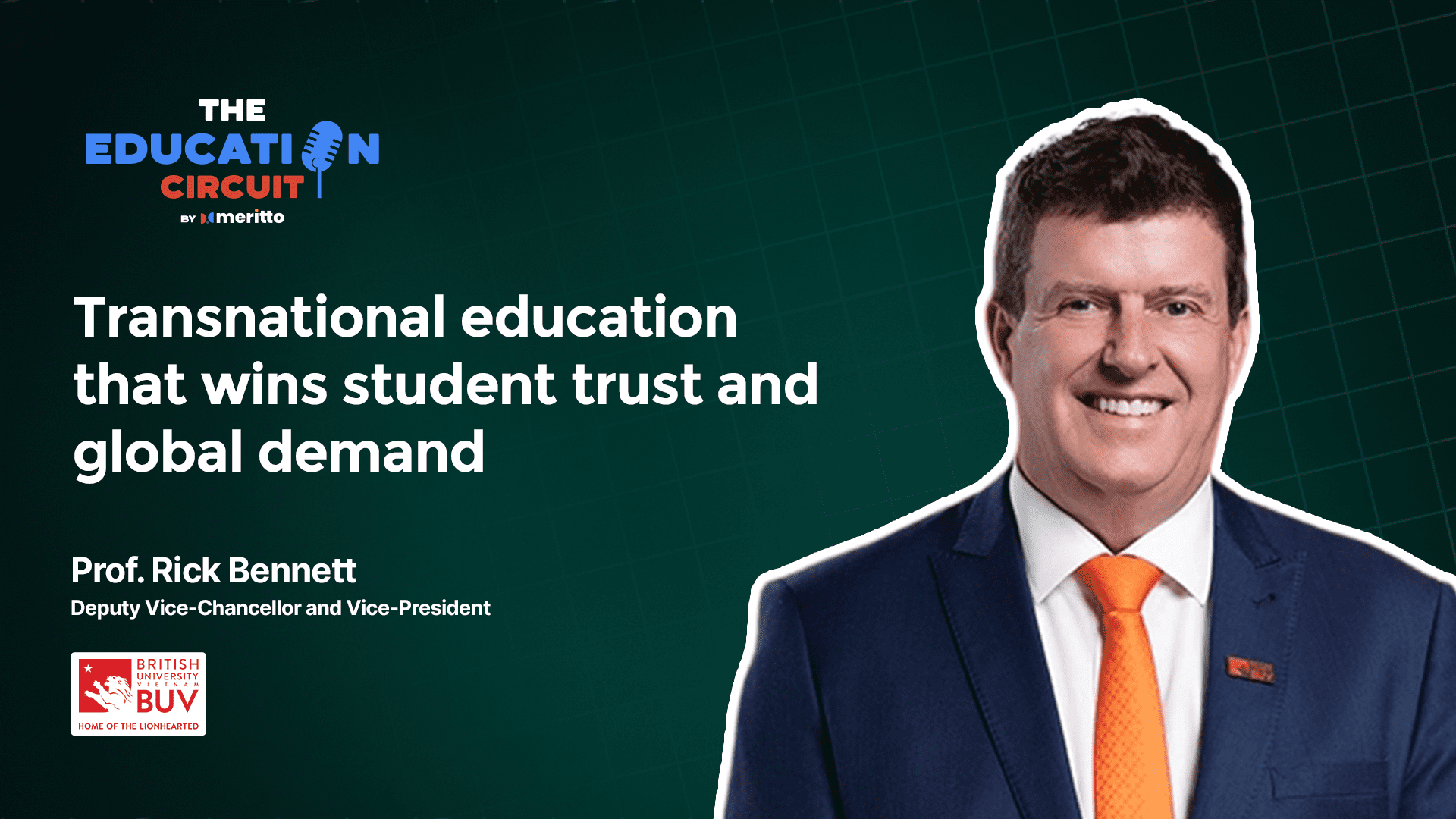
Transnational education is entering a new phase. As universities expand across Southeast Asia and other emerging regions, delivering an international degree abroad is no longer sufficient. Institutions are now judged on whether the academic standards, governance frameworks, and student experience match the expectations associated with global education.In a recent episode of #EducationCircuitByMeritto, Prof. Rick Bennett, Deputy Vice-Chancellor and Vice-President at British University Vietnam (BUV), shared insights from building one of the region’s most established transnational education models. The conversation explored how universities can scale international programs while maintaining academic credibility, strong employability outcomes, and long-term student trust.
Here are the key insights from the discussion.
1. The new geography of international education
The global map of higher education is shifting. For decades, countries such as the United States, the United Kingdom, and Australia dominated international student mobility. Today, new regional education hubs are emerging.
Prof. Rick Bennett describes this shift as the rise of the “New 20”, rapidly developing education destinations including Japan, Korea, Singapore, Malaysia, Indonesia, and Thailand. These markets are attracting increasing interest from students and families seeking international-quality education closer to home.
“The monopoly of the West is being disrupted by what I call the ‘New 20’, a group of emerging regional education hubs.”
Economic growth, an expanding middle class, and improved local infrastructure are enabling students to pursue globally recognised degrees without relocating to traditional Western destinations. But the changing geography of higher education is only part of the story. It is also reshaping how students make decisions about international education.
2. The postgraduate pivot in student decision-making
As international education becomes more expensive and complex, many students are adopting a more strategic approach to educational investment. Rather than sending students abroad for an entire degree, many now choose transnational programs locally for undergraduate education while reserving resources for postgraduate study at leading global institutions.
Prof. Bennett refers to this shift as the “Postgraduate Pivot.”
“Many families are choosing local transnational education options for undergraduate foundations while reserving their resources for high-impact postgraduate studies later.”
For universities, this trend creates a growing opportunity for programs that combine global academic standards with strong local relevance. However, capitalizing on this opportunity requires universities to rethink how transnational education models are designed.
3. Designing credible transnational education models
International expansion is not simply about replicating degree programs in another country. The real test lies in whether the educational experience reflects the standards associated with the home institution. According to Prof. Bennett, quality must remain the central principle guiding any transnational model.
“Institutions must prioritise quality, because quality leads to credibility.”
Students enrolling in cross-border programs expect the same academic rigor, teaching standards, and institutional reputation associated with the university’s main campus. Delivering this requires strong academic governance, thoughtful curriculum design, and consistent oversight across locations. Without these foundations, international expansion can quickly undermine institutional reputation. But strong academic design alone is not enough. Students and families increasingly evaluate programs through another lens: career outcomes.
4. Employability as the core value proposition
For many students, international education is primarily a pathway to career advancement. As a result, employability outcomes have become a central measure of program value. Programs that integrate industry partnerships, internships, and applied learning opportunities tend to generate stronger student demand. Industry-connected learning ensures academic programs remain aligned with evolving workforce needs while strengthening the perceived return on investment for students.
Institutions that embed industry engagement into program design are better positioned to remain competitive in dynamic education markets. Yet even the strongest academic design and industry alignment must ultimately translate into a meaningful student experience.
5. The student experience as the real measure of quality
While institutional reputation attracts attention, the credibility of a transnational program is ultimately determined by the student experience. Students evaluate their education through interactions with faculty, classroom engagement, academic support services, and campus culture.
Prof. Bennett emphasised that consistency across these touchpoints is essential.
“Credibility is not built through branding alone; it’s built through consistent delivery.”
When the student experience aligns with expectations associated with international education, trust develops naturally. When it does not, even a globally recognised brand can quickly lose its influence in new markets. As more institutions attempt to expand internationally, maintaining this consistency becomes increasingly difficult.
6. The risks of scaling transnational education
As cross-border education expands, universities face new structural challenges. International education was once dominated by a small group of Western destinations attracting students from developing economies. Today, rising costs, geopolitical uncertainty, and shifting student priorities are reshaping this landscape. At the same time, the number of cross-border programs is increasing rapidly, intensifying competition within regional markets. In this environment, reputation alone is no longer sufficient.
Successful programs rely on robust quality assurance systems that include:
- Alignment with home-country accreditation bodies
- Compliance with local regulatory frameworks
- International academic benchmarking and recognition
Universities that approach cross-border programs as long-term institutional commitments are more likely to sustain their position in an evolving global environment. Alongside these structural shifts, another force is beginning to reshape international education: technology.
7. Technology and the future of cross-border learning
Artificial Intelligence is beginning to reshape how universities approach teaching, learning, and collaboration across borders.
Concerns around generative AI mirror earlier debates that occurred when the internet first emerged in education. At that time, technology was often viewed primarily as a threat to academic integrity. Today, a similar discussion is unfolding around AI.
“If we are sending students into the workplace without the skills and technologies they will need, we are doing them a massive disservice.”
Rather than resisting technological change, universities increasingly recognize the need to prepare students for workplaces where AI will be embedded in everyday decision-making. Advances in translation tools and digital collaboration platforms may also reduce long-standing barriers in international education, making cross-border learning more accessible.
As knowledge becomes widely accessible through technology, universities will increasingly focus on developing critical thinking, adaptability, and judgement, skills that remain difficult to automate. This shift also requires universities to reconsider their broader role within the societies they operate in.
From global expansion to national contribution
Expectations placed on international universities are also evolving. In the past, cross-border programs were often viewed primarily as a way to expand institutional reach. Today, host countries expect foreign universities to contribute more directly to local economic and social development. This requires universities to align programs with workforce needs, industry partnerships, and national talent priorities. Institutions that approach cross-border education as an investment in human capital are more likely to build lasting relationships with governments, industries, and communities.
Rethinking the purpose of international education
The future of international education may ultimately be defined less by geography and more by outcomes. As technology levels the playing field for knowledge access and language barriers diminish, the traditional question, Where is the degree from? is gradually losing relevance.
A more important question is emerging:
What kind of graduate does the degree produce?
In an increasingly complex and technology-driven world, universities that focus on developing resilient, ethical, and adaptable graduates will be best positioned to shape the future of global education.
About Meritto
Meritto is a unified, AI-powered, modular and automated platform purpose built for educational organizations enabling them to attract, engage, and enroll students. It is built with modular architecture that allows institutions to adopt the platform based on their specific requirements, operational scale, and digital maturity.
About #EducationCircuitByMeritto
#EducationCircuitByMeritto is Meritto’s thought-leadership podcast series that brings forward honest, high-impact conversations with education leaders shaping the future of the industry. From shifting student expectations to smarter recruitment and enrollment strategies, each episode dives into the real challenges institutions face today.
- [EXPERT INSIGHTS] The new playbook for transnational education
- Trust as the real driver of enrollment in Malaysia | An expert’s take on Meritto’s podcast
- How UAE universities can future-proof undergraduate education | An expert’s take on Meritto’s podcast
- How Voice AI Agents scale student engagement and lead nurturing
- The 3P framework for predictable student enrollment growth in 2026