
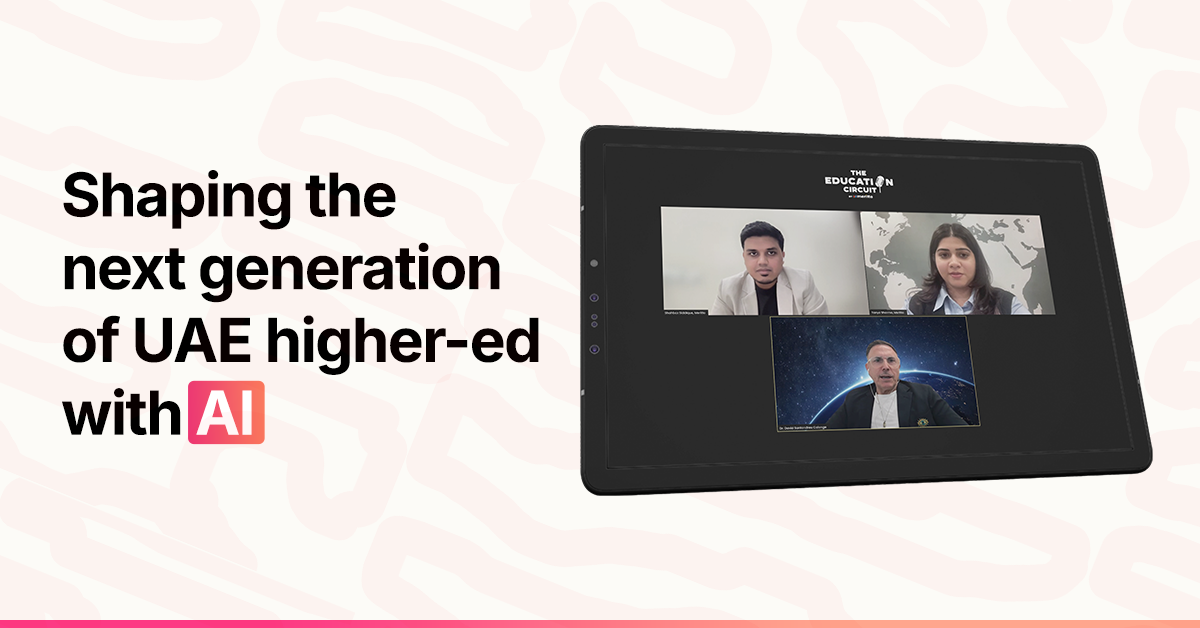
Artificial intelligence is rewriting the rules of global higher education, and the UAE’s higher-ed isn’t just adapting, it’s leading. With one of the world’s most ambitious national AI strategies, the country is rapidly evolving into a hub where future-ready academic models, industry-aligned programs, and AI-powered learning experiences are becoming the new standard.
To understand how this transformation is unfolding, we hosted a special edition of #EducationCircuitByMeritto featuring Dr. David Santandreu Calonge, Head of Educational Program Development at Mohamed Bin Zayed University of Artificial Intelligence (MBZUAI), one of the world’s first research universities dedicated entirely to AI. Click here to watch the episode. In this conversation, we explored how AI is reshaping curriculum design, academic operations, student expectations, and institutional strategy across the UAE.
Here are the biggest insights and takeaways from this landmark episode:
1. How the UAE’s AI vision is redefining higher education
The UAE’s National Strategy for AI 2031 is driving universities to redesign their academic models and build stronger AI-focused programs. Institutions are updating curricula, expanding research in key educational areas, and developing new pathways to train the next generation of AI-ready talent.
“One of the main goals of the national strategy is to elevate the UAE’s global reputation in AI, and MBZUAI contributes to this through the research we produce and the talent we train,” shared Dr. David Santandreu Calonge in our latest episode of #EducationCircuitByMeritto. “Our work is encouraging other universities to strengthen their AI programs and build world-class learning experiences for students.”
2. What today’s learners expect from graduate programs
Today’s graduate students want learning experiences that go beyond traditional lectures. They expect interactive classrooms, updated content that keeps pace with rapid advances in AI, and clear connections between theory and real-world application. They also look for interdisciplinary exposure, relevant internships, and programs flexible enough to adapt as the field evolves.
“Students now want active, engaging learning, not one-way communication,” shared Dr. David Santandreu Calonge in our latest episode of #EducationCircuitByMeritto. “In fast-moving areas like AI, you can’t reuse last semester’s material. New research emerges constantly, and curricula must be refreshed to match it. Learners look for practical examples, interdisciplinary teamwork, meaningful internships, and programs that stay current. Universities need to move faster so students receive the latest knowledge and skills.”
3. How MBZUAI is embedding AI into academic design
At Mohamed Bin Zayed University of Artificial Intelligence, technology is built directly into the learning experience. Faculty use generative tools to create assignments, quizzes, and course content, while students apply AI to develop projects, videos, and presentations. The university also integrates AI into research, data work, and entrepreneurship through incubation programs, hackathons, and ongoing training.
“Our LMS plugin is a simple example, faculty can generate content instantly, and students can engage with materials more efficiently,” shared Dr. David Santandreu Calonge in our latest episode of #EducationCircuitByMeritto. “With generative AI used across courses and GPT-5 EDU available to everyone on campus, AI becomes part of everyday teaching and learning. Programs like our incubation center and Tech Tuesdays help students and faculty keep experimenting and applying AI in meaningful ways.”
4. Why collaboration between AI research institutions and traditional institutions matters
One of the strongest enablers of transformation is collaboration. Partnerships between AI-specialized institutions like MBZUAI and traditional universities create powerful opportunities for:
- Joint curriculum development.
- Faculty upskilling.
- Shared research initiatives.
- Student mobility across AI-focused and foundational disciplines.
These collaborations accelerate ecosystem-wide readiness, ensuring AI isn’t limited to a few institutions but becomes a capability distributed across the UAE’s full higher-ed landscape.
5. Balancing AI-assisted learning with academic integrity
As students increasingly use AI tools for assignments, research, and project creation, universities face a new and nuanced challenge: How do you embrace AI without compromising academic integrity?
MBZUAI approaches this with structured guidelines that:
- Encourage responsible use of AI tools
- Define clear boundaries for academic work
- Equip faculty to evaluate AI-influenced outputs
- Promote transparency and ethical conduct
“The goal isn’t to restrict AI,” Dr. David explained. “It’s to ensure students use it meaningfully, as a partner in learning, not as a shortcut.”
6. The rise of Agentic AI, and what it means for universities
As Agentic AI becomes more capable, its impact on university operations and academic work will grow significantly. These systems can analyze requirements, automate routine tasks, and support faculty in designing more personalized learning experiences. For universities, agentic AI represents a shift from using AI as a tool to relying on it as a collaborative partner across academic and administrative functions.
“Agentic AI will soon help institutions review admission and policy requirements, guide faculty in creating course-specific AI agents, and automate many staff tasks,” shared Dr. David Santandreu Calonge in our latest episode of #EducationCircuitByMeritto. “It’s ultimately about empowering teams, giving faculty and staff intelligent support so they can focus on higher-value work and create better learning experiences for students.”
7. Two AI capabilities UAE universities must build now
“The first priority is investing in your people, supporting faculty and staff through upskilling and reskilling,” shared Dr. David Santandreu Calonge in our latest episode of #EducationCircuitByMeritto. “The second is engaging with the companies creating these tools. Spend time with them, learn from their insights, and build the capabilities your institution needs to use AI in ways that truly matter.”
8. The mindset shift higher-ed leaders must embrace
Preparing institutions for an innovation-driven future requires more than new tools or strategies, it demands a shift in mindset. Leaders must be willing to explore new possibilities, experiment beyond traditional boundaries, and approach AI with curiosity rather than fear. Success in this new era will come from teams who are open to learning, unafraid of change, and equipped with the right talent to guide transformation.
Final thoughts & next steps
AI is not simply reshaping UAE higher education; it’s accelerating a new chapter of innovation. Dr. David emphasized that the universities that progress fastest will be those willing to learn, experiment, and update their programs with the pace of change. Success now depends on upskilling people, embracing generative tools in teaching and research, and staying flexible as new capabilities emerge.
He reinforced that AI should be approached with curiosity, not fear. Institutions that empower their teams, partner closely with industry, and encourage continuous experimentation will be best positioned to prepare students for an AI-driven future.
Those who act boldly today will shape the next generation of higher education in the region. Schedule a personalized demo today.
- Trust as the real driver of enrollment in Malaysia | An expert’s take on Meritto’s podcast
- How UAE universities can future-proof undergraduate education | An expert’s take on Meritto’s podcast
- How Voice AI Agents scale student engagement and lead nurturing
- The 3P framework for predictable student enrollment growth in 2026
- What’s shaping student recruitment, retention, and reputation in the UAE