As international universities expand into markets like Malaysia, global reputation alone no longer secures enrollment. Brand recognition may attract attention, but today’s decisions are shaped by scrutiny, measurable outcomes, and the consistency between promise and delivery.
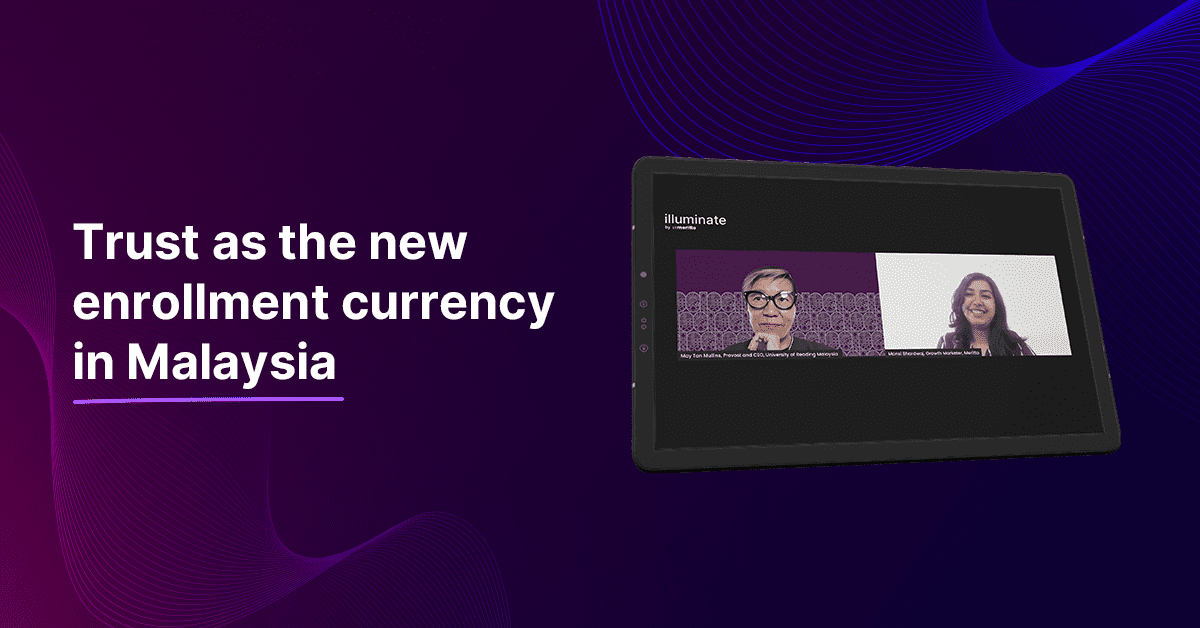
In this edition of #EducationCircuitByMeritto, May Tan Mullins, Provost and CEO of the University of Reading Malaysia, reflects on what institutional trust truly requires, from governance and academic standards to admissions alignment and responsible AI adoption. The conversation explores why credibility must be built across systems and leadership decisions, not just messaging.
Here are the key insights from the discussion.
1. How students evaluate universities today
For years, international universities relied on brand recognition to establish presence in new regions. But in Malaysia, student evaluation has evolved.
Today’s students are outcome-focused and data-driven. They assess employability pathways, industry partnerships, professional accreditation, mobility opportunities, and return on investment before committing.
As May Tan Mullins noted, reputation still matters, but “it is just not enough on its own anymore.” Students are evaluating tuition not just as a cost, but against tangible benefits: career prospects, global recognition, and long-term mobility.
The shift is clear: evaluation is now outcome-driven, not perception-driven.
2. Where does institutional trust truly begins
When asked where institutional trust truly begins: governance, academic standards, leadership, or student experience, May Tan Mullins distilled it to one word: Integrity.
“I really think that institutional trust begins and ends with the word integrity.”
For her, governance is not procedural formality. Transparent decision-making builds confidence across students, staff, and the broader community. Academic equivalence across campuses reinforces rigor. Leadership credibility depends on alignment between words and actions.
“If you say it, you must do it,” she emphasized, highlighting role modeling as central to trust-building.
Integrity, consistently practiced, transforms structures into credibility.
3. Balancing global standards with local relevance
Leading an international branch campus requires precision. Global standards are non-negotiable. But delivery must be locally relevant.
May Tan Mullins described this as separating the “what” from the “how.” The academic standards and learning outcomes are defined by the home campus. The pedagogy, case studies, industry engagement, and student support must reflect the Malaysian context.
This includes navigating regulatory differences, aligning with local accreditation requirements, and building relevant industry partnerships without diluting academic rigor.
“Global standards are non-negotiable,” she stated. But cultural intelligence enhances student success without compromising quality.
4. The greatest risk to institutional credibility
Institutional failure rarely begins with one dramatic mistake. More often, it begins with misaligned expectations.
According to May Tan Mullins, the biggest risk lies in expectation gaps between stakeholders; home campus and local partners, commercial goals and academic integrity, marketing narratives and student reality.
If one partner prioritizes rapid growth while another prioritizes quality assurance, credibility fractures. If marketing promises mobility or career pathways that external policies later restrict, disappointment erodes trust.
Misalignment, whether internal or external is the silent risk that weakens institutions.
5. Building trust through responsible use of AI
As AI becomes central to recruitment, admissions, and academic systems, leadership decisions carry long-term consequences.
May Tan Mullins offered a strategic perspective: AI should reinforce credibility, not replace human judgment.
“We see AI as a tool,” she explained, emphasizing that students are encouraged to understand AI, use it responsibly, and learn its ethical implications.
At the leadership level, transparency is critical. Institutions must clearly communicate how AI is used in admissions or evaluation processes. AI can improve efficiency and decision support.
“If we use it wisely, thoughtfully, it helps to amplify credibility.”
Governance, oversight, and ethical clarity determine whether AI builds trust or introduces risk.
6. Students expect alignment between promise and experience
Modern students expect academic equivalence with the home campus. They do not want a diluted version of a global brand.
May Tan Mullins stressed that students must feel they belong fully to a global university, not an outpost. Consistency across academic standards, quality assurance, and student experience reinforces legitimacy.
Credibility strengthens when what is promised during recruitment matches what is delivered on campus. When that alignment breaks, trust erodes quickly.
7. What will distinguish universities that thrive in Southeast Asia
Looking ahead, the institutions that succeed in Southeast Asia will combine global credibility with local relevance.They will demonstrate:
- Local integration without compromising standards.
- Strong industry linkages and graduate readiness.
- Transparent governance structures.
- Ethical AI implementation.
- Consistency across stakeholder expectations
- Agility in updating programs and skill frameworks
May Tan Mullins also emphasized agility, an area where universities often struggle due to structural bureaucracy.
“If we are not agile, we risk losing relevance.”
In a fast-moving education landscape shaped by geopolitical shifts and AI disruption, institutions must update curriculum, partnerships, and skills development rapidly to stay aligned with emerging sectors.
Final thoughts & next steps
In Malaysia’s evolving higher education landscape, trust is no longer assumed through legacy or rankings. It is earned through integrity, governance discipline, academic rigor, and consistent delivery.
As highlighted in this #EducationCircuitByMeritto podcast, the future of international higher education lies in alignment; between global standards and local relevance, innovation and oversight. Reputation may open the door. But integrity sustains it.
About Meritto
Meritto is a unified, AI-powered, modular and automated platform purpose built for educational organizations enabling them to attract, engage, and enroll students. It is built with modular architecture that allows institutions to adopt the platform based on their specific requirements, operational scale, and digital maturity.
About #EducationCircuitByMeritto
#EducationCircuitByMeritto is Meritto’s thought-leadership podcast series that brings forward honest, high-impact conversations with education leaders shaping the future of the industry. From shifting student expectations to smarter recruitment and enrollment strategies, each episode dives into the real challenges institutions face today.
- Trust as the real driver of enrollment in Malaysia | An expert’s take on Meritto’s podcast
- How UAE universities can future-proof undergraduate education | An expert’s take on Meritto’s podcast
- How Voice AI Agents scale student engagement and lead nurturing
- The 3P framework for predictable student enrollment growth in 2026
- What’s shaping student recruitment, retention, and reputation in the UAE