The Higher-Ed Trust Blueprint
A Practical Guide to Implementing the Digital Personal Data Protection Act in Higher Education
Student data powers every stage of the modern education lifecycle, from inquiries and applications to academics, payments, and alumni engagement. But with the Digital Personal Data Protection Act (DPDP), every piece of that data now carries legal responsibility. For higher-ed, this shift is not simply about compliance. It is about building trust, accountability, and secure systems that protect student information while enabling institutional growth.
This ebook brings together practical guidance on how institutions can translate the requirements of the DPDP Act into real operational practices. It explores how institutions can structure data governance, manage consent, secure personal data, and establish transparent processes that meet regulatory expectations.
What’s in it for you?
After reading this ebook, you will gain practical insights that help your institution:
- Understand how the DPDP Act applies to higher education institutions and the responsibilities that come with handling student data.
- Identify the different roles defined under the law and what they mean for your institution’s operations.
- Learn how to design DPDP-aligned data practices including data minimization, consent management, retention policies, and transparent privacy notices.
- Map how student data moves across departments, systems, and vendors to establish stronger governance and accountability.
- Assess your institution’s readiness for DPDP using a structured compliance scorecard and phased implementation roadmap.
Frequently Asked Questions
Get answers to frequently asked questions about everything we do.Meritto, the flagship product of NoPaperForms, is the Operating System for Student Enrollments. It is a unified, AI-powered, modular, and automated platform purpose-built for educational organisations, enabling them to attract, engage, and enrol students while automating the entire enquiry-to-enrolment process.
Its comprehensive suite of purpose-built tools, including Enrollment Cloud, Education CRM, Application Platform, Education Payment Cloud, and Modern Engagement Suite, acts as the system of record for enrolments and seamlessly addresses every aspect of the enrolment process.
At the heart of Meritto lies its natively built layer of agentic AI, Mio AI. This layer introduces intelligent, autonomous, and semi-autonomous agents into everyday institutional workflows. Embedded across the Meritto platform, Mio AI agents serve as digital teammates for different teams, helping institutions scale student engagement and improve team productivity and performance.
Used by over 1,000 educational organisations globally, Meritto is designed to support complex, high-volume admissions environments with scalability, security, and deep process configurability across every vertical of education.
Yes. The DPDP Act applies to digital personal data and to personal data collected offline that is subsequently digitised in any form.
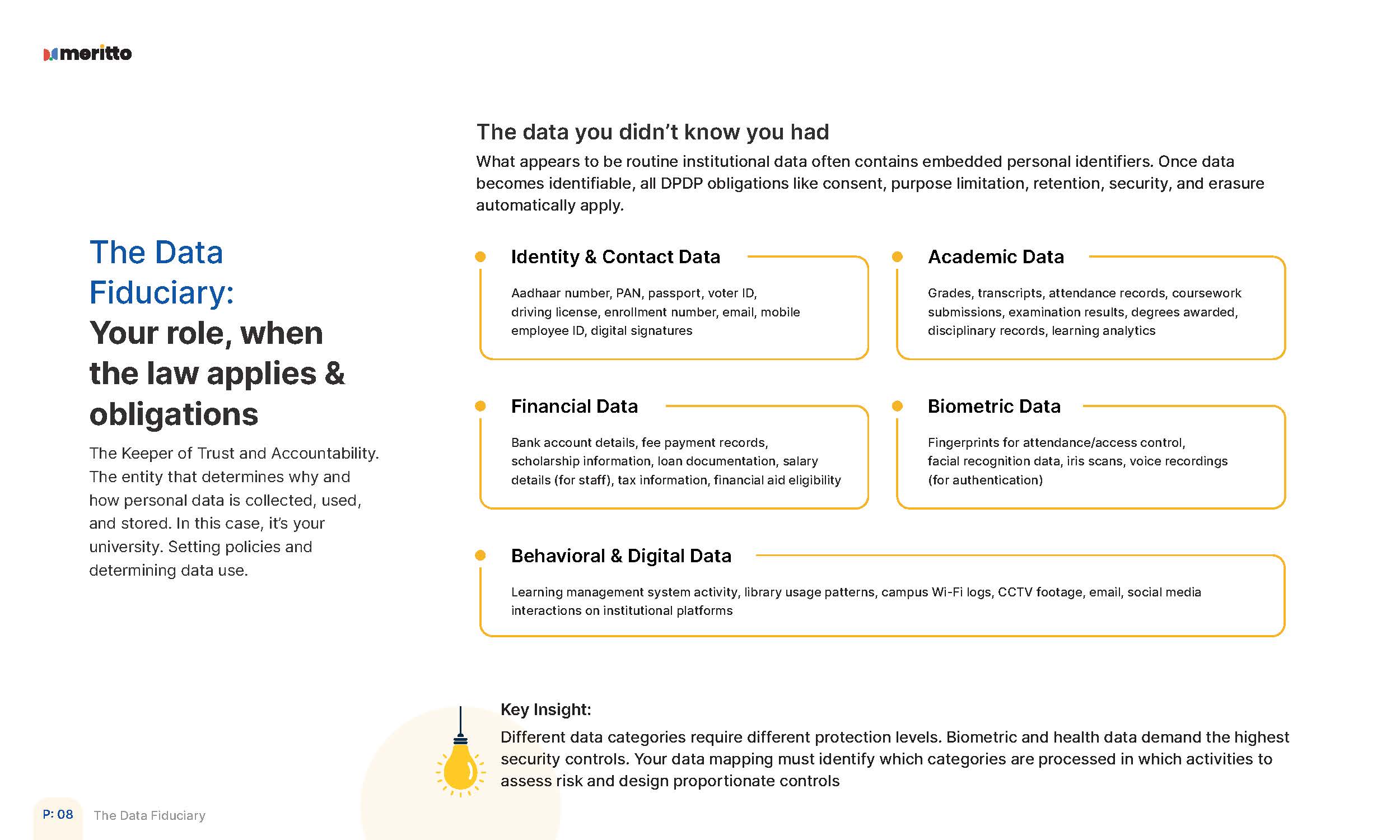
This includes a paper admission form entered into a CRM, a scanned consent form, a visitor register transferred to Excel, or a document uploaded to an internal portal. Once the data enters a digital system and can be linked to an identifiable individual, obligations relating to consent, purpose limitation, retention, security, and erasure apply.
Under the DPDP Act, the university or educational institution is generally the Data Fiduciary because it determines why and how personal data is collected and processed. The student is the Data Principal whose personal data is being processed, while technology vendors acting on the institution’s instructions are Data Processors.
When a student is under 18, the student is also considered a Child under the Act, and the processing of their personal data requires verifiable parental consent.
Two additional roles may also be relevant. A Consent Manager provides an accessible and transparent way for Data Principals to manage consent, while a Significant Data Fiduciary may be designated by the government based on factors such as the volume and sensitivity of data processed and the associated risks.
The six key principles are lawful purpose, data minimisation, storage limitation, reasonable security, transparency, and accountability.
In practice, institutions should process personal data only for clearly stated and lawful purposes, collect only the information that is necessary, and retain it only for as long as a valid purpose exists.
They should also protect personal data through safeguards such as masking, encryption, and role-based access, provide Data Principals with clear and accessible privacy notices, and ensure that every third-party vendor handling data follows the institution’s privacy and security requirements.