
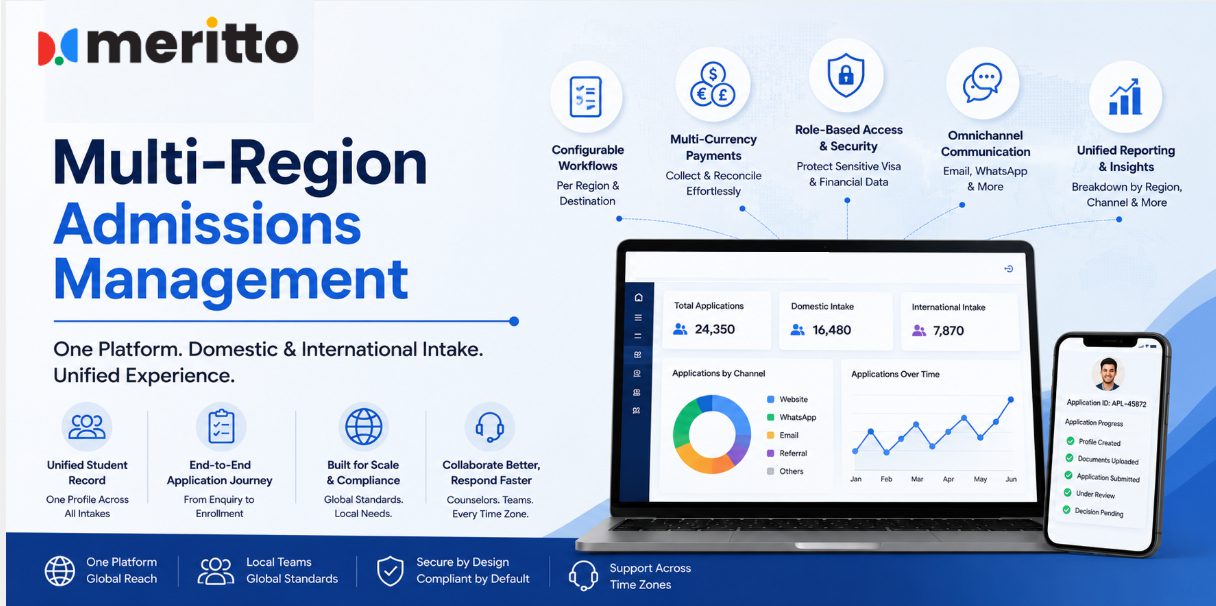
Institutions running both domestic and international admissions often end up with two different systems by default, not by design. A domestic CRM handles local enquiries well enough, and international applications get bolted on through spreadsheets, shared inboxes, and a separate visa-tracking process. The two rarely talk to each other, and reporting across both becomes a manual reconciliation job every quarter.
The real question isn’t whether a platform “supports” international admissions in some generic sense. It’s whether it handles the specific ways domestic and international intake actually differ.
Where Domestic and International Admissions Genuinely Diverge
Destination-specific document requirements. A student applying to an Australian university typically needs GTE (Genuine Temporary Entrant) documentation. One applying to Canada needs to meet IRCC compliance requirements. A domestic applicant needs neither. These aren’t cosmetic differences, they change what documents get requested, when, and how they’re verified.
Currency and payment rails. Domestic fee collection usually runs through local payment gateways in local currency. International applications often involve application fees, visa fees, and forex handling, sometimes across multiple currencies for the same applicant if they’re weighing several countries.
Communication channel preferences. WhatsApp dominates day-to-day communication in markets like India and the UAE. Email remains the primary channel for many Western institutions and applicants. A platform built around one default channel tends to under-serve whichever segment doesn’t match that default.
Data sensitivity and access control. Visa documents, passport details, and financial proofs carry higher sensitivity than a domestic enquiry form. Restricting access to this data by role, not just by team, becomes a genuine requirement rather than a nice-to-have.
Time zones and response windows. A counselling team operating in IST needs different escalation logic for a Canada-bound applicant in EST than for a domestic one in the same city.

What a Genuinely Unified System Needs to Do
Handling both segments on one platform isn’t just a matter of storing all the data in the same database. It requires:
- Configurable workflows per destination or region, so a Canada-bound application can trigger IRCC-specific document checklists while a domestic application follows a shorter path, without maintaining two separate systems.
- Role-based access and audit logs specifically for higher-sensitivity document types, so a senior counsellor can see a visa file that a junior team member cannot.
- Multi-currency payment handling within the same fee collection workflow, rather than routing international payments through a separate tool.
- Unified reporting that still lets an admissions head break down performance by region, country, or channel, rather than forcing a manual merge of two data exports.
Where this Typically Breaks Down
Generic CRMs, and even some education-specific ones, often solve for one segment well and treat the other as an edge case. A platform built primarily for domestic admissions tends to bolt on international handling as custom fields and manual workflows. A platform built primarily for study-abroad consultancies sometimes lacks the volume-handling and local payment integrations that domestic admissions at scale requires.
The practical test: ask whether a single applicant record can move between a domestic and an international workflow without needing to be re-entered, and whether a report can be sliced by destination country without exporting to a spreadsheet first.
Questions Worth Asking any Vendor Claiming to Support Both
- Can workflows be configured per destination country, or is international handling limited to custom fields on the same generic form?
- Does the platform generate and reconcile payments in multiple currencies natively, or does it require a separate tool for international fee collection?
- Is access to visa and financial documents restricted by role, with an audit trail showing who viewed or edited them?
- Can a single lead move from a domestic enquiry to an international application (or the reverse, common with students exploring both local and overseas options) without duplicate data entry?
- Can leadership pull a combined report across both segments, broken down by country or channel, without manually merging two exports?
A platform that can’t answer most of these clearly is likely running two admissions processes side by side rather than genuinely unifying them, regardless of what the product page claims.
Where Meritto fits
Meritto runs domestic admissions through its Education CRM and international, study-abroad admissions through a separate but integrated Study Abroad CRM product line, both on the same underlying platform. The study abroad product supports destination-specific workflow configuration (GTE-style checklists, IRCC-aligned steps), role-based access and data masking for visa and financial documents, and multi-currency payment link generation within the same fee workflow used domestically. It’s used by consultancies including Atmia Education, Jamboree, and Go-Global for exactly this kind of multi-country application management, alongside institutions running domestic admissions on the core CRM.