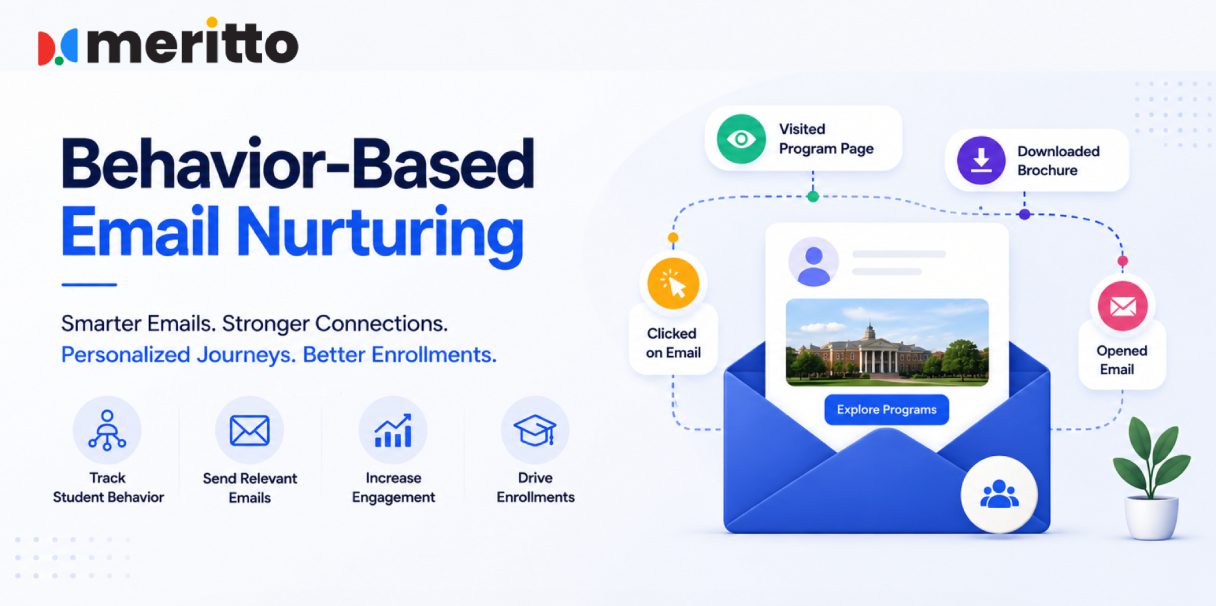
Most “personalized” email in admissions marketing still means inserting a first name into a template. Actual personalization works differently: the email a prospective student receives, and when they receive it, changes based on what they’ve actually done, not just which list they’re on. Getting this right depends less on which tool you buy and more on whether the underlying system has four specific capabilities.
The Four Things that Separate Real Nurturing from a Newsletter
Behavioral triggers, not just time-based sequences. A basic drip campaign sends email 1 on day 0, email 2 on day 3, regardless of what the recipient does in between. A behavior-based system instead reacts: a student who starts an application but abandons it gets a different message than one who completes it, and both differ from someone who’s only opened the landing page. The trigger is the action, not the calendar.
Branching logic. Real journeys aren’t linear. A prospective student expressing interest in one program versus another, or in scholarships versus not, needs to split into different paths from that point forward. Platforms without if/else branching force every recipient down the same sequence regardless of what they’ve told you through their behavior.
Lead scoring feeding the automation, not sitting beside it. Scoring a lead’s intent is only useful if the score actually changes what happens next, triggering a counsellor alert, accelerating the next email, or holding back a lower-priority sequence. A scoring model that exists in a dashboard but doesn’t connect to the automation is analytics, not nurturing.
Data pulled from the same source as the rest of the funnel. The most common failure point in admissions marketing isn’t the email tool, it’s that the email platform doesn’t see what the CRM sees. A student who’s already spoken to a counsellor, or already submitted a document, shouldn’t receive a generic “still thinking it over?” email meant for someone who hasn’t engaged at all.
Where this Typically Breaks in Practice
Standalone email marketing tools like Mailchimp or MailerLite handle the first two capabilities reasonably well but usually sit outside the admissions CRM, which means behavioral triggers are limited to email-specific actions (opens, clicks) rather than the full range of admissions signals (application starts, document uploads, payment status). General B2B marketing automation platforms like HubSpot or Marketo handle lead scoring and branching well but aren’t built around education-specific behaviors like exam slot bookings or interview scheduling, so triggers have to be custom-built rather than native.
The gap shows up most clearly at scale: a small volume of leads can be manually adjusted around a generic tool’s limitations. A few thousand inbound enquiries a month across multiple programs cannot.
There’s also a deliverability dimension that gets overlooked. Admissions communication often needs to reach students across very different email environments, corporate-style institutional inboxes in some markets, consumer webmail in others, and platforms that don’t natively separate transactional email (payment confirmations, interview schedules) from marketing sequences tend to see both categories affected when one triggers spam filtering. Systems built specifically for this volume typically separate the two paths for exactly this reason.
What to Check Before Choosing a Platform
- Does the system trigger emails off admissions-specific events (application started, document uploaded, payment pending) or only generic web and email activity?
- Can a single journey branch into multiple paths based on stated interest, engagement level, or lead score, without building a separate campaign for each segment?
- Does the lead score actually change what the automation does next, or is it a number that sits in a report?
- Is the email engine reading from the same lead and application data as the rest of the admissions funnel, or does it require a separate sync?
- Can a counsellor see, in one place, which automated emails a specific student has already received, so a human follow-up doesn’t contradict or duplicate what’s already been sent?
- Is transactional email (payment confirmations, interview schedules) sent through a path separate from marketing sequences, so deliverability issues in one don’t affect the other?
Where Meritto Fits
Meritto’s Modern Engagement Suite runs email, WhatsApp, SMS, and voice broadcast through a single engagement layer (METS) that shares the same underlying lead and application data as the core CRM, rather than syncing from a separate email tool. Mio AI drives the behavioral side of this: it analyzes real-time student activity, such as application starts, exam slot bookings, and document uploads, and adjusts what gets sent and when, while Zing generates instant alerts to counsellors when a high-intent action happens, so automated nurturing and human follow-up are working from the same signal rather than two disconnected systems.
- Connected Intelligence: The Infrastructure Behind Institutional Agility

- More Data, But Less Insight? Inside the Intelligence Era of Education
- How universities can turn AI into real institutional impact
- Which CRMs Can Show Cost per Lead and Cost per Enrollment by Channel?
- How to Track Digital Marketing Agency Performance for Student Recruitment
- Admission Counselor Productivity: Tools to Track Performance Effectively