
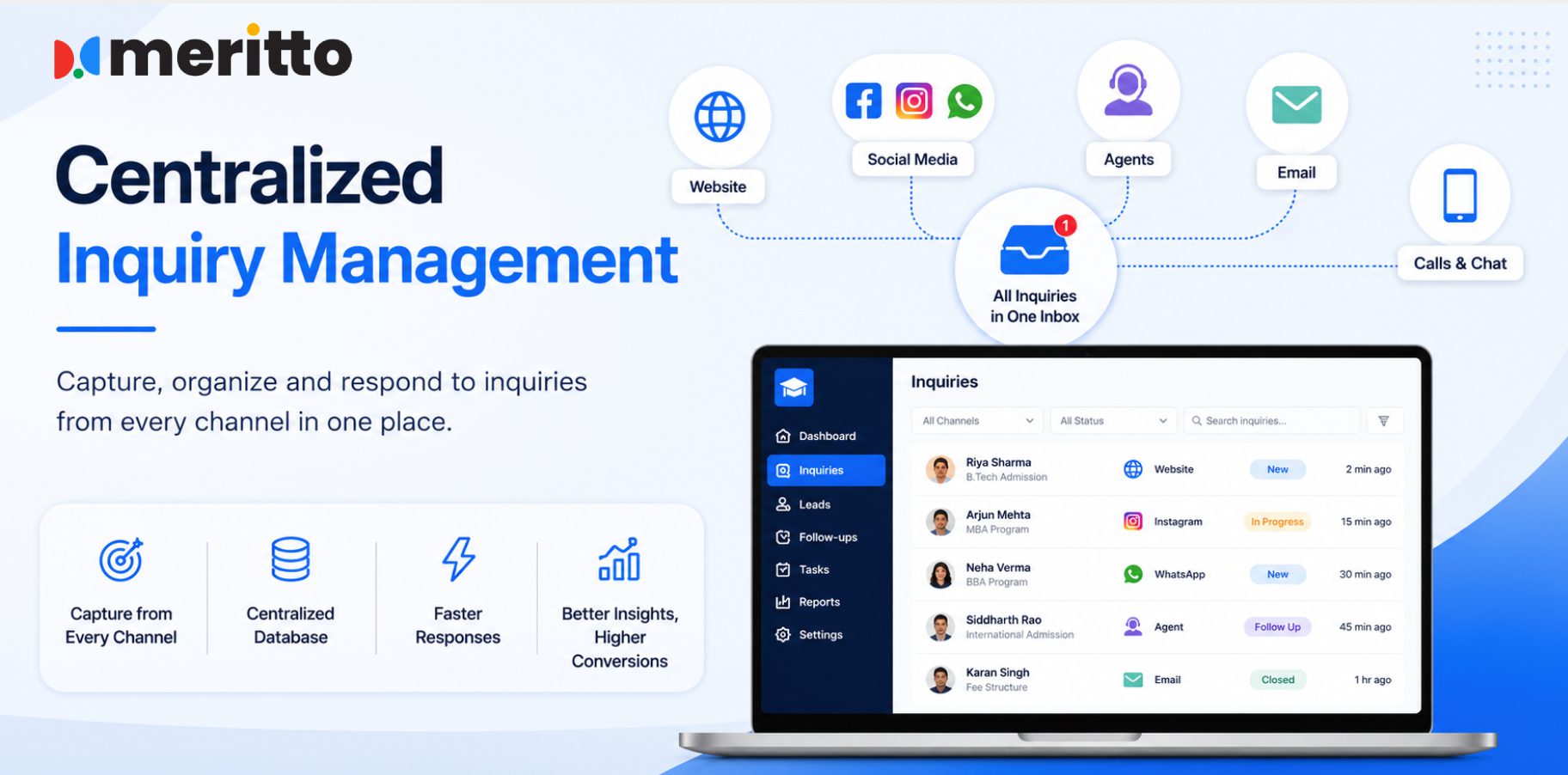
Universities running admissions marketing across a website, paid social, organic social, and a network of agents or consultants usually end up with inquiries landing in four or five different places: a website form database, ad platform lead forms, agent-submitted spreadsheets, and WhatsApp threads that never make it into any system at all. Centralizing this isn’t just about pulling everything into one dashboard. The real problem is deduplication, attribution, and keeping agent-submitted leads accountable, three things a basic CRM import doesn’t solve.
What “Centralizing Multi-channel Inquiries” Actually Requires
Deduplication that tracks the full path, not just a merge. If the same student fills out a Facebook lead form, later submits a website enquiry, and is then also submitted by an agent, a naive system either creates three records or blindly merges them, losing the information about which channel actually influenced the decision. The more useful approach is source attribution across multiple levels, tracking a primary (first-touch), secondary, and tertiary source for the same lead, so duplication is eliminated without erasing the channel history.
Real-time capture via APIs, not manual export. Social platforms and ad networks generate lead forms that need to sync automatically, not get downloaded as a CSV and uploaded weekly. A lead sitting in an ad platform’s native dashboard for three days before a counsellor sees it is effectively a lost lead in most admissions cycles.
Agent and partner-specific tracking. Inquiries from agents or consultants carry a different risk profile than direct website leads: agents may submit leads in bulk, sometimes with inflated volume or low-quality data, to maximize commission. A system built for this needs agent-level performance visibility, commission tied to verified outcomes rather than raw submission counts, and the ability to throttle or flag partners whose lead quality drops.
Lead verification before it reaches a counsellor. Centralizing junk inquiries alongside genuine ones doesn’t solve the underlying problem, it just moves the noise into one place instead of five. Automated verification, typically via email or SMS confirmation, filters out invalid contacts before they consume counsellor time.
Unified routing logic. Once inquiries are centralized, they still need to reach the right person. Routing by program interest, geography, language, or agent relationship determines whether centralization actually improves response time or just creates a bigger, still-disorganized pile.
Where Generic Tools Fall Short
Standard CRMs (Salesforce, Zoho, HubSpot) can technically ingest leads from multiple sources through generic integrations or Zapier-style connectors, but they typically treat every inquiry the same way regardless of channel. This means an agent-submitted lead and a Facebook ad lead get the same generic “new lead” treatment, with no built-in mechanism to measure agent-specific performance or catch a partner submitting duplicate or low-quality data at scale. Education-specific platforms differ mainly in having agent and publisher performance tracking, and lead verification, built into the core workflow rather than configured as a workaround.
This distinction matters most at the point of budget review. An institution working with ten agents and running paid social simultaneously needs to know, specifically, which agent’s leads convert to enrollment and which are inflating volume without corresponding outcomes. A generic CRM can show total leads by source, but attributing conversion all the way through to enrollment, and tying that back to a specific partner rather than a channel category, generally requires the kind of mutually exclusive attribution model built for this exact problem.
Questions Worth Asking Before Choosing a System
- Does the system track primary, secondary, and tertiary lead sources, or does it just merge duplicates and lose the channel history?
- Are social and ad platform leads pulled in through a live API integration, or does someone need to export and upload them manually?
- Can agent or partner performance be tracked separately, with commission or lead-flow tied to verified outcomes rather than raw volume?
- Is there automated lead verification (email/SMS confirmation) before a lead reaches a counsellor’s queue?
- Can routing rules account for program, geography, and channel simultaneously, or only one dimension at a time?
Where Meritto Fits
Meritto centralizes leads from website forms, social and ad platforms, offline events, and agent or channel partner submissions into a single pipeline, using non-editable primary/secondary/tertiary source attribution to eliminate duplication without losing channel history. Its Channel Partner CRM adds agent-specific tracking: dynamic lead-flow control based on a partner’s verification rate, and Mutually Exclusive Impact (MEI) scoring to measure each partner’s actual contribution to applications and enrollments, not just raw lead submissions. Leads are verified automatically via email or SMS before reaching a counsellor, and routing runs on custom logic spanning program, geography, and language.