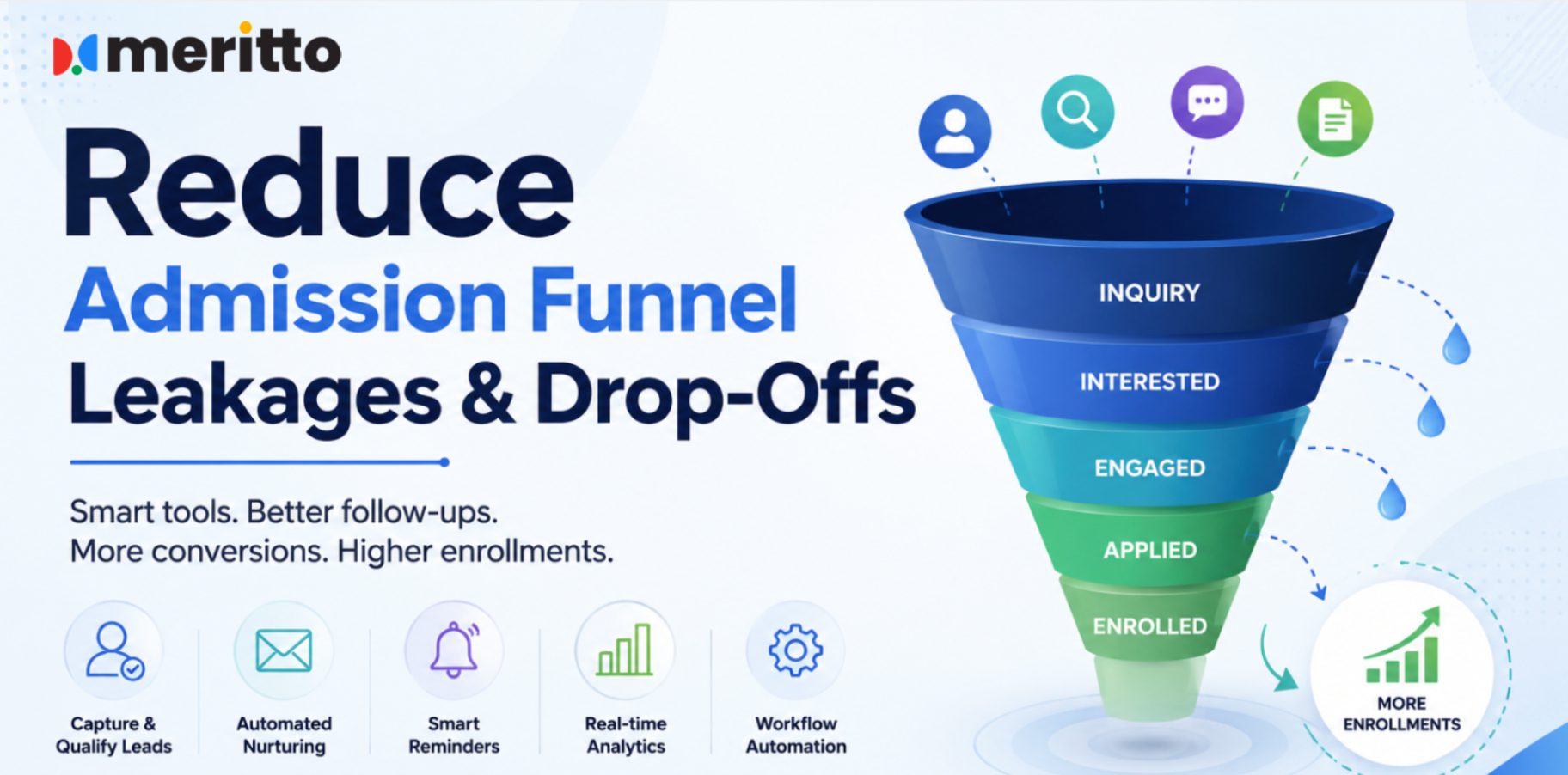
“Drop-off” gets treated as a single problem, but it actually happens at three distinct points in the admissions funnel, each with a different cause and a different fix. Treating it as one problem is usually why the fix doesn’t work: a tool built to solve inquiry-stage leakage won’t touch application abandonment, and vice versa.
The Three Places Leakage Actually Happens
Inquiry stage: leads that never get followed up. A common industry finding is that response speed within the first five minutes dramatically changes conversion odds, and delays of even a few minutes measurably drop it. Leakage here isn’t about interest, it’s about leads sitting unassigned or unverified while counsellor capacity is spent elsewhere.
Application stage: forms started but never finished. This is the largest and most studied leak. Causes are consistent across research on the topic: application forms that are too long, unclear document requirements, unexpected fees, and a lack of visible progress. One frequently cited figure suggests roughly three in five applicants who start an application never complete it when the process lacks a guided, portal-based experience.
Payment and final-step stage: applicants who stall at fees or document verification. Even applicants who make it through the form can stop at a payment page, a missing transcript, or a pending document check, often the closest to enrollment and the most valuable to recover.
What Actually Reduces Leakage at Each Stage
At inquiry: automated lead verification (email or SMS confirmation) before a lead reaches a counsellor, combined with real-time distribution logic based on course, geography, or language, rather than a queue a counsellor works through manually. Intent scoring that flags high-probability leads for immediate outreach, rather than treating every inquiry identically, matters more here than any single communication channel.
At application: stage-triggered nudges rather than generic reminders. A student who stopped at document upload should get a message about the specific document, not a general “come back and finish” email. Saved progress, so returning to an application doesn’t mean starting over, removes one of the most common reasons students simply give up. A visible progress indicator (what’s done, what’s pending) reduces the anxiety-driven abandonment that happens when the process feels like a black box.
At payment and final steps: flexible payment options (installments, multiple methods) reduce abandonment caused by upfront cost friction. Automated reminders tied to the specific pending item, a payment link, a document checklist, work better than a blanket follow-up. For high-intent applicants who remain stalled despite automated nudges, a human counsellor follow-up, timed by the system rather than left to manual tracking, tends to close the gap that automation alone can’t.
The Distinction that Matters Most: Automation with Escalation, not Automation instead of it
The research consistently comes back to one point: automated recovery workflows work best when they detect inactivity and handle the first one or two nudges, then hand off to a human for applicants who remain stalled and show high intent. Pure automation without escalation misses students whose hesitation is about a specific concern, financial aid, program fit, that only a conversation resolves. Pure manual follow-up doesn’t scale past a few hundred applicants without leakage creeping back in.
This is also where channel choice matters more than it first appears. Email works for detailed information but is often too slow for a first nudge. A short, specific message on a faster channel, confirming that progress was saved and linking directly back to the next step, recovers more attention than a generic email arriving a day later. The message itself matters too: a nudge that names the exact pending item (“your transcript upload is still pending”) consistently outperforms a vague “complete your application” reminder, since it removes the step of the student having to figure out what’s actually left to do.
Questions Worth Asking about any System
- Does lead verification happen automatically before a counsellor sees the inquiry, or does verification rely on the counsellor doing it manually?
- Are application nudges triggered by the specific stage where a student stopped (payment, document, form), or are they generic reminders sent on a fixed schedule?
- Is application progress saved automatically, so a returning applicant doesn’t restart from zero?
- Does the system escalate stalled, high-intent applicants to a human counsellor automatically, or does someone have to notice the applicant is stuck?
- Can leadership see where in the funnel leakage is concentrated, by stage and by source, rather than only a single overall conversion rate?
Where Meritto Fits
Meritto’s Student Admission Portal saves application progress and shows a step-by-step view of what’s pending, addressing the form-abandonment stage directly. At inquiry, its Lead Nurturing system verifies leads automatically before they reach a counsellor and scores intent to prioritize outreach. Mio AI continuously analyzes application progress, engagement patterns, and payment status to flag disengagement signals before a student drops off, triggering automated nudges first and surfacing high-intent, stalled applicants for counsellor follow-up when automation alone isn’t resolving the stall.
- Connected Intelligence: The Infrastructure Behind Institutional Agility

- More Data, But Less Insight? Inside the Intelligence Era of Education
- How universities can turn AI into real institutional impact
- Which CRMs Can Show Cost per Lead and Cost per Enrollment by Channel?
- How to Track Digital Marketing Agency Performance for Student Recruitment
- Admission Counselor Productivity: Tools to Track Performance Effectively