A modern higher education growth strategy rests on continuous reinvention: new markets, new programmes and new partnerships, backed by the operational capability to turn each opportunity into predictable, measurable enrolment growth. Long-range plans built on a stable world no longer hold. Institutions now grow by staying ahead of change, earning student trust and connecting data, people and technology across the student journey.
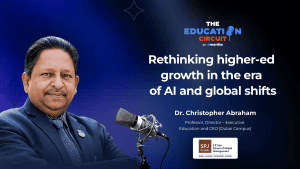
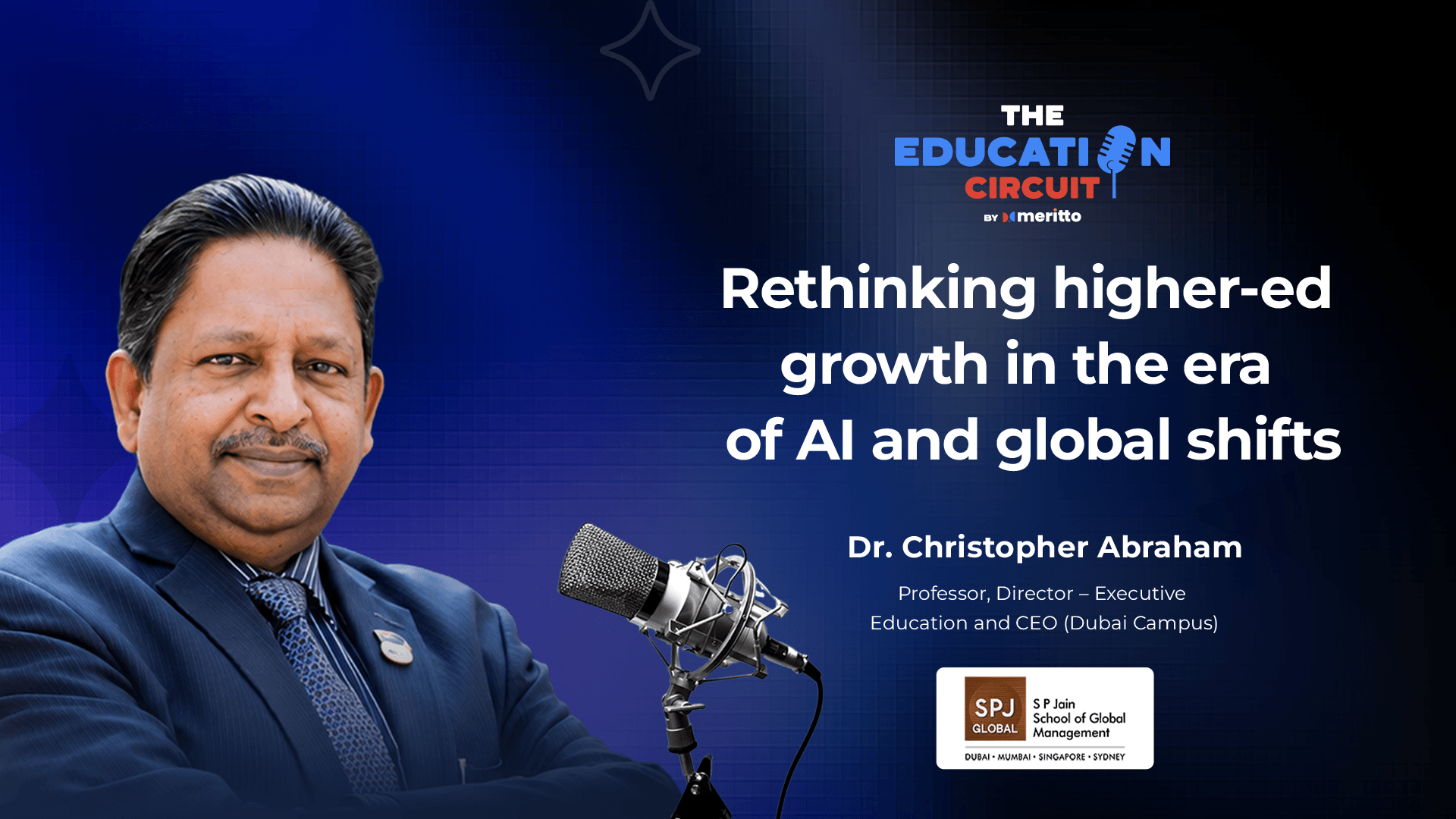
That was the central idea in the latest episode of #EducationCircuitByMeritto, a podcast series that brings together leaders and practitioners shaping the future of education. The episode featured two complementary perspectives:
- Dr. Christopher Abraham, Professor, Director of Executive Education and CEO of the Dubai Campus at SP Jain School of Global Management, who has spent more than two decades in institution building, admissions, programmes, partnerships and campus leadership.
- Faiz Varsi, Director of International Business at Meritto, who works closely with institutions across international markets on enrolment, student experience and growth.
Together, they explored what competitiveness means today, where growth is emerging, what shapes student choice and what institutions must build to sustain growth.
Key takeaways
- Competitiveness now means agility. In a volatile, fast-changing world, fixed five-year plans give way to staying well ahead of the curve.
- Growth comes from continuous reinvention. New markets, interdisciplinary programmes and international partnerships are the strongest levers.
- Scale depends on capability. A unified view of the student journey, data turned into action and operational discipline make growth predictable.
- Student choice is a family decision. Institutions win trust by helping students and parents understand outcomes, not through marketing alone.
- Relevance is a habit. Institutions that keep changing with the trends stay relevant; those that do not become redundant.
What does it mean for a university to be competitive today?
Being competitive today means staying ahead of change rather than planning around stability. Dr. Abraham described the environment through two frameworks: VUCA (volatile, uncertain, complex and ambiguous) and BANI (brittle, anxious, nonlinear and incomprehensible), a term that gained currency after the pandemic.
In a more predictable era, institutions could write detailed five and ten year strategic plans. Today, he argued, that approach no longer reflects reality. The advantage belongs to institutions that stay several steps ahead of their competition.
Four principles of competitiveness
- Excellence as a habit. Quality across infrastructure, programmes, faculty and the student body has to be consistent, until it becomes part of institutional culture.
- Disruptive innovation. Competitive institutions choose the harder, more distinctive path over the easy, conventional one.
- A willingness to take considered risks. New markets and new models carry uncertainty, and growth requires the confidence to act on it.
- Consistent quality across contexts. As institutions expand across countries, each market brings its own regulations. The challenge is meeting every local requirement while assuring the same quality of programmes, faculty and learning outcomes everywhere.
Where are the strongest growth opportunities for universities?
The strongest growth opportunities sit in three areas: new markets, new programmes and strategic international partnerships. Dr. Abraham framed each as a lever institutions can pull to stay relevant, rather than a one-off expansion.
1. New markets, chosen deliberately
Geographic expansion works best when locations are chosen as regional hubs with their own talent flows and industry demand. Programmes can then be curated to what each market needs, instead of replicating one model everywhere.
2. Continuous innovation changes the institution itself
The larger lesson was that sustained growth reshapes an institution’s identity. Each new market, programme or partnership broadens what the institution stands for. As Dr. Abraham put it, continuous innovation is “the mantra behind your survival and growth.”
What makes university growth predictable, measurable and scalable?
Predictable growth depends on three capabilities: a unified view of the student journey, the ability to turn data into action at scale and operational discipline. Faiz Varsi explained that identifying an avenue for growth and building the capability to pursue it consistently are two different things.
He framed the student lifecycle in three layers: an input layer (admissions), a throughput layer (academics) and an output layer (placements). The capabilities below focus on the input layer, where enrolment growth is won or lost.
| Capability | What it means for institutions |
| A unified view of the student journey | Knowing where enquiries come from, how students progress and where the institution loses them |
| Data into insight, insight into action | Using AI and automation to personalise engagement, prioritise the right opportunities and focus teams where they create the most impact |
| Operational discipline | Consistent processes, clear ownership and measurable outcomes |
In his summary, predictable growth comes from turning data into insight, insight into action and action into a repeatable growth engine. Technology enables that journey, while people and leadership remain at its centre.
What shapes a student’s choice of university beyond the degree?
Beyond the degree, students choose the institution they trust most with a high-stakes decision. That trust is built across the entire student journey, through every enquiry, conversation and interaction long before an offer is made. Prospective students now discover, compare and evaluate institutions across many touchpoints. Each one shapes their confidence in where they will study.
The paradox of choice
Dr. Abraham pointed to the paradox of choice. When students face too many options, decisions become harder and can lead to poorer outcomes. The advantage goes to institutions that guide each student with relevant, timely information at the right stage of the journey.
A decision with many stakeholders
For many students, particularly from middle-class families across Asia, choosing a university is a financial, social and career decision at once. It may involve an education loan and a first move away from home. Parents are often the investors, so engagement has to address both the student’s aspirations and the family’s questions about return on investment.
Informed engagement over broadcast marketing
Branding still matters, but students and parents now expect engagement that reflects their context. Institutions build confidence by connecting them with the voices that matter, at the moments that matter:
- Alumni, who can speak to career outcomes
- Current students, who can describe the learning experience
- Faculty, who can explain how programmes are designed and delivered
The underlying principle is empathy with every stakeholder in the decision. Institutions that understand where each student is in the journey, what they have already asked and what they need next can offer a personalised, consistent experience. For the student, that experience leads to an informed choice and a learning journey that translates into their career aspirations.
Where does AI fit in a higher education growth strategy?
AI creates the most value when it is integrated into how an institution operates, not added as a standalone tool. As one line from the episode put it, the real opportunity is “not about implementing AI, but integrating it meaningfully into how an institution operates.“
In practice, this connects directly to the capabilities above. AI and automation help institutions personalise engagement at scale, prioritise the students most likely to enrol and free teams to focus on the conversations where they add the most value. The foundation is a connected view of the student journey, so that AI works with the full context of each student rather than in isolation.
The full episode goes further into where AI can create strategic advantage for universities and where it delivers the most practical value in day-to-day workflows.
The leadership mindset behind sustained growth
Sustained growth starts with leaders who treat change as constant. Reflecting on a career that spanned consulting, sales, teaching and institution building, Dr. Abraham drew one lesson above the rest: “Unless you change with the changing trends, you become irrelevant, you become redundant.“
He described institution building as demanding and uncertain work, done “with and through people.” Growth figures are the visible result, but they rest on the commitment of the teams behind them.
Most of all, he returned to purpose. The measure of an institution is the impact it creates, when graduates go on to lead organisations, head departments and build their own ventures. For leaders, growth and relevance matter because they sustain that impact.
Listen to the full episode here
The new growth playbook for higher education brings strategy and execution together. Institutions need the vision to find new markets, programmes and partnerships, and the capability to turn that vision into consistent enrolment growth.
The full episode also covers how strategic partnerships contribute to programme relevance and student outcomes, the institutional capabilities that will matter most in the years ahead, and what the strongest institutions will have understood earlier than everyone else.
See what predictable enrolment growth looks like in practice
Growth becomes predictable when every student interaction is connected, visible and measurable. Meritto, the AI-powered Operating System for Student Enrolments, brings enquiry management, student engagement, applications and admissions onto one platform. Your teams work from a single view of every student, turn data into timely action and build a growth engine they can repeat intake after intake.
About Meritto
Meritto is the AI-powered Operating System for Student Enrollments and NoPaperForms’ flagship product for student enrollments. It is a unified, modular and automated platform purpose-built for educational organisations, enabling them to attract, engage and enroll students on one platform.
By bringing data, context and workflows together, Meritto manages the complete enquiry-to-enrollment journey, from enquiry capture and student engagement to applications, document verification, admission offers and final enrollment. It serves as the system of record for the enrollment journey, helping educational organisations grow enrollments, improve conversions, optimise marketing spends and increase operational efficiency.
About Collexo
Collexo is NoPaperForms’ Operating System for Fee Collections and Payments and its embedded payments platform, purpose-built for educational organisations.
It enables institutions to collect, manage, reconcile and report student-related payments through one unified platform, serving as the financial system of record for fee collection and payment workflows. Collexo integrates with licensed payment partners and payment gateways, while providing the software and technology layer required to manage education-specific fee collection and payment workflows.
About Mio AI:
Mio AI is NoPaperForms’ agentic AI platform and intelligence layer across its education technology platform. Built on the education-specific data, context and workflows of Meritto and Collexo, Mio AI enables educational organisations to deploy intelligent, goal-driven agents across student-facing and institutional workflows. NoPaperForms_Brand_Positioning_…
Mio AI Guide is a conversational AI agent for student-facing engagement. It can answer student queries in real time, capture and qualify enquiries, and guide students towards relevant next steps across defined enrollment journeys.
Mio AI Voice enables AI-led voice engagement across defined student journeys at scale, including qualification, reactivation and other enrollment workflows. Because Mio AI works with the underlying education context, its agents can use information such as a student’s stage in the enrollment journey, prior interactions and relevant next steps to make engagement more contextual and goal-driven.
About #EducationCircuitByMeritto
#EducationCircuitByMeritto is Meritto’s thought-leadership podcast series that brings forward honest, high-impact conversations with education leaders shaping the future of the industry. From shifting student expectations to smarter recruitment and enrollment strategies, each episode dives into the real challenges institutions face today.
FAQs: What’s new at Meritto
A higher education growth strategy is an institution’s plan for increasing enrolments, revenue and relevance. Today, it typically combines new markets, new programmes and strategic partnerships with the operational capability to turn those opportunities into predictable, measurable enrolment growth.
The environment has become volatile, uncertain and nonlinear, often described as a VUCA or BANI world. Fixed five- or ten-year plans assume a stability that no longer exists, so institutions gain more by staying agile and ahead of change.
Three capabilities matter most: a unified view of the student journey, the ability to turn data into insight and action at scale, and operational discipline built on consistent processes, clear ownership and measurable outcomes.
Students weigh career outcomes, return on investment, the learning experience and trust in the institution. Because the decision often involves families and financial commitments, institutions that inform students and parents through alumni, current students and faculty can build stronger confidence.
The greatest value comes from integrating AI into day-to-day institutional workflows and the student journey, rather than deploying it as a standalone tool. Connected student data gives AI the context it needs to personalise engagement and help teams prioritise.
Recommended Reads
- The new growth playbook for higher education

- How Mio AI Voice helps institutions achieve enrollment outcomes at scale
- Connected Intelligence: The Infrastructure Behind Institutional Agility
- More Data, But Less Insight? Inside the Intelligence Era of Education
- How universities can turn AI into real institutional impact
- Which CRMs Can Show Cost per Lead and Cost per Enrollment by Channel?