Institutions are data-rich, but action-poor. Closing that gap is now the single biggest lever on enrollment, retention, and placement outcomes.
An accepted offer does not convert into a completed enrollment. A student begins disengaging. A programme loses demand. A cohort reaches placement season with skill gaps that could have been addressed earlier.
In the first article in this series, More Data, But Less Insight?, we described the distance between available data and timely decisions as the intelligence gap. This article moves from that problem to the institutional capability required to close it.
These outcomes appear in different parts of an institution, but they can share the same underlying problem: relevant information remained separated until the opportunity to act had narrowed.
This is where three institutional capabilities come together.
Data infrastructure connects what the institution knows. Connected intelligence explains what it means. Institutional agility determines whether people can act while the outcome is still open.
The value is not in producing more information. It is in creating a dependable path from signal to context, from context to human judgement and from judgement to coordinated action.
What to take from this read
- Data infrastructure is the foundation, connected intelligence the capability and institutional agility the result.
- Institutions must detect, understand, decide, act and learn across the learner journey.
- AI can support this chain, but cannot replace human judgement.
Outcomes are where cracks in the infrastructure becomes visible
Infrastructure can sound like a technical concern until it affects an institutional outcome.
To see how this plays out, consider Ananya, a student whose journey reflects a familiar reality across Indian higher education. From her first programme enquiry to enrolment and academic progression, every interaction creates a new piece of information, often in a different institutional system.
She discovers a programme, asks about scholarships, applies, uploads documents and attempts a fee payment. After enrollment, her journey expands across attendance, assessments, credits, payments and student support.
Each function may hold an accurate fragment. Admissions sees a delayed application. Finance records a failed payment. The academic system captures falling attendance. Student support holds an unresolved request.
If these systems do not recognise Ananya as the same learner, no one sees the complete change. A counsellor, faculty member and support team may each respond reasonably while remaining disconnected from the wider situation.
The institution has data. It lacks the infrastructure to turn those fragments into shared context and coordinate a response. Connected intelligence closes this distance without replacing the people responsible for the outcome.
AI ambition is exposing an institutional readiness gap
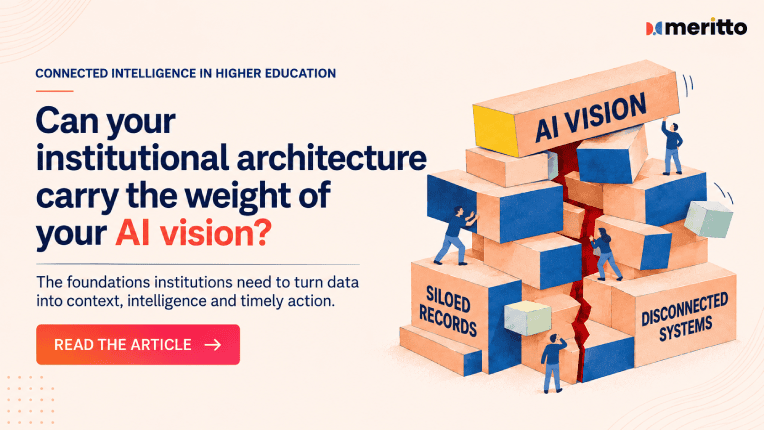
A 2025 FICCI–EY-Parthenon report based on a survey of 30 Indian HEIs offers a useful snapshot of this tension. Of the institutions surveyed, 18 considered AI a strategic priority backed by dedicated resources. 12 had an institution-wide AI vision or roadmap, while another 5 had policies for particular departments or units.
Yet the same report describes data and technology capability as uneven. Around 70% of the surveyed institutions were investing in high-compute technologies, while gaps remained in cloud infrastructure, unified data platforms and digitised administrative records.
The survey is small and should not be treated as nationally representative. But, its value lies in the contrast it reveals: institutions can invest in the capacity to run AI before building the foundations needed to give it a connected, reliable context.
This infrastructure is becoming more important as learner journeys become less linear. According to the Ministry of Education’s All India Survey on Higher Education 2023–24, 69% of responding universities reported registration on the Academic Bank of Credits, while 49% offered multiple entry and exit in academic programmes.
As credits and pathways extend across stages and systems, institutions need learner records that remain connected and current. AISHE does not measure whether this infrastructure exists, but it shows why managing increasingly flexible journeys through disconnected records is becoming more difficult.
The five capabilities behind institutional agility
Connected intelligence becomes operational when the institution can move through five linked stages:
| Stage | Institutional capability | Outcome question |
| Detect | Recognise a meaningful change while action is still possible | Did we see the change early enough? |
| Understand | Assemble the signals and history that explain it | Did the responsible person receive the complete context? |
| Decide | Apply institutional rules and human judgement | Was ownership clear, and was the decision informed? |
| Act | Complete and coordinate the intervention | Did the response happen within the required time? |
| Learn | Record the result and improve the next response | Do we know what worked? |
Every stage depends on the one before it.
A signal without context may create a false alarm. Context without ownership may produce no decision. An action may stall between departments, while an intervention without outcome feedback teaches the institution nothing.
This is why institutional agility is not simply speed. It is the ability to move through the entire chain with enough context, ownership and control to influence the outcome responsibly.
Leadership can make this measurable through questions such as:
- How long passes between an event and an actionable signal?
- What proportion of priority signals reaches a named owner?
- How much context is assembled without manual searching?
- What proportion of recommendations results in completed action, and what happens afterwards?
These measures do not assume that infrastructure automatically improves enrolment, persistence or progression. They show whether it is creating the conditions for earlier and more coordinated action.
What infrastructure must make possible
Connected intelligence requires more than computing capacity or a central repository. It needs:
- a shared way to recognise the learner across systems and stages;
- interoperable records across institutional functions;
- data that becomes available within the time required by the decision;
- consistent definitions, access controls and accountable ownership;
- workflows that route signals, decisions and escalations; and
- decision and outcome histories.
This changes how institutional leaders can evaluate technology investment. The question is no longer only whether systems have been connected technically. It is whether that connection helps a responsible person understand a situation and complete the right intervention.
Infrastructure becomes valuable at the moment it changes what the institution is capable of doing.
The architecture of institutional intelligence
Five layers. Every layer matters.
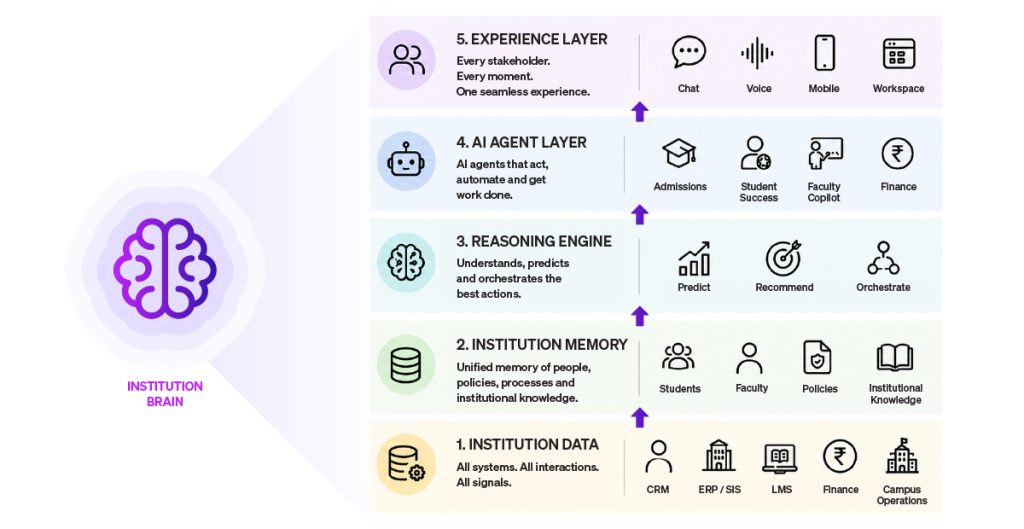
If infrastructure is to change what an institution can do, each layer has to strengthen the one above it.
It begins with connected data. Without a reliable and current view across systems, there is no common foundation for understanding the learner.
That foundation becomes more useful when it develops into institutional memory. The knowledge held across an institution through its people, policies, processes, previous interactions, decisions and outcomes gives data its context and continuity. It allows the institution to understand what has happened before, what has changed and what it has learned along the way.
Together, data and institutional memory give reasoning the context it needs. Current signals can be interpreted alongside institutional history, rules, priorities and previous outcomes, helping the institution understand not only what is happening, but what it may mean and what requires attention.
That reasoning is what makes AI agents effective. Their value does not come from acting independently, but from acting on reliable context, within institutional guardrails, and with a clear understanding of what should happen next.
At the top sits experience and human judgement. Intelligence only becomes consequential when it reaches the person responsible for the outcome in a form that helps them understand, decide and act with confidence.
The architecture therefore builds in sequence: data creates visibility, institutional memory adds context and continuity, together they enable reasoning, reasoning gives AI the intelligence to act, and human judgement turns that capacity into responsible action.
The institution’s ability to act intelligently at the top will always depend on the strength of the foundation beneath it.
Human judgement is part of the infrastructure
Higher education decisions are rarely only computational.
Falling attendance may indicate disengagement, but it may also reflect health, work, accessibility or financial circumstances. Repeated applicant questions may indicate hesitation or a genuine need for reassurance.
A system can recognise a pattern. It cannot assume ownership of the human circumstances behind it.
The NITI Aayog Responsible AI approach document identifies principles including safety and reliability, equality, inclusivity and non-discrimination, privacy and security, transparency, accountability, and the protection of positive human values. It also calls for monitoring, impact assessment, audit and grievance-redressal mechanisms.
Keeping people in the loop should provide three meaningful forms of control:
- Interpretive control: people can see why a signal or recommendation was produced.
- Decision control: they can accept, change, defer or reject it.
- Accountability control: the institution records the decision, the action and the route for questioning an adverse outcome.
Human involvement should not be reduced to a final approval click. It must be designed into the movement from detection to action.
Build the connected foundation through one learner journey
Connected intelligence cannot emerge from another isolated dashboard, data warehouse or departmental integration. It requires a common foundation through which signals from admissions, finance, academics, engagement and student support can be understood around the same learner and translated into coordinated action.
The goal is institution-wide connectivity, and achieving it requires transformation across data, systems, workflows, governance and decision-making. That transformation should be anchored in the outcomes the institution wants to improve, such as offer-to-fee conversion, first-semester persistence, academic progression or placement readiness. This ensures that the connected foundation is designed not merely to move data between systems, but to turn institutional signals into timely intelligence and coordinated human action.
To make this transformation operational, institutional leaders should ask:
- Which outcomes require earlier visibility and action?
- What signals across admissions, finance, academics, engagement and student support contribute to those outcomes?
- How will the institution create a consistent understanding of the same learner across every system and stage?
- How will connected data be interpreted and turned into decision-ready intelligence?
- How will that intelligence reach the right person and trigger coordinated action?
- How will human judgement, accountability and outcome feedback remain part of every decision?
These are not questions for a single learner journey or isolated use case. Together, they define an institution-wide operating model in which systems share context, intelligence supports decisions and actions contribute to organisational learning.
A connected system is therefore more than an integration project. It is an institutional capability that creates a shared understanding of every learner journey and enables people across the institution to act with greater context, coordination and confidence.
The next advantage will be the ability to act
AI is becoming more capable. Learner journeys are becoming more complex. Neither development will automatically make an institution more intelligent or agile.
The advantage will belong to institutions that place connected, decision-ready context in the right hands while action can still matter.
Data infrastructure makes that possible. Connected intelligence makes it meaningful. Institutional agility turns it into action. Human judgement ensures that the action remains responsible.
The first leadership question was:
What could our people achieve if they knew earlier?
The next is:
Which outcomes could they protect if the institution were built to act in time?
About Meritto
Meritto is the Operating System for Student Enrollments. It is a unified, AI-powered, modular and automated platform purpose built for educational organizations enabling them to attract, engage, and enroll students. With it, educational organizations can automate the entire enquiry to enrollment process.
About Collexo
Collexo is a vertical SaaS-based embedded payments platform which operates as a unified suite for fee collections and payments. It has been built to automate and streamline the entire fee collection process, from fee payments to reconciliation and invoicing. It is integrated with payment gateways as a software provider on top of licensed payment partners. We empower educational organizations to build various workflows, receipts, automations, and student journeys.
About Mio AI
Mio AI acts as the core layer that powers both student engagement and team performance, with a suite of purpose-built intelligent agents embedded across the platform. With it, your students get faster, smarter engagement, and your teams get an AI-powered co-pilot that makes every hour more productive.
Mio AI Guide acts as an always-on, multilingual chat agent that assists students with instant, context-aware responses across your website and enrollment portals, from program queries to application support. Mio AI Voice takes it further with autonomous, human-like calling that qualifies inbound leads, re-engages dormant inquiries, and moves students forward, saving your counseling team hours of manual outreach.
FAQs: Connected Intelligence in Higher Education
Connected intelligence is an institution’s ability to bring together relevant data, activity, rules and history from across the learner journey. It turns disconnected signals into decision-ready contexts so that faculty members, counsellors, administrators and leaders can act while an outcome can still be influenced.
AI depends on the quality, context and accessibility of institutional data. If admissions, finance, academics, engagement and student-support records remain disconnected, AI receives only a partial view of the learner. Connected data infrastructure gives AI the reliable institutional context required to generate relevant insights and support responsible decisions.
An ERP records and manages institutional transactions, while system integration allows data to move between platforms. Connected intelligence goes further by interpreting signals from multiple systems, explaining what is changing and helping the responsible person determine what action may be needed.
Institutional agility is the ability to detect change, understand its context, make an informed decision, coordinate action and learn from the result. It is not simply about operating faster. It is about helping the institution respond while enrollment, persistence, academic progression or placement outcomes can still be influenced.
Connected intelligence can help institutions identify changes such as declining attendance, missed assessments, incomplete applications or unresolved support requests earlier. It does not guarantee improved outcomes, but it gives the responsible teams more complete context and more time to provide appropriate support.
Recommended Reads
- What’s new at Meritto: Our latest launches to turn more interest into admissions

- Admission Agent Attribution: The Real Problem Isn’t Tracking. It’s the Handoff.
- DPDP compliance for higher education: How universities move from policy to institutional practice
- The new growth playbook for higher education
- How Mio AI Voice helps institutions achieve enrollment outcomes at scale
- Connected Intelligence: The Infrastructure Behind Institutional Agility