The world has already moved from reports to signals.
Across industries, the value of data is being redefined. Banks use it to identify unusual activity before it becomes a loss. Supply chains use it to anticipate disruptions before shelves are affected. Businesses use it to recognise changing behaviour while there is still time to respond.
This transformation is not simply about adopting more technology. It is about moving from recording outcomes to shaping them. Higher education now stands at the same inflection point, with an opportunity to bring insight closer to the people and moments where it can make the greatest difference.
Digitisation and intelligence are not the same.
Many institutions can report what happened last month, last semester or during the previous admission cycle. Far fewer can explain why it happened, what is likely to happen next and where human attention is needed today.
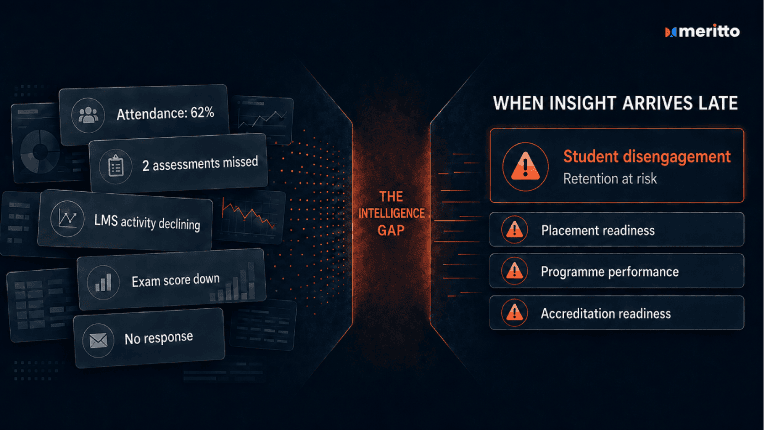
That distance between data and a timely decision is the intelligence gap. It is also where institutions are quietly losing outcomes.
What to take from this read
- Higher education does not have a shortage of data. It has a shortage of timely, contextual insight.
- The cost of this gap appears in student attrition, missed enrollments, declining programme performance, placement readiness and last-minute accreditation work.
- Intelligence does not mean allowing AI to make institutional decisions. It means giving people the context and time to make better ones.
- The Intelligence Era of Education is ultimately about expanding what institutions and their people can achieve.
Why do institutions have more data but less insight?
Because digitisation happened one function at a time.
Admissions adopted a platform. Attendance moved into the ERP. Academic activity entered the LMS. Examinations, fee management and student communication developed their own processes and records.
Each system may perform its assigned task well. The problem appears when a decision depends on signals spread across several of them.
Consider a student whose attendance has fallen to 62 percent.
The ERP can report the number. But what if the same student has also missed two assessments, stopped opening course material, performed poorly in a recent examination and not responded to communication?
Individually, each signal may look routine. Together, they tell a different story.
The institution may already have everything it needs to recognise that the student is disengaging. Yet the full picture often reaches a faculty member, counsellor or academic leader only after the student has failed an examination, stopped attending or decided to leave.
The data was available. The opportunity to act was lost.
What does delayed insight cost an institution?
The consequences extend far beyond reporting.
| Institutional moment | What may already be visible | What timely human action could protect |
| A student begins disengaging | Falling attendance, missed assessments, weaker performance and declining activity | Student success, wellbeing and retention |
| An applicant becomes hesitant | Delayed responses, repeated questions, engagement patterns and incomplete steps | Enrollment and applicant experience |
| A programme begins declining | Changes in applications, student performance, feedback and outcomes | Academic planning and programme performance |
| Students approach placement season | Skill gaps, academic eligibility and participation patterns | Placement readiness |
These are not abstract technology problems. They are moments in which an institution could have acted but did not have the complete picture in time.
The value of intelligence lies in making these moments visible sooner.
NEP 2020 has made the intelligence gap harder to ignore
The operating environment of higher education is becoming more flexible, individualised and outcome-oriented.
Under the National Education Policy 2020 and subsequent UGC frameworks, institutions are being asked to support academic structures that are far more dynamic than the fixed programme and cohort models around which many existing systems were designed.
Three changes are particularly significant:
Learner journeys are becoming more individual
Multiple entry and exit, major and minor combinations, multidisciplinary study and simultaneous academic programmes create more possible pathways for every learner.
A student may exit after completing one stage, return later, transfer credits or pursue a combination that does not resemble the traditional linear degree journey.
This means institutions need to understand progression at the level of the individual learner, not only at the level of the batch or programme.
Academic records need to remain portable and current
The Academic Bank of Credits, linked with APAAR and the wider digital academic-record ecosystem, supports the accumulation, transfer and redemption of credits.
A record can no longer be treated only as an internal institutional ledger. Credits and achievements need to remain accurate, verifiable and usable across a learner’s academic journey.
Outcomes need to be captured continuously
The shift toward flexible curricula, continuous assessment and outcome-oriented education requires institutions to observe learning as it happens.
Credits may come from academic courses, vocational learning, internships, experiential learning and other recognised activities under the National Credit Framework.
At the same time, expectations around institutional transparency and public self-disclosure make it increasingly difficult to depend on data assembled only when a report, inspection or accreditation cycle is due.
Every one of these changes is an operational demand.
That is why the Intelligence Era is no longer a distant conversation about AI. The demands institutions face today already require better visibility, context and decision support.
Intelligence expands what people can achieve
The Intelligence Era is not only about giving people better insight. It is about expanding what institutions are able to achieve with that insight.
When teams can see emerging patterns, understand the signals behind them and identify where attention is needed, they are no longer limited to responding after an outcome has been recorded. They can intervene earlier, plan with greater confidence and pursue possibilities that previously felt too complex to manage.
A counsellor can engage an applicant before interest is lost. A faculty member can support a student before disengagement becomes withdrawal. Academic leaders can explore more flexible programmes without being constrained by what existing reports can represent. Institutional leadership can act on emerging risks and opportunities instead of waiting for the next review cycle.
This is how technology stops setting the ceiling on institutional ambition. The goal is to equip people to see sooner, decide with greater clarity and achieve outcomes that may previously have remained out of reach.
What changes in the Intelligence Era?
The most important change is not the number of tools an institution uses. It is what its people are able to do with the information already available to them.
| From reports to signals: Instead of learning about a problem after an outcome has been recorded, teams can see emerging changes while intervention is still possible. |
| From isolated numbers to context: An attendance percentage, an application status or an assessment score becomes more useful when viewed alongside the signals that explain it. |
| From equal attention to timely attention: Not every student, applicant, programme or process requires the same response at the same moment. Intelligence helps people identify where their attention is likely to matter most. |
| From delayed reaction to informed action: The objective is not another dashboard. It is a clearer next step for the person responsible for the outcome. |
This is where intelligence changes more than the quality of a decision. It expands the range of outcomes an institution can pursue. Leaders are no longer constrained by what their systems can report or what their teams can manually piece together. They can respond sooner, design with greater confidence and turn institutional ambition into action.
The question for institutional leadership is no longer simply, “What can our systems record?”
It is:
What could our people achieve if they knew earlier?
That is the best place to begin the journey toward the Intelligence Era of Education.
About Meritto
Meritto is the Operating System for Student Enrollments. It is a unified, AI-powered, modular and automated platform purpose built for educational organizations enabling them to attract, engage, and enroll students. With it, educational organizations can automate the entire enquiry to enrollment process.
About Collexo
Collexo is a vertical SaaS-based embedded payments platform which operates as a unified suite for fee collections and payments. It has been built to automate and streamline the entire fee collection process, from fee payments to reconciliation and invoicing. It is integrated with payment gateways as a software provider on top of licensed payment partners. We empower educational organizations to build various workflows, receipts, automations, and student journeys.
About Mio AI
Mio AI acts as the core layer that powers both student engagement and team performance, with a suite of purpose-built intelligent agents embedded across the platform. With it, your students get faster, smarter engagement, and your teams get an AI-powered co-pilot that makes every hour more productive.
Mio AI Guide acts as an always-on, multilingual chat agent that assists students with instant, context-aware responses across your website and enrollment portals, from program queries to application support. Mio AI Voice takes it further with autonomous, human-like calling that qualifies inbound leads, re-engages dormant inquiries, and moves students forward, saving your counseling team hours of manual outreach.
FAQs: The Intelligence Era of Education
The Intelligence Era of Education is the shift from using technology primarily to record past activity toward using information to understand what is happening, anticipate what may happen next and support timely human action.
No. Intelligence should support decision-making, not take ownership of it. AI can surface patterns, provide context and indicate where attention may be needed. Faculty members, counsellors, administrators and institutional leaders retain responsibility for interpreting the situation and deciding what action to take.
Data becomes valuable when it reaches the right person with enough context and time to act. If signals remain separated across attendance, academics, admissions, examinations and engagement systems, institutions may identify an outcome only after the opportunity to influence it has passed.
An ERP is primarily designed to record and manage transactions and workflows. It may report attendance, marks, fees or application status accurately, but decisions often depend on understanding the relationship between several signals. Intelligence adds that context while keeping the relevant person in control of the action.
NEP 2020 and subsequent frameworks introduce more flexible learner pathways, portable credits, multidisciplinary programmes, continuous assessment and greater expectations around institutional information. These changes require institutions to understand individual learner journeys and outcomes continuously, rather than relying only on fixed programme structures and retrospective reports.
Recommended Reads
- What’s new at Meritto: Our latest launches to turn more interest into admissions

- Admission Agent Attribution: The Real Problem Isn’t Tracking. It’s the Handoff.
- DPDP compliance for higher education: How universities move from policy to institutional practice
- The new growth playbook for higher education
- How Mio AI Voice helps institutions achieve enrollment outcomes at scale
- Connected Intelligence: The Infrastructure Behind Institutional Agility