Acquiring AI has never been easier. Most institutions have already begun, whether through a CRM assistant, a student-facing chatbot, or a generative AI tool. Yet none of that equals AI readiness in higher education. Readiness is the harder part, because it depends on five things most institutions have not yet fixed: connected data, redesigned processes, responsible governance, capable people, and clear leadership. Until those are in place, even the most sophisticated AI sits on top of a fragmented institution and simply produces faster fragmentation. The institutions that pull ahead are not the ones with the most AI. They are the ones that use AI as a reason to rethink how the whole institution operates around the student.
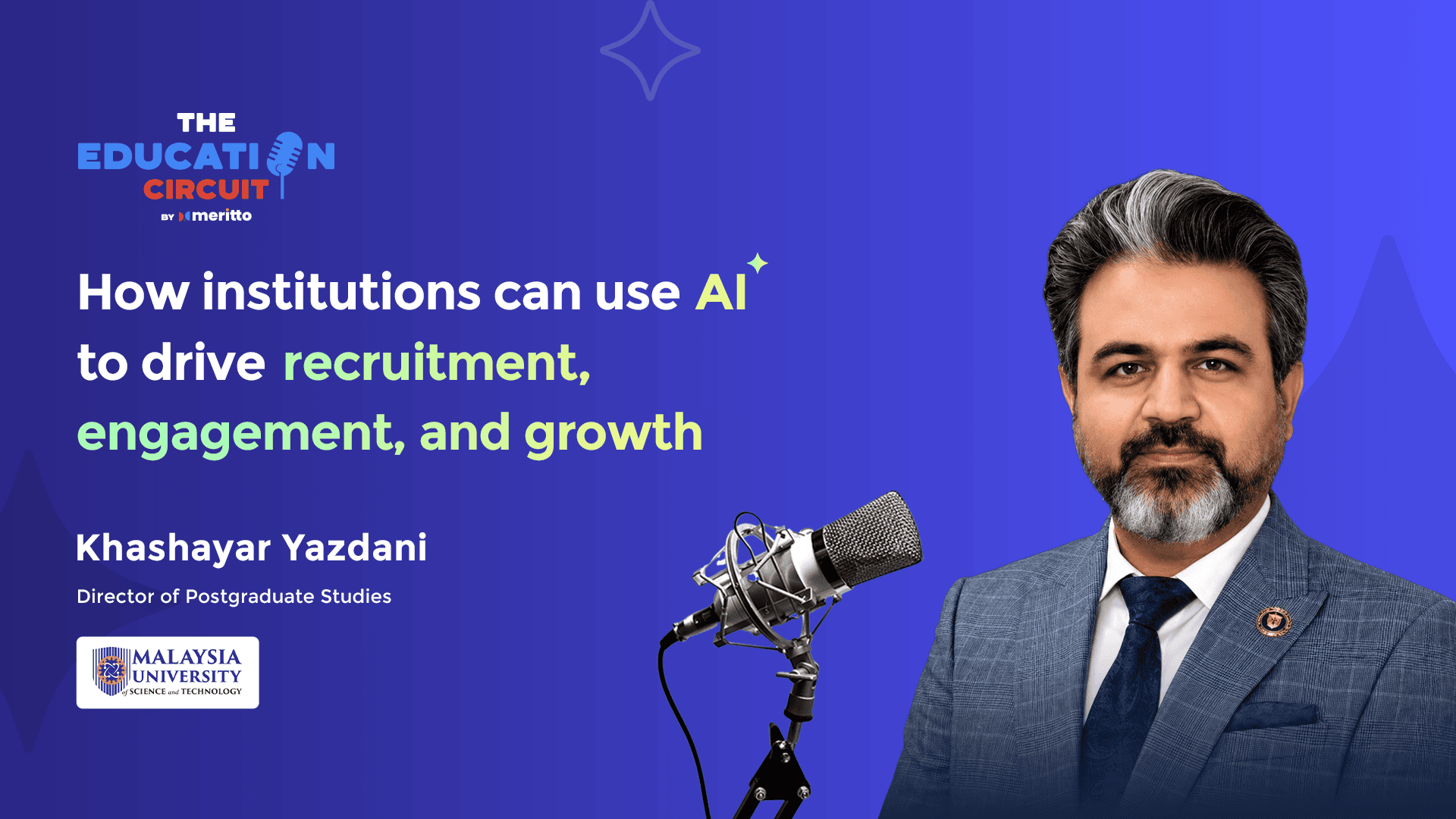
That distinction ran through the latest episode of #EducationCircuitByMeritto, a conversation between a conversation that brought together two complementary perspectives on the same challenge, one from inside the institution and one from the front line of enrolment technology. Associate Professor Dr. Khashayar Yazdani, Director of Postgraduate Studies at Malaysia University of Science and Technology, has spent his career moving from analytics and data into digital transformation and now agentic AI. Faiz Varsi, Director for Southeast Asia at Meritto, works on the ground with institutions trying to operationalise exactly these ideas. What follows is the strategic argument their conversation made, and what it asks of any leader deciding where AI actually belongs.
Why “should we use AI?” is no longer the right question
The useful question has changed from whether to use AI to how to redesign the institution around it. Not long ago, the AI conversation in higher education centred on caution and curiosity, on what the technology was and where it might fit. That debate is effectively over. As Dr. Khashayar put it, the better question now is “how we can redesign the institution around a responsible, connected, and intelligent way of working.”
His own trajectory explains why. He started in data and analytics, helping organisations understand what happened and make better decisions. The lesson that reshaped his thinking was that dashboards alone change nothing. “Better dashboards alone do not create transformation,” he said. “The bigger challenge is connecting data, people, processes, and decisions.” Generative and agentic AI then changed the conversation again, because intelligence stopped being the property of technical teams. Lecturers, administrators, and students can now interact with a system in plain language, and increasingly that system does more than answer. It understands an objective, supports a workflow, recommends an action, and acts across connected processes.
That is the arc worth internalising: from data, to insight, to intelligent action. And it comes with a principle Dr. Khashayar was emphatic about. AI should stay human-central. It exists to reduce repetitive work so that people can concentrate on judegment, creativity, empathy, and relationships, not to replace them.
Why AI adoption is not AI readiness
AI readiness is the organisational capacity to use AI well, and it is not the same as owning AI tools. This is the single most important idea in the discussion. “It’s very easy to launch a chatbot,” Dr. Khashayar noted, “but that doesn’t make an institution AI-ready.” He laid out five barriers that stand between a university and genuine readiness:
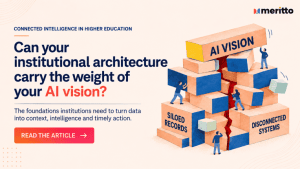
- Fragmented data. Universities are not short on data. They are short on connected data. The same student exists as separate records across the CRM, the student information system, the learning platform, the finance system, and a scatter of spreadsheets. The problem is not a lack of data, it is fragmentation.
- Legacy processes. Putting AI on top of an inefficient process and calling it transformation does not work. In his words, “automating a poor process simply gives you a faster poor process, not a better process.”
- Governance and trust. Universities hold sensitive student, academic, finance, and research data. Privacy, security, bias, and accountability are not optional add-ons; they are preconditions.
- People and skills. AI transformation cannot be delivered by the IT department alone. Lecturers, admissions teams, administrators, and students all need different levels of AI literacy.
- Leadership and ownership. In many institutions, he observed, “AI is happening everywhere, but strategically it belongs nowhere.” Without clear ownership, effort scatters and nothing compounds.
The strategic reading is that these barriers are sequential dependencies, not a menu. You cannot govern data you have not connected, and you cannot scale AI on processes you have not redesigned. Readiness is the work of removing all five, in order.
Why connected data beats buying more tools
AI delivers real institutional results only when it is connected to the entire student journey, not bolted on as a standalone layer. This is where Faiz sees adoption efforts stall. Institutions typically start with a specific use case such as automation, chatbots, lead engagement, or analytics, but the tool gets introduced separately from the institution’s existing data, workflows, and systems. “The technology may work,” he said, “but the impact remains very limited.”
His example was the pre-recruitment cycle. Finance, admissions and recruitment, marketing, and management are all working towards one common goal, yet each operates in its own silo on disconnected platforms. The predictable result is that “most of the decisions which are being taken are being taken on an assumption basis rather than backed by facts and figures.” The fix is not more technology. It is the right use case matched to the right technology, used, as he put it, “in the right pattern.” At Meritto, that means connecting AI across the journey from the first enquiry through engagement, application, and conversion, so AI stops being another tool and becomes part of how the institution operates.
What changes when the institution remembers the student
Connected data flips the burden of memory from the student to the institution. Dr. Khashayar offered the line that best captures the whole shift: “In a fragmented institution, the student remembers the institution. But in a connected institution, the institution remembers the students.” A student experiences one continuous journey, enquiry, application, enrolment, study, graduation, while the institution often splits that same person across eight or ten systems, an applicant in one, a student ID in another, a payment in a third.
Connecting those systems does more than complete the picture. It changes what the institution can do next. It allows a move from reactive service to proactive engagement: instead of waiting for a student to ask which document is missing, the institution can spot the gap and guide them. Faiz made the same point through context. If a prospective student has already inquired about an MBA, attended a webinar, downloaded a brochure, and spoken to a counsellor, but the next message still opens with “Hi, are you interested in our MBA programme?”, then, as he said, “we haven’t really become smarter.” His rule is a good design test for any enrolment stack: “The student shouldn’t have to keep introducing themselves to the university.”
Both were clear about the boundary. A 360-degree view of the student, in Dr. Khashayar’s phrase, “should never become a 300-degree surveillance.” Connected data has to be governed by responsibility, which sits naturally alongside Malaysia’s Personal Data Protection Act and its national AI governance guidelines. The goal is the right data, for the right purpose, at the right time.
How agentic AI delivers speed, relevance, and continuity
Students now expect three things from a first interaction: speed, relevance, and continuity. As Dr. Khashayar framed it, they want a fast reply, the right answer, and a connected experience that does not force them to start over each time. Meeting that across thousands of enquiries, at night, across time zones, and often in a language other than English, is where most teams simply run out of hours.
The best way to deploy agentic AI here is human plus AI. Let agentic AI carry the repetitive, high-volume work, the follow-ups, the qualification, and the round-the-clock responses in the applicant’s own language, so your teams can focus on what actually matters: guiding students forward. It reads intent, carries context forward so a student never has to repeat their programme interest or nationality, and predicts the best next action for each student, so the right person reaches out at the right moment with the right message.
Dr. Khashayar summarised the operating model any institution can borrow: “AI for availability, AI for personalisation, and human for judgement and relationship.” That is the whole strategy in one line. Let the system be tireless and consistent, and free your people for the human work that actually builds trust. On a connected enrolment platform, this is exactly the point where AI becomes part of how the institution engages every student.
The strategic takeaway for institutional leaders
The pattern across the conversation is consistent. Competitive advantage does not come from how much AI a university buys. It comes from readiness: connected data, redesigned processes, responsible governance, capable people, and clear leadership, with humans kept firmly at the centre of judgement and relationships.
The Malaysian context makes the urgency concrete. In 2026, all twenty public universities in the country rolled out Google’s Gemini for Education to close to 600,000 students, and the Thirteenth Malaysia Plan is pushing digital skills and public-private collaboration. Yet the Digital Education Council’s 2026 global survey found that while 88 percent of students now use AI in their learning, institutional readiness trails badly, with only 29 percent of students believing their instructors are equipped to guide them on it. The tools are already everywhere. The advantage now belongs to the institutions willing to do the unglamorous work of becoming ready to use them.
Listen to the full episode here
See what a connected, AI-ready enrolment journey looks like
Bring recruitment, admissions, engagement, and retention into one connected view with Meritto’s enrollment platform.
About Meritto
Meritto is the Operating System for Student Enrollments. It is a unified, AI-powered, modular and automated platform purpose built for educational organizations enabling them to attract, engage, and enroll students. With it, educational organizations can automate the entire enquiry to enrollment process.
About Collexo
Collexo is a vertical SaaS-based embedded payments platform which operates as a unified suite for fee collections and payments. It has been built to automate and streamline the entire fee collection process, from fee payments to reconciliation and invoicing. It is integrated with payment gateways as a software provider on top of licensed payment partners. We empower educational organizations to build various workflows, receipts, automations, and student journeys.
About Mio AI:
Mio AI acts as the core layer that powers both student engagement and team performance, with a suite of purpose-built intelligent agents embedded across the platform. With it, your students get faster, smarter engagement, and your teams get an AI-powered co-pilot that makes every hour more productive.
Mio AI Guide acts as an always-on, multilingual chat agent that assists students with instant, context-aware responses across your website and enrollment portals, from program queries to application support. Mio AI Voice takes it further with autonomous, human-like calling that qualifies inbound leads, re-engages dormant inquiries, and moves students forward, saving your counseling team hours of manual outreach.
About #EducationCircuitByMeritto
#EducationCircuitByMeritto is Meritto’s thought-leadership podcast series that brings forward honest, high-impact conversations with education leaders shaping the future of the industry. From shifting student expectations to smarter recruitment and enrollment strategies, each episode dives into the real challenges institutions face today.
FAQs: What’s new at Meritto
Students now behave like digital consumers. They begin online, often on TikTok, Instagram, or comparison portals, and they weigh rankings, reviews, and YouTube campus tours before ever filling out a form. They compare universities the way they compare smartphones, and they trust the voices of other students more than institutional advertising.
Prospective students expect instant, personalised replies at any hour, and an institution that takes hours or days to respond often loses them to a faster competitor. AI makes 24-hour engagement possible by handling routine questions immediately and holding a real conversation across channels like WhatsApp and social media.
AI is changing how students discover institutions, how quickly they expect to be answered, and how universities support them after enrolment. The deeper shift the panel identified is that AI is exposing how fragmented the student journey has always been, and its real value is continuity: connecting the journey from first inquiry through learning to employability, rather than adding isolated tools at single points.
No. AI works best as an intelligent co-pilot, not a replacement. It automates repetitive work such as follow-ups, lead qualification, and pattern detection, which frees counsellors and lecturers for the mentoring and meaningful conversations that only people can have.
By making support anticipatory instead of reactive. Predictive analytics can read signals like attendance, learning management activity, and grades to flag at-risk students early, so lecturers can step in before a term is lost. Personalised nudges about deadlines, workshops, and electives keep students engaged over time, which supports retention.
A unified view of the student must not become surveillance. Responsible use rests on clear consent, proper data governance, role-based access, and firm policies on transparency and human accountability. The point is connecting the right data for the right purpose, under the right governance.
Recommended Reads
- What’s new at Meritto: Our latest launches to turn more interest into admissions

- Admission Agent Attribution: The Real Problem Isn’t Tracking. It’s the Handoff.
- DPDP compliance for higher education: How universities move from policy to institutional practice
- The new growth playbook for higher education
- How Mio AI Voice helps institutions achieve enrollment outcomes at scale
- Connected Intelligence: The Infrastructure Behind Institutional Agility