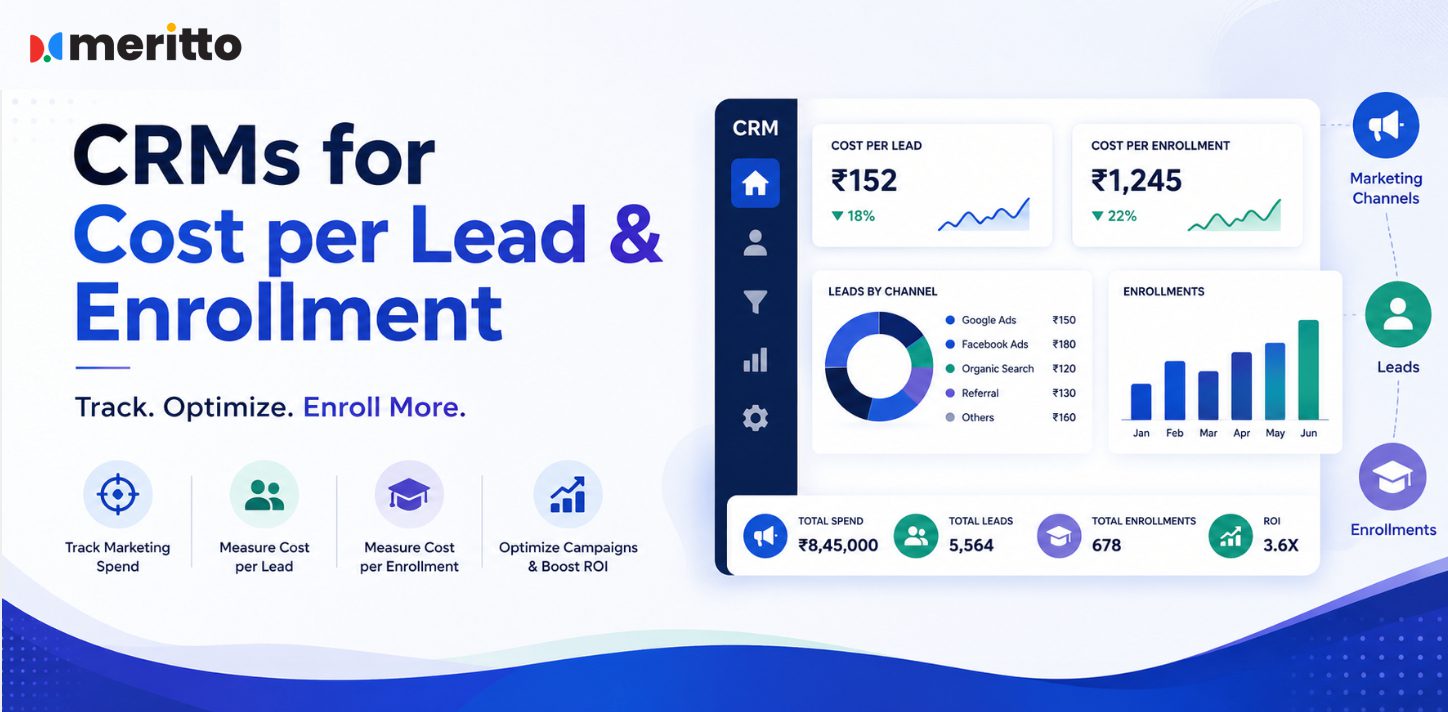
Most CRMs can tell an institution where its inquiries came from.
Far fewer can reliably show what each enrolled student cost.
Calculating cost per lead is relatively simple. The institution divides its campaign spend by the number of inquiries generated. Calculating cost per enrollment is more demanding because the CRM must connect marketing spend with the entire student journey—from the first inquiry to application, payment, offer acceptance, and final enrollment.
The CRM must also preserve the original source, identify duplicate inquiries, track multiple campaign interactions, and apply one consistent definition of an enrollment.
Without that foundation, a cost-per-enrollment dashboard may look precise while producing a misleading answer.
Which CRMs Can Track Cost per Lead and Cost per Enrollment?
CRMs that can connect marketing campaigns with final conversion outcomes include:
- Meritto, which is purpose-built to connect student recruitment sources with applications, payments, and enrollments
- Salesforce, when campaigns, opportunities, costs, and enrollment outcomes are correctly configured
- HubSpot, when advertising interactions are connected to contacts, deals, and revenue or enrollment stages
- Other configurable CRMs, when institutions build the necessary source, campaign, application, and enrollment data structure
The critical difference is not whether the CRM contains a campaign dashboard. It is whether the system can preserve attribution throughout the enrollment journey.
A general-purpose CRM may be able to calculate the metric after significant customization. An education-specific CRM is more likely to understand inquiries, applications, programs, campuses, intakes, fee payments, and enrollment outcomes as connected parts of the same process.
Cost per Lead Is Not an Enrollment Metric
Cost per lead measures how cheaply a channel generates inquiries.
Cost per Lead = Channel Spend ÷ Leads Generated
Suppose a university spends ₹6,00,000 on a paid search campaign and receives 1,200 inquiries.
Cost per Lead = ₹6,00,000 ÷ 1,200 = ₹500
This tells the university how efficiently the campaign filled the top of its funnel. It does not show whether those inquiries were genuine, eligible, reachable, interested, or eventually enrolled.
Cost per enrollment measures the cost of producing the final outcome.
Cost per Enrollment = Channel Spend ÷ Enrollments Generated
If the same campaign generates 40 enrollments:
Cost per Enrollment = ₹6,00,000 ÷ 40 = ₹15,000
Now consider another channel:
|
Channel |
Spend |
Leads |
Enrollments |
Cost per Lead |
Cost per Enrollment |
|
Paid search |
₹6,00,000 |
1,200 |
40 |
₹500 |
₹15,000 |
|
Education portal |
₹4,00,000 |
500 |
60 |
₹800 |
₹6,667 |
|
Webinar |
₹2,00,000 |
200 |
35 |
₹1,000 |
₹5,714 |
Paid search appears to be the strongest channel when the institution looks only at cost per lead.
Once enrollments are considered, it is the most expensive channel in the comparison.
This is the limitation of CPL-led decision-making: it rewards inexpensive inquiry generation even when those inquiries produce poor enrollment outcomes.
What Must a CRM Connect to Calculate Cost per Enrollment?
A reliable cost-per-enrollment calculation requires four connected data layers.
1. Marketing expenditure
The CRM needs accurate expenditure data for each relevant source, such as:
- Advertising channel
- Campaign
- Ad account
- Agency
- Publisher or education portal
- Event or education fair
- School outreach campaign
- Referral program
- Program or course
- Campus
- Intake or academic session
Institutions must also decide what “cost” includes.
A media-only calculation may include just advertising expenditure. A fully loaded acquisition cost may include:
- Media spend
- Agency retainers
- Portal fees
- Creative production
- Event participation
- Technology costs
- Call-centre costs
- Counselor costs
Both calculations can be useful, but they answer different questions. The CRM should not mix them without clearly labelling the methodology.
2. Persistent source attribution
The CRM must preserve where the student originally came from.
This becomes difficult when the same student:
- Submits more than one form
- Inquires about multiple programs
- Returns through a different campaign
- Speaks with more than one counselor
- Uses different phone numbers or email addresses
- Applies after several weeks or months
- Is uploaded again by an agency or publisher
If the original source is overwritten every time a student returns, the institution loses the ability to evaluate acquisition performance accurately.
Meritto, for example, records source information across primary, secondary, tertiary, and subsequent source levels. Its source-attribution structure is designed to retain multiple interactions without repeatedly creating the same inquiry as a new student record.
That distinction matters because an institution must be able to answer two separate questions:
- Which source first introduced the student?
- Which later interactions influenced the application or enrollment?
3. Enrollment-funnel progression
The CRM must connect the source with each meaningful stage of the admission journey:
- Inquiry received
- Inquiry verified
- Student contacted
- Counseling completed
- Application started
- Application submitted
- Application fee paid
- Documents approved
- Offer issued
- Offer accepted
- Registration fee paid
- Enrollment confirmed
Without this progression, a CRM can report leads but cannot explain where a channel loses students.
For example, two campaigns may both generate 1,000 inquiries:
|
Funnel stage |
Campaign A |
Campaign B |
|
Inquiries |
1,000 |
1,000 |
|
Verified inquiries |
750 |
500 |
|
Applications started |
400 |
300 |
|
Applications submitted |
250 |
220 |
|
Enrollments |
80 |
90 |
Campaign A creates more verified leads and application starts, but Campaign B produces more enrollments.
A lead-level report would favour Campaign A. A source-to-enrollment report would reveal the stronger final outcome from Campaign B.
4. A consistent definition of enrollment
An institution must decide exactly when an applicant becomes an enrolled student.
Possible definitions include:
- Offer accepted
- Registration fee paid
- First fee installment paid
- Enrollment number generated
- Student transferred to the student information system
- Student attending classes after the refund period
The chosen definition directly changes the reported cost per enrollment.
If marketing counts every registration payment while finance excludes refunded or cancelled admissions, the two departments will report different acquisition costs for the same channel.
The definition should therefore be documented, standardized, and applied automatically inside the reporting system.
Which CRM Is Best for Channel-Level Enrollment Cost Tracking?
The right platform depends on how much education-specific configuration the institution needs.
Meritto
Meritto is built around the student enrollment lifecycle rather than a conventional B2B sales funnel. It connects campaign sources with student inquiries, applications, counselor actions, payments, and enrollment outcomes.
Its reporting can be used to evaluate channel performance beyond lead volume, including conversion rates, qualified or verified inquiries, applications, and cost per enrollment. Meritto also positions source-to-enrollment attribution as a shared layer between marketing and admissions, helping both teams evaluate the same student journey rather than maintaining separate reports.
Meritto is particularly relevant when an institution needs to compare:
- Digital advertising campaigns
- Agencies and publishers
- Education portals
- Organic and direct inquiries
- Events and education fairs
- Referrals and walk-ins
- Multiple campuses
- Multiple courses or programs
- Different academic sessions and intakes
Instead of mapping students to generic sales opportunities, institutions can assess performance using education-specific stages such as application started, application submitted, fee paid, and enrolled.
Salesforce
Salesforce supports campaign-cost and ROI reporting. Its campaign reports can show responses, related opportunities, won opportunities, actual campaign costs, ROI, average cost per response, and average cost per customer.
Salesforce Campaign Influence can also connect multiple campaigns with the same opportunity, which is useful when several interactions contribute to a long conversion journey.
To calculate cost per enrollment, an institution would generally need to configure:
- The student inquiry as a lead or contact
- The admission opportunity as an opportunity or custom object
- Enrollment as a successful opportunity outcome
- Campaign membership and campaign costs
- Program, campus, intake, and application relationships
- Payment and student-information-system integrations
- Duplicate-management and attribution rules
Salesforce can support sophisticated attribution, but the reliability of the result depends on implementation quality and ongoing CRM administration.
HubSpot
HubSpot provides contact-creation, deal-creation, and revenue-attribution reporting. Campaign attribution reports can measure campaigns by contacts created, deals created, or revenue generated.
Connected advertising accounts can also bring campaign-performance data from platforms such as Google, Facebook, and LinkedIn into HubSpot.
An institution can use HubSpot to estimate cost per enrollment when:
- Advertising costs are available
- Student sources and campaign interactions are captured
- Applications or admissions are represented as deals
- Enrollment is defined as a successful deal stage
- Each student is associated with the right application or deal
- Final enrollment data is returned to the CRM
HubSpot is a strong option for digital marketing attribution. However, institutions with multiple applications per student, document workflows, program-specific eligibility, complex fee milestones, or agent networks may need additional customization and integrations.
Showing Cost per Enrollment Is Not the Same as Measuring It Correctly
A dashboard can divide spend by enrollments and still produce the wrong answer.
The following issues commonly distort the calculation.
Duplicate inquiries inflate lead volume
A student may submit a form through Google, return through an education portal, and later register for a webinar.
If the CRM treats these as three different students, the institution may:
- Understate cost per lead
- Overstate inquiry volume
- Miscalculate channel conversion
- Credit multiple campaigns with the same enrollment
Identity resolution and duplicate management are therefore part of marketing attribution—not merely database administration.
Lead sources get overwritten
A counselor may update the source from “Google Ads” to “Direct” after speaking with the student. An imported application may replace the original source with “Website.” A new inquiry may be assigned to the most recent campaign.
Each change breaks the connection between acquisition spend and the final enrollment.
Original source fields should either be non-editable or governed through strict permissions and audit trails.
Marketing and admissions use different records
Marketing may report leads from advertising platforms, while admissions reports applicants from the CRM and finance reports enrolled students from an ERP or student information system.
When these datasets are not connected at the student level, cost per enrollment becomes a spreadsheet-matching exercise.
A reliable system should create one traceable chain:
Campaign → Inquiry → Applicant → Payment → Enrollment
The institution credits only the last interaction
A student may first discover a university through an education portal, later search for it on Google, attend a webinar, and finally apply after receiving a WhatsApp reminder.
Giving all credit to the final WhatsApp interaction would ignore the channel that created the original demand. Giving all credit to the education portal would ignore the interactions that helped convert the student.
This is why institutions need an explicit attribution model rather than an accidental one.
All leads are treated as equal
A lead with an invalid phone number should not carry the same analytical value as a verified applicant.
Institutions should therefore calculate costs at several funnel stages:
- Cost per raw inquiry
- Cost per unique inquiry
- Cost per verified lead
- Cost per counseling-ready lead
- Cost per application start
- Cost per submitted application
- Cost per paid application
- Cost per offer acceptance
- Cost per enrollment
This exposes exactly where each channel creates or loses value.
Which Attribution Model Should Institutions Use?
There is no single attribution model that answers every marketing question.
First-touch attribution
First-touch attribution gives credit to the source that originally introduced the student.
It answers:
Which channels are creating new demand?
This model is useful for evaluating awareness, reach, portals, organic discovery, and prospecting campaigns.
Last-touch attribution
Last-touch attribution gives credit to the final tracked interaction before the student converts.
It answers:
Which interaction immediately preceded the application or enrollment?
This may be useful for evaluating retargeting, reminders, webinars, counselor outreach, and conversion campaigns.
Multi-touch attribution
Multi-touch attribution divides credit across several interactions.
It answers:
Which combination of channels contributed to the student’s decision?
This is valuable for long enrollment journeys, but it requires cleaner and more complete interaction data.
Meritto’s multi-touch attribution approach is designed to retain interactions from discovery through application and enrollment rather than evaluating channels only at inquiry creation.
A practical approach
Institutions do not have to choose only one model.
A useful dashboard can show:
- First-touch source
- Last-touch source
- Influencing sources
- Enrollment volume
- Fully attributed enrollment credit
- Cost per enrollment under each model
This prevents one attribution model from becoming the unquestioned version of truth.
Different Channels Should Not Always Be Evaluated Identically
Every source has a different role in the student journey.
Paid advertising
Paid advertising should be assessed using:
- Cost per unique inquiry
- Cost per verified lead
- Application rate
- Enrollment rate
- Cost per enrollment
- Fee revenue generated
- Enrollment value by program
Agencies and publishers
Agencies and education portals should also be measured by:
- Duplicate rate
- Invalid-lead rate
- Lead acceptance rate
- Program relevance
- Application-submission rate
- Enrollment rate
- Cost or commission per enrollment
A publisher delivering large lead volumes may still be inefficient if many records are duplicated or unrelated to the promoted program.
Events and education fairs
Events require the institution to combine:
- Participation cost
- Travel and staffing costs
- Leads scanned or collected
- Follow-up completion
- Applications generated
- Enrollments produced
A fair may have a high cost per lead but still produce strong enrollments for a specialized or high-fee program.
Organic channels
Organic search, direct traffic, referrals, and AI-assisted discovery may not carry a direct media cost.
Institutions should not label these channels “free.” They can instead calculate an allocated cost that includes content, technology, search optimization, and team expenditure—or report conversion efficiency without pretending the acquisition cost is zero.
What Should a Channel-Performance Dashboard Show?
A useful dashboard should allow marketing and admissions leaders to move from cost to quality to enrollment.
At minimum, it should show:
|
Measurement area |
Recommended metrics |
|
Spend |
Total spend, media spend, agency spend, allocated spend |
|
Inquiry generation |
Raw inquiries, unique inquiries, verified inquiries |
|
Lead quality |
Duplicate rate, invalid rate, contactability, qualification rate |
|
Applications |
Started, completed, submitted, paid |
|
Admissions |
Eligible, offered, accepted, enrolled |
|
Conversion |
Lead-to-application, application-to-enrollment, lead-to-enrollment |
|
Unit economics |
CPL, cost per verified lead, cost per application, CPE |
|
Revenue |
Application revenue, fee revenue, revenue per enrollment, ROMI |
|
Operational performance |
Response time, follow-up attempts, counselor conversion |
|
Segmentation |
Channel, campaign, agency, program, campus, intake, geography |
The dashboard should also support drill-downs. A low-performing channel may perform well for one course, city, campus, or student segment.
An institution should not pause an entire channel before examining those underlying differences.
Questions to Ask a CRM Vendor
Before accepting that a CRM can track cost per enrollment, ask the vendor to demonstrate the complete calculation.
Source capture
- Does the CRM preserve the original source?
- Can it record multiple source interactions?
- Can users edit source information?
- Is there an audit trail for source changes?
- How are offline sources captured?
Identity and duplicates
- How does the CRM identify the same student across different forms?
- Can one student express interest in multiple programs?
- Can it retain multiple inquiries without creating duplicate student identities?
- What happens when agencies upload an existing lead?
Funnel tracking
- Can the CRM track application starts, submissions, payments, offers, and enrollments?
- Can it report conversion between every stage?
- Can funnel stages vary by program or institution?
- Can withdrawn and refunded students be excluded?
Cost and attribution
- Can campaign expenditure be imported or integrated?
- Can agency and publisher costs be included?
- Does it support first-touch, last-touch, and multi-touch reporting?
- Can it calculate cost by campus, program, intake, or geography?
- Can the institution define its own enrollment event?
Integrations and governance
- Can final enrollment data be returned from the ERP or SIS?
- Can fee-payment status be connected with the application?
- Are source fields protected by permissions?
- Can reports be exported with record-level detail?
- Can marketing and admissions work from the same dashboard?
A vendor should be able to demonstrate the journey from one campaign spend entry to the exact applicants and enrollments attributed to it.
A Simple Test for Your Current CRM
Institutions can assess their current attribution maturity using one enrolled student.
Select a recent enrollment and try to answer:
- Where did the student first discover the institution?
- Which campaign, agency, publisher, or event generated the inquiry?
- Did the student return through other sources?
- Were duplicate inquiries merged or counted separately?
- Which program and intake did the student finally choose?
- When was the application started and submitted?
- Which payment confirmed the enrollment?
- Was the admission later cancelled, refunded, or deferred?
- How much spend should be attributed to this student?
- Can the CRM produce this trail without manual spreadsheet matching?
If the institution cannot answer these questions, it does not yet have reliable cost-per-enrollment reporting—even if a dashboard displays a CPE figure.
The Best CRM Connects Spend With Enrollment Outcomes
The best CRM for tracking cost per lead and cost per enrollment is not necessarily the platform with the largest number of marketing dashboards.
It is the platform that can:
- Preserve the student’s source history
- Resolve duplicate identities
- Connect inquiries with applications
- Track payments and enrollment milestones
- Apply consistent attribution rules
- Integrate final enrollment outcomes
- Compare channel performance across programs and intakes
Salesforce and HubSpot can support this measurement when their sales-oriented data models are carefully configured around the admission journey. Salesforce provides robust campaign and opportunity reporting, while HubSpot provides strong digital interaction and revenue attribution.
Meritto approaches the problem from the enrollment side. As an education-specific CRM and enrollment platform, it connects campaign performance with the stages institutions actually manage: inquiry, application, payment, and enrollment.
That is the real standard institutions should use.
A CRM should not stop at telling the marketing team how many leads a channel generated. It should show whether those leads became students and what it truly cost to enroll them.
- How Mio AI Voice helps institutions achieve enrollment outcomes at scale

- Connected Intelligence: The Infrastructure Behind Institutional Agility
- More Data, But Less Insight? Inside the Intelligence Era of Education
- How universities can turn AI into real institutional impact
- Which CRMs Can Show Cost per Lead and Cost per Enrollment by Channel?
- How to Track Digital Marketing Agency Performance for Student Recruitment