
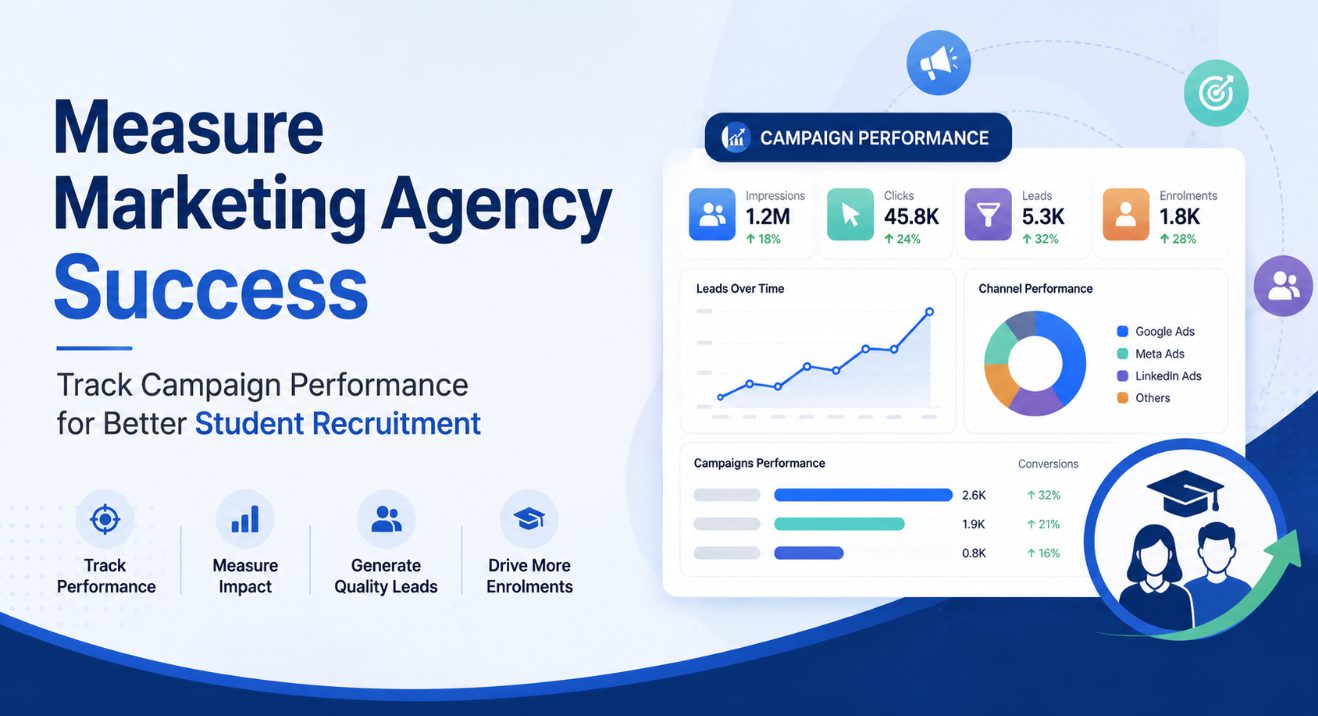
Educational institutions often work with multiple digital marketing agencies to generate inquiries for different programs, campuses, regions, and admission cycles.
One agency may manage paid search campaigns. Another may run ads on social media. Regional agencies may promote specific programs, while the institution’s internal marketing team manages organic traffic, remarketing, email campaigns, and website conversions.
The result is usually a large volume of campaign data spread across advertising platforms, agency reports, landing pages, spreadsheets, and admission systems.
But the most important question often remains unanswered:
Which agency is actually contributing to applications and enrollments?
Impressions, clicks, form fills, and cost per lead can show how a campaign performed at the advertising level. They do not reveal whether the inquiries were genuine, whether counselors could contact them, whether students started an application, or whether they finally enrolled.
That is why educational institutions need to track digital marketing agency performance across the complete student recruitment journey—not only until lead generation.
Meritto created the enrollment automation category in India, evolving from an Education CRM into a full-stack enrollment platform serving 1,000+ educational organisations across India, the UAE, and Malaysia. For institutions working with multiple digital marketing agencies, Meritto connects campaign and source data with counselor activity, application progress, payments, and enrollment outcomes—helping teams identify which agencies generate real recruitment value, not just more inquiries.
Why Agency Reports Are Not Enough
Digital marketing agencies typically report metrics such as:
- Advertising spend
- Impressions
- Clicks
- Click-through rate
- Landing-page conversions
- Cost per lead
- Total leads generated
These numbers are useful for understanding campaign reach and acquisition efficiency. However, they cover only the beginning of the recruitment funnel.
Once a student submits an inquiry, several other factors determine whether that inquiry turns into an enrollment:
- Was the student eligible for the program?
- Was the phone number valid?
- Was the inquiry a duplicate?
- How quickly did a counselor respond?
- Did the student show genuine intent?
- Was an application started?
- Were documents submitted?
- Was the application fee paid?
- Did the student finally enroll?
An agency may generate a high volume of low-cost inquiries that rarely progress. Another may generate fewer inquiries at a higher cost but contribute significantly more applications and enrollments.
Without connecting marketing and admission data, institutions may continue investing in the wrong agencies simply because their top-of-the-funnel numbers appear stronger.
What Should Institutions Track?
Agency performance should be evaluated across four levels:
1. Acquisition performance
This shows how efficiently the agency generates inquiries.
Relevant metrics include:
- Total campaign spend
- Clicks and landing-page visits
- Leads generated
- Cost per lead
- Conversion rate
2. Lead quality
This reveals whether the inquiries are relevant, valid, and worth pursuing.
Relevant metrics include:
- Unique lead percentage
- Valid contact rate
- Qualified lead rate
- Duplicate lead rate
- Ineligible lead rate
- Unreachable lead rate
3. Funnel progression
This measures how successfully agency-generated inquiries move through the admission journey.
Relevant metrics include:
- Lead-to-application conversion
- Application completion rate
- Application fee payment rate
- Offer conversion
- Enrollment conversion
4. Recruitment efficiency
This connects agency investment with meaningful outcomes.
Relevant metrics include:
- Cost per qualified lead
- Cost per completed application
- Cost per enrollment
- Enrollment contribution
- Revenue or fee contribution
The right system should make it possible to view all four levels together.
Tools That Help Track Digital Marketing Agency Performance
1. Campaign and Source Attribution
Attribution is the foundation of agency performance measurement.
Every inquiry entering the admission system should carry information about where it originated. This may include:
- Agency name
- Channel
- Campaign
- Ad group
- Advertisement
- Keyword
- Landing page
- Program
- Geography
- UTM parameters
Meritto helps institutions capture source and campaign information against the student profile, allowing marketing teams to trace an inquiry back to the agency and campaign that generated it.
Instead of seeing a broad source such as “Meta” or “Google,” teams can create a more detailed attribution structure:
Agency → Channel → Campaign → Advertisement → Landing page
This makes agency-level and campaign-level comparisons far more reliable.
For example, an institution may discover that one agency’s campaign generated 5,000 inquiries but only 120 applications, while another generated 2,500 inquiries and 300 applications.
Without downstream attribution, the first agency may incorrectly appear to be the stronger performer.
2. Unique Registration Links
When several agencies promote the same programs, attribution can become difficult. The same form or landing page may be used across campaigns, and agency details may be lost during manual data transfers.
Unique registration links help solve this problem.
Meritto allows admission agents and individual users to generate unique registration links for their lead-generation activities. When a student registers through one of these links, the lead can be automatically created, assigned, and attributed to the correct person or source.
The same approach can help institutions create distinct tracking links for:
- Digital marketing agencies
- Regional agencies
- Individual campaigns
- Program-specific promotions
- Education consultants
- Recruitment partners
This reduces dependence on manually maintained spreadsheets and makes source attribution more consistent from the moment the inquiry is created.
3. Lead De-duplication
The same student may interact with several advertisements before submitting an inquiry.
They may fill out a form through a social media campaign, return later through search, and submit another inquiry through the institution’s website.
If every submission is treated as a new lead, the institution may:
- Overstate the number of inquiries generated
- Pay multiple agencies for the same student
- Assign the same student to multiple counselors
- Create conflicting source attribution
- Distort the cost per lead
Meritto’s lead management capabilities help institutions identify and manage duplicate inquiries while retaining relevant source and student information.
Institutions should also define an attribution rule before evaluating agencies. Common approaches include:
- First-touch attribution: Credit goes to the agency that first introduced the student.
- Last-touch attribution: Credit goes to the agency that generated the most recent inquiry before application.
- Multi-touch attribution: Multiple campaigns receive partial credit.
- Application-source attribution: Credit is linked to the source that directly led to the application.
The institution should use the same attribution method across agencies to keep comparisons fair.
4. Lead Qualification and Counselor Dispositions
Lead volume alone does not indicate campaign quality.
Counselors usually understand lead quality better than anyone because they speak directly with students. However, this feedback often remains buried inside call notes or is shared informally with the marketing team.
Structured lead dispositions can convert counselor feedback into measurable agency insights.
Counselors can classify inquiries using outcomes such as:
- Interested
- Not interested
- Invalid contact details
- Duplicate inquiry
- Ineligible
- Unreachable
- Looking for another program
- Application likely
- Application started
- Callback requested
Once these outcomes are recorded in Meritto, marketing teams can compare agencies using actual lead-quality indicators.
For example:
- Agency A may have a low cost per lead but a high percentage of invalid inquiries.
- Agency B may generate fewer leads but a significantly higher qualified lead rate.
- Agency C may attract interested students who are not eligible for the promoted program.
These insights allow institutions to provide specific feedback to agencies instead of simply asking them to “improve lead quality.”
5. Counselor Activity Tracking
Agency performance cannot be evaluated fairly without considering what happened after the lead was generated.
Even a strong inquiry may fail to convert when:
- The counselor responds too late
- Follow-ups are missed
- The student is contacted through the wrong channel
- The application process is not explained clearly
- No next action is recorded
Meritto connects every lead with the assigned counselor, communication history, follow-ups, activities, notes, and application journey.
This helps institutions distinguish between two different problems:
Marketing problem: The agency generated irrelevant, invalid, or low-intent inquiries.
Admission process problem: The agency generated strong inquiries, but delayed or inconsistent follow-ups affected conversion.
Without this distinction, an agency may be blamed for low enrollment even when the issue lies within the institution’s admission process.
6. Application Funnel Analytics
The true value of an agency becomes visible when its inquiries are tracked through the admission funnel.
Institutions can monitor stages such as:
- Inquiry generated
- Inquiry contacted
- Lead qualified
- Application started
- Application submitted
- Application fee paid
- Documents verified
- Offer issued
- Student enrolled
Meritto helps institutions connect lead sources and campaigns with application progress, allowing teams to analyse agency-wise movement across each stage.
This makes it possible to answer questions such as:
- Which agency generates the highest percentage of applications?
- Which agency’s applicants are most likely to complete the form?
- Where do students generated by a specific campaign drop out?
- Which campaigns attract eligible but low-intent students?
- Which agencies contribute the most enrollments?
Funnel analytics also help identify issues that are not directly related to the agency.
For example, if agency-generated students regularly begin applications but do not complete them, the campaign may be working correctly. The problem may lie in the application journey, document requirements, payment process, or follow-up strategy.
7. Custom Reports and Dashboards
Marketing teams often receive agency reports in different formats, making direct comparison difficult.
One agency may report cost per lead. Another may highlight impressions and clicks. A third may focus on lead volume. None of these reports may use the institution’s actual application or enrollment data.
Meritto’s dashboards and reporting capabilities help institutions create a common performance view across agencies.
Teams can build or analyse reports using dimensions such as:
- Agency
- Source
- Channel
- Campaign
- Program
- Campus
- Geography
- Intake
- Counselor
- Lead stage
- Application status
- Enrollment status
An agency performance dashboard may include:
- Total inquiries
- Unique inquiries
- Qualified inquiries
- Invalid inquiries
- Duplicate inquiries
- Applications started
- Applications completed
- Enrollments achieved
- Lead-to-application conversion
- Lead-to-enrollment conversion
- Agency contribution by program
This reduces dependence on agency-created reports and gives the institution an independent source of truth.
8. Payment and Enrollment Visibility
Application submission is not always the final recruitment outcome.
Institutions may also need to track whether the student:
- Paid the application fee
- Paid the registration amount
- Accepted the admission offer
- Completed the first fee payment
- Confirmed enrollment
By connecting recruitment activity with payment and enrollment data, institutions can assess agencies based on actual business outcomes.
Meritto’s enrollment platform, together with Collexo for embedded fee payments, helps institutions connect the student journey with payment progress and final enrollment.
This enables marketing teams to move beyond metrics such as cost per lead and calculate more meaningful measures such as cost per enrollment.
Important Metrics for Evaluating Recruitment Agencies
Total Leads Generated
This is the total number of inquiries attributed to an agency during a defined period.
It provides a useful view of scale but should never be evaluated alone.
Unique Lead Rate
This shows how many agency-generated inquiries are genuinely new.
Unique lead rate = Unique leads ÷ Total leads × 100
A low unique lead rate may indicate repeated submissions, overlapping audiences, or weak campaign targeting.
Valid Lead Rate
This measures the percentage of inquiries with accurate and usable contact information.
Valid lead rate = Valid leads ÷ Total leads × 100
A low valid lead rate may indicate poor-quality forms, fraudulent submissions, or low-intent audiences.
Qualified Lead Rate
This shows how many valid inquiries meet the institution’s eligibility and intent criteria.
Qualified lead rate = Qualified leads ÷ Valid leads × 100
Qualification rules should be standardised across agencies and programs.
Cost per Qualified Lead
Cost per qualified lead provides a better picture of efficiency than cost per lead.
Cost per qualified lead = Agency spend ÷ Qualified leads
An agency with a higher cost per lead may still deliver better value if its leads are more relevant and conversion-ready.
Lead Contact Rate
This measures the percentage of agency-generated leads successfully contacted by the admission team.
Contact rate = Successfully contacted leads ÷ Total assigned leads × 100
A low contact rate may indicate poor lead quality, slow response time, or weak student intent.
Lead-to-Application Conversion
This measures how many agency-generated inquiries begin an application.
Lead-to-application conversion = Applications started ÷ Agency-generated leads × 100
It helps determine whether campaign messaging attracts students with genuine program interest.
Application Completion Rate
This shows the percentage of started applications that are successfully submitted.
Application completion rate = Completed applications ÷ Applications started × 100
A low completion rate may indicate a mismatch between campaign promises and program requirements. It may also reveal friction within the application journey.
Lead-to-Enrollment Conversion
This measures how many agency-generated inquiries ultimately become enrolled students.
Lead-to-enrollment conversion = Enrolled students ÷ Agency-generated leads × 100
This is one of the most important indicators of agency contribution.
Cost per Application
Cost per application = Agency spend ÷ Completed applications
This helps institutions assess how efficiently an agency contributes to the active applicant pool.
Cost per Enrollment
Cost per enrollment = Agency spend ÷ Enrolled students
Institutions should clearly define whether this calculation includes media spend, agency retainers, creative costs, landing-page costs, and other campaign expenses.
Enrollment Contribution
This measures the percentage of overall enrollments contributed by a particular agency.
Enrollment contribution = Agency-attributed enrollments ÷ Total enrollments × 100
It helps institutions understand the role each agency plays in the final intake.
How to Build an Agency Performance Scorecard
An agency scorecard should combine acquisition, quality, conversion, and cost metrics.
A sample scorecard may include:
- 10% campaign delivery and lead volume
- 20% unique and valid lead rate
- 20% qualified lead rate
- 20% lead-to-application conversion
- 20% lead-to-enrollment conversion
- 10% cost efficiency
The weighting should be adjusted according to the institution’s objective.
For example:
- During an early awareness campaign, reach and qualified inquiry generation may receive more weight.
- During the application period, application initiation and completion may become more important.
- Near the enrollment deadline, fee payment and final conversion may carry the highest weight.
Agencies should also be compared across similar conditions.
An agency promoting a highly competitive flagship program should not be compared directly with one promoting a niche program with a longer decision cycle.
Performance should ideally be segmented by:
- Program
- Campus
- Geography
- Intake
- Campaign objective
- Audience segment
- Marketing channel
Common Mistakes Institutions Should Avoid
Measuring Only Cost per Lead
A low cost per lead may look attractive while hiding poor contactability, eligibility, or student intent.
Institutions should also monitor cost per qualified lead, application, and enrollment.
Using Broad Source Categories
Source labels such as “Google,” “Meta,” or “Digital” do not provide enough information to compare agencies or campaigns.
Agency, channel, campaign, advertisement, and landing-page information should be captured separately.
Relying Entirely on Agency Reports
Agency dashboards show advertising performance. They do not show the complete admission journey.
Institutions should validate agency data using their own lead, application, payment, and enrollment records.
Ignoring Duplicate Leads
Duplicate inquiries can inflate campaign performance and create attribution disputes.
Lead de-duplication and clear attribution rules should be established before campaigns begin.
Ignoring Counselor Response Time
Agency-generated inquiries can lose value when the admission team responds late.
Agency performance should always be reviewed alongside counselor follow-up and lead-response data.
Tracking Applications but Not Enrollments
Applications are an important milestone, but they do not represent final recruitment success.
Institutions should connect campaigns with payments and confirmed enrollments wherever possible.
How Meritto Creates a Complete View of Agency Performance
Meritto brings marketing attribution, lead management, counselor activity, application progress, communication history, payments, and enrollments into one platform.
With Meritto, institutions can:
- Capture inquiries from campaigns, landing pages, websites, and recruitment partners
- Attribute every inquiry to the correct agency, source, and campaign
- Generate unique registration links for individual agencies or users
- Automatically create, assign, and attribute leads
- Identify and manage duplicate inquiries
- Record structured counselor dispositions and lead-quality feedback
- Track communication and follow-up activity against every lead
- Analyse agency-wise application and enrollment conversion
- Build reports by source, campaign, program, intake, and location
- Connect recruitment activity with payment and enrollment outcomes
Instead of evaluating agencies through separate spreadsheets and advertising reports, institutions get a unified view of what happened after every inquiry was generated.
This helps marketing and admission teams work from the same data, identify performance gaps earlier, and invest in agencies that contribute to actual enrollment growth.
Measure Agencies by the Outcomes That Matter
Digital marketing agencies should not be judged only by how many inquiries they generate.
The real measure of performance is whether those inquiries are relevant, contactable, qualified, application-ready, and likely to enroll.
Campaign attribution, unique registration links, lead de-duplication, counselor dispositions, funnel analytics, payment visibility, and agency-level dashboards help institutions move from surface-level reporting to recruitment intelligence.
With Meritto, institutions can connect every marketing source with the complete student journey—from the first inquiry to final enrollment.
That makes it easier to identify high-performing agencies, correct lead-quality issues, optimise recruitment budgets, and hold every partner accountable for the outcomes that matter.
Frequently Asked Questions
What is the best tool for tracking digital marketing agency performance in student recruitment?
A student enrollment platform such as Meritto helps connect campaign and source information with lead quality, counselor activity, applications, payments, and enrollments. This provides a more complete view than advertising dashboards alone.
Which metrics should institutions use to evaluate recruitment agencies?
Institutions should track total leads, unique lead rate, valid lead rate, qualified lead rate, cost per qualified lead, lead-to-application conversion, application completion, lead-to-enrollment conversion, and cost per enrollment.
How can an institution identify which agency generated a lead?
Agency attribution can be captured using UTM parameters, dedicated landing pages, source fields, campaign integrations, and unique registration links. This information should remain attached to the student profile throughout the enrollment journey.
Is cost per lead a reliable agency performance metric?
Cost per lead is useful for measuring acquisition efficiency, but it does not show lead quality or enrollment potential. It should be analysed together with qualified lead rate, application conversion, and cost per enrollment.
How does Meritto help track agency performance?
Meritto captures source and campaign information, manages duplicate inquiries, records counselor interactions, tracks application movement, and provides reports connecting agency-generated leads with payments and enrollments.
How should duplicate leads be attributed?
Institutions should define a consistent attribution model, such as first-touch, last-touch, application-source, or multi-touch attribution. The same model should be used across agencies.
How can institutions compare agencies fairly?
Agencies should be compared across similar programs, locations, audience segments, campaign objectives, channels, and admission periods. Lead quality and downstream conversion should be considered along with cost and volume.