Admission counselors influence every important movement in the student enrollment journey. They respond to inquiries, understand student preferences, recommend programs, follow up on applications, resolve concerns, and help students move towards enrollment.
However, measuring admission counselor productivity is not as simple as counting calls made or leads contacted.
A counselor may complete hundreds of activities without meaningfully moving students forward. Another may handle fewer leads but convert a much higher percentage of them. Admission teams therefore need tools that measure both the volume of work and the outcomes generated from it.
A student enrollment CRM helps institutions bring these data points together. It allows managers to evaluate counselor performance using response times, follow-up completion, student engagement, application movement, conversions, and other indicators connected to enrollment outcomes.
This guide explains the tools and metrics admission offices can use to calculate counselor productivity more effectively.
What Is Admission Counselor Productivity?
Admission counselor productivity measures how effectively a counselor converts assigned opportunities into meaningful enrollment outcomes.
It includes operational activities such as:
- Responding to new student inquiries
- Completing scheduled follow-ups
- Connecting with students across communication channels
- Updating student information
- Initiating and completing applications
- Moving students through enrollment stages
- Converting qualified prospects into enrolled students
Productivity should not be confused with activity.
A counselor making 80 calls a day may appear productive. But if most calls are made to low-intent students, follow-ups are missed, and applications remain incomplete, the activity may not contribute significantly to enrollment.
Effective productivity measurement connects counselor effort with student movement.
Why Traditional Productivity Tracking Falls Short
Many admission offices still track counselor performance through spreadsheets, manual call records, and periodic status updates.
This creates several limitations.
Managers may know how many calls were made but not what happened during those calls. They may see the total number of assigned leads but not whether high-intent opportunities received timely attention. Application numbers may be available at the team level without showing which counselor influenced each conversion.
Manual reporting also depends heavily on counselors consistently updating every interaction.
As lead volumes increase, disconnected systems make it difficult to answer basic performance questions:
- Which counselors respond fastest to new inquiries?
- How many assigned leads are receiving regular follow-ups?
- Which counselors convert the highest percentage of qualified leads?
- Where are students dropping out of the application process?
- Are counselors focusing on high-intent opportunities?
- Which counselors may need coaching or additional support?
A centralized admission CRM helps answer these questions using real-time student and counselor activity data.
Tools That Help Calculate Admission Counselor Productivity
1. Counselor Performance Dashboards
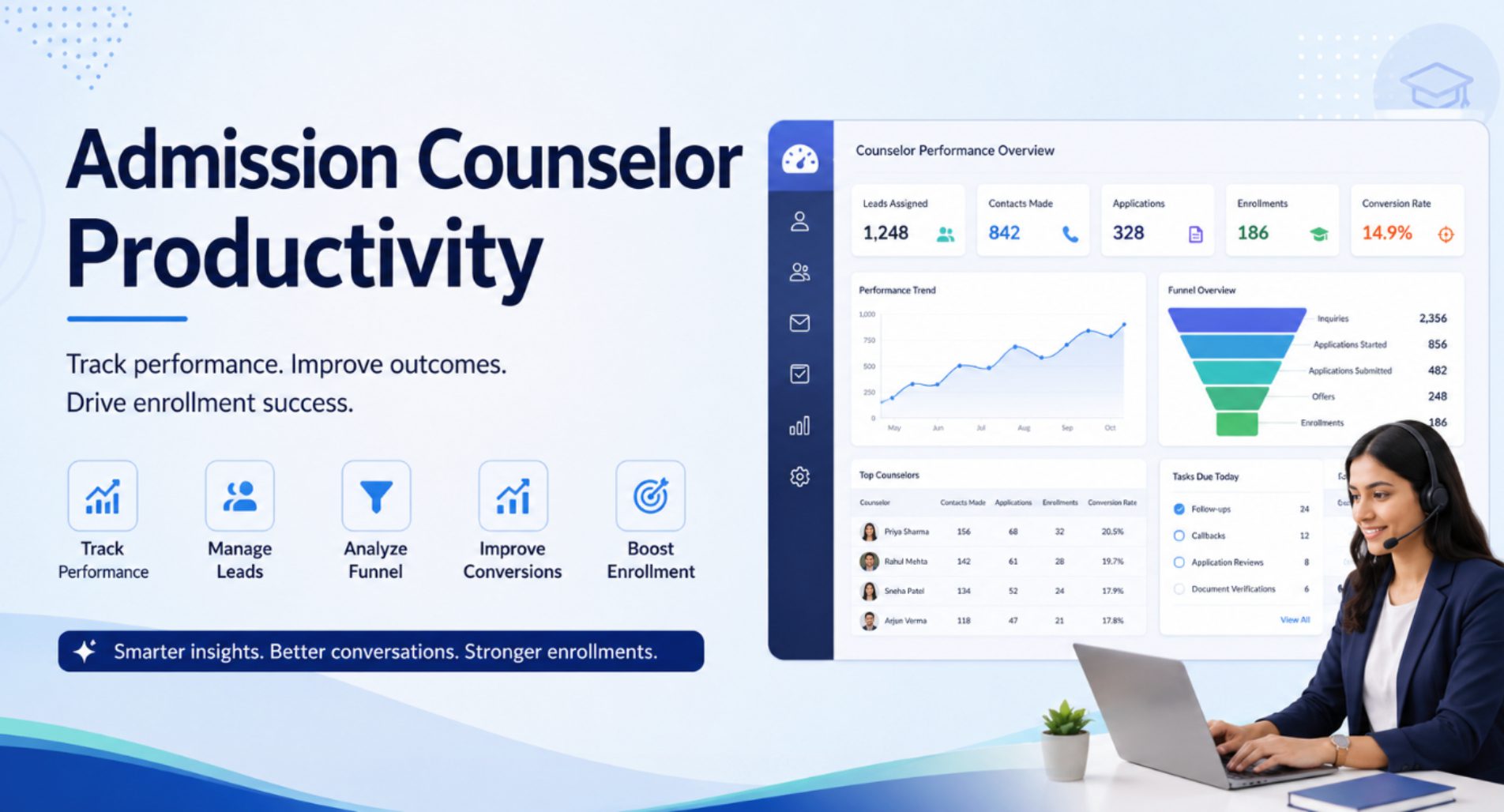
A counselor performance dashboard gives admission managers a consolidated view of individual and team performance.
It can display metrics such as leads assigned, leads contacted, follow-ups completed, applications generated, conversions achieved, and pending activities.
Instead of waiting for weekly reports, managers can monitor performance as the enrollment cycle progresses.
Dashboards also make comparisons more meaningful. A manager can compare counselors working within similar programs, regions, lead sources, or admission stages rather than evaluating everyone using the same isolated activity target.
A useful dashboard should allow managers to move from a summary metric to the underlying student records. This helps them understand why performance is improving or declining instead of looking only at totals.
2. Lead Assignment and Ownership Tracking
Counselor performance cannot be measured accurately without clear lead ownership.
A lead assignment tool records which counselor received each inquiry, when it was assigned, whether it was reassigned, and how quickly the counselor acted on it.
This prevents ambiguity around accountability.
Institutions can use automated assignment rules to distribute leads based on factors such as program, campus, location, language, counselor availability, or workload. Round-robin allocation can also help distribute opportunities more evenly.
With transparent assignment data, managers can distinguish between low productivity and workload imbalance. A counselor handling a larger volume of complex applications should not be evaluated in the same way as someone managing a smaller or less complex lead pool.
3. Lead Scoring and Prioritization Tools
Not every student inquiry has the same likelihood of converting.
Lead scoring helps counselors identify opportunities that require immediate attention. Scores may be influenced by student activity, profile completeness, communication engagement, application progress, program interest, and other behavioral or demographic factors.
This allows managers to evaluate whether counselors are acting on the right opportunities.
For example, a counselor may complete many follow-ups but still miss students who have repeatedly visited the application portal, opened communications, or started an application. Lead prioritization tools make such intent signals visible.
Productivity can then be measured not only by how much work a counselor completes, but also by how effectively they prioritize high-potential students.
4. Communication Tracking
Student conversations often happen across calls, email, SMS, WhatsApp, and other communication channels.
A communication tracking tool records these interactions against the student profile. It can show messages sent, calls attempted, responses received, campaign engagement, and the outcome of each interaction.
This helps institutions measure important indicators such as:
- First response time
- Contact rate
- Average follow-up frequency
- Student response rate
- Communication channel effectiveness
- Time since the last interaction
Communication logs also provide context.
A low conversion rate may not always indicate poor counselor performance. Students may be unreachable, ineligible, unresponsive, or no longer interested. Structured communication outcomes help managers separate these cases from opportunities that were lost because of delayed or inconsistent follow-ups.
5. Follow-Up and Task Management Tools
Admissions involve multiple commitments made during student conversations.
A counselor may need to share program information, verify a document, schedule a callback, explain a fee structure, or remind a student to complete an application.
Follow-up tools help counselors schedule these actions and receive reminders before they become overdue.
Managers can track follow-up completion rates, overdue tasks, upcoming activities, and the number of students without a planned next action.
This is one of the clearest indicators of process discipline.
A counselor may have strong communication skills but still lose opportunities because follow-ups are not completed on time. Task and calendar tools make these gaps visible before they affect enrollment numbers.
6. Application Funnel Analytics
The primary objective of admission counseling is to move students through the enrollment funnel.
Application funnel analytics show how many students progress from inquiry to application, submission, payment, verification, offer, and enrollment.
Managers can evaluate counselor performance using stage-level movement rather than relying only on final enrollment numbers.
Useful metrics include:
- Inquiry-to-application conversion
- Application initiation rate
- Application completion rate
- Application fee payment rate
- Offer-to-enrollment conversion
- Average time spent at each stage
- Number of inactive or stalled applications
Stage-level analytics also help identify where support is required.
A counselor may generate a high number of applications but have a low completion rate. Another may convert fewer inquiries into applications but maintain strong application-to-enrollment performance. These patterns can guide more specific coaching and process improvements.
7. AI-Powered Counselor Insights
AI can help admission teams interpret the large amount of data available inside student profiles.
Instead of requiring counselors to manually review every interaction, AI-powered tools can summarize the student journey, identify conversion signals, highlight risks, and recommend the next action.
This makes counselors more productive before and during student conversations.
AI insights can also support managers by identifying recurring performance patterns. For example, they may reveal that a counselor frequently delays follow-ups, overlooks high-intent students, or needs support handling a particular objection.
The objective is not to replace counselor judgment. It is to give counselors better context and help managers provide more relevant coaching.
8. Interaction Capture and CRM Data Quality Tools
Performance analytics are only reliable when counselors consistently record student interactions.
However, requiring users to update multiple CRM sections after every conversation creates unnecessary administrative work. Important notes may be delayed, incomplete, or missed altogether.
Smart interaction capture tools allow counselors to update lead details, opportunities, follow-ups, activities, and conversation outcomes from one place.
This reduces data-entry effort while improving the completeness of counselor performance data.
Accurate CRM data gives managers a clearer picture of what counselors are doing, what students need, and which actions are influencing conversion.
Key Metrics for Measuring Counselor Productivity
No single metric can accurately represent counselor performance. Admission offices should use a balanced set of activity, efficiency, engagement, and outcome indicators.
Lead Response Time
Lead response time measures how quickly a counselor contacts a student after an inquiry is assigned.
A delayed first response can reduce the likelihood of meaningful engagement, particularly when students are exploring multiple institutions.
Contact Rate
Contact rate shows the percentage of assigned students with whom the counselor successfully establishes communication.
It helps differentiate between activities attempted and actual student conversations.
Follow-Up Completion Rate
This measures the percentage of scheduled follow-ups completed within the expected time.
A high follow-up completion rate indicates process consistency and stronger control over the counselor’s pipeline.
Application Initiation Rate
Application initiation rate measures how many contacted or qualified students begin an application.
It helps determine whether counselor conversations are generating sufficient intent and action.
Application Completion Rate
This metric tracks how many initiated applications are successfully submitted.
It is especially useful for identifying counselors who effectively help students overcome documentation, payment, or process-related barriers.
Lead-to-Enrollment Conversion Rate
This is calculated as:
Number of enrolled students ÷ Number of assigned or qualified leads × 100
Institutions should clearly define whether the calculation uses all assigned leads, contacted leads, or qualified leads. Using the same definition across the team is necessary for fair comparison.
Average Conversion Time
Average conversion time measures how long it takes a counselor to move a student from inquiry to a defined outcome.
A shorter conversion time can indicate stronger follow-up and decision support, although institutions should account for program complexity and admission timelines.
Pipeline Movement
Pipeline movement measures how many students move from one enrollment stage to the next during a defined period.
It provides an earlier indication of performance than waiting for final enrollment numbers.
Data Update Compliance
This measures how consistently counselors update student records, interaction notes, outcomes, and next actions.
Good CRM discipline improves collaboration, reporting accuracy, and the continuity of the student experience.
How to Calculate an Admission Counselor Productivity Score
Institutions can create a weighted productivity score using metrics aligned with their admission priorities.
For example:
Counselor productivity score =
- 20% response and contact performance
- 20% follow-up completion
- 20% application movement
- 30% enrollment conversion
- 10% CRM data quality
The exact weighting should depend on the counselor’s role and the stage of the admission cycle.
During the early inquiry period, response time and contact rate may carry more weight. Closer to application deadlines, application completion and enrollment conversion may become more important.
Institutions should also account for:
- Lead quality
- Program demand
- Geographic market
- Intake period
- Counselor experience
- Lead volume
- Student eligibility
- Average application complexity
A productivity score should support better decisions, not reduce counselor performance to an isolated number.
How Meritto Helps Track Counselor Productivity
Meritto brings student data, communication history, application activity, and counselor actions into one enrollment platform.
Managers can use dashboards and reports to monitor assigned leads, pending follow-ups, student movement, application progress, and counselor-level conversions.
Lead assignment and reassignment capabilities help institutions distribute opportunities based on workload and business rules. Lead scores and engagement signals help counselors prioritize students who are more likely to move forward.
Inside the lead profile, counselors can access student details, timelines, communication logs, engagement information, application activity, follow-ups, and notes without switching between disconnected tools.
Mio AI Coach further analyses the student journey to surface intent, conversion readiness, risk level, and recommended next actions. This helps counselors start each conversation with better context.
Smart Capture allows counselors to update lead information, opportunities, activities, and follow-ups through one intelligent form after a student interaction. This reduces administrative effort and improves the quality of performance data available to managers.
Together, these capabilities help admission offices move beyond activity tracking and evaluate how effectively counselors contribute to student progression and enrollment outcomes.
Best Practices for Evaluating Counselor Performance
Counselor performance should be reviewed regularly, but not only at the end of an admission cycle.
Managers should combine real-time monitoring with weekly or monthly performance discussions. These reviews should focus on the reasons behind the numbers and the actions required to improve them.
Institutions should avoid using call volume as the primary productivity metric. High activity does not always translate into high student engagement or conversion.
Performance benchmarks should also remain contextual. Counselors should ideally be compared with peers managing similar programs, lead types, regions, and funnel stages.
Most importantly, productivity data should be used for coaching rather than surveillance.
When counselors can clearly see their pipeline, pending actions, and conversion gaps, they are better equipped to manage their work. When managers have access to the same context, they can provide timely and specific support.
Measure the Work That Moves Students Forward
The most effective admission offices do not evaluate counselors only by how busy they appear.
They measure whether students receive timely responses, relevant guidance, consistent follow-ups, and the support required to complete their enrollment journey.
CRM dashboards, lead scoring, communication tracking, follow-up tools, application analytics, and AI-powered insights give institutions a more complete view of counselor productivity.
With the right tools, admission managers can identify performance gaps earlier, coach counselors more effectively, balance workloads, and focus the team on actions that contribute directly to enrollment.
Meritto helps institutions connect counselor activity with student engagement, application progress, and enrollment outcomes—all within one unified student enrollment platform.
Frequently Asked Questions
What is the best way to measure admission counselor productivity?
The best approach is to combine activity metrics with student outcome metrics. Institutions should evaluate response time, contact rate, follow-up completion, application movement, conversion rate, and CRM data quality rather than relying only on calls made or leads handled.
Which tools can track admission counselor performance?
Admission offices can use student enrollment CRM dashboards, lead assignment systems, communication tracking tools, follow-up management, lead scoring, application funnel analytics, and AI-powered counselor assistance.
How is counselor conversion rate calculated?
Counselor conversion rate is generally calculated by dividing the number of enrolled students by the number of assigned, contacted, or qualified leads and multiplying the result by 100. Institutions should use a consistent lead definition across all counselors.
Why is call volume not enough to measure productivity?
Call volume measures activity but does not show whether students were contacted, engaged, moved to the next admission stage, or eventually enrolled. It should be evaluated alongside contact, application, and conversion metrics.
How can a CRM improve counselor productivity?
A CRM centralizes student data, communication history, follow-ups, application progress, and counselor activities. It reduces manual tracking, highlights priority opportunities, automates repetitive actions, and gives counselors clearer next steps.
How can admission managers use performance data?
Managers can use performance data to identify workload imbalances, delayed follow-ups, funnel bottlenecks, coaching requirements, high-performing practices, and opportunities to improve the overall admission process.
- Connected Intelligence: The Infrastructure Behind Institutional Agility

- More Data, But Less Insight? Inside the Intelligence Era of Education
- How universities can turn AI into real institutional impact
- Which CRMs Can Show Cost per Lead and Cost per Enrollment by Channel?
- How to Track Digital Marketing Agency Performance for Student Recruitment
- Admission Counselor Productivity: Tools to Track Performance Effectively