The short answer
AI is already reshaping how Malaysian universities attract, enrol, and support students. Yet the leaders on this episode argue its biggest value is not speed or automation. It is continuity: connecting a fragmented student journey into one intelligent view, from the first inquiry through enrolment, learning, and employability.
Artificial intelligence has stopped being a future topic in Malaysian higher education. It already shapes how institutions attract students, design programmes, and support learners. The harder question, the one this episode of The #EducationCircuitByMeritto set out to answer, is what happens when most universities are still navigating that shift in silos, without a single connected view of the student.
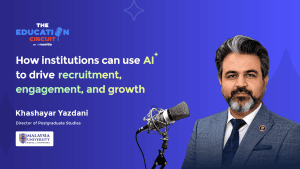
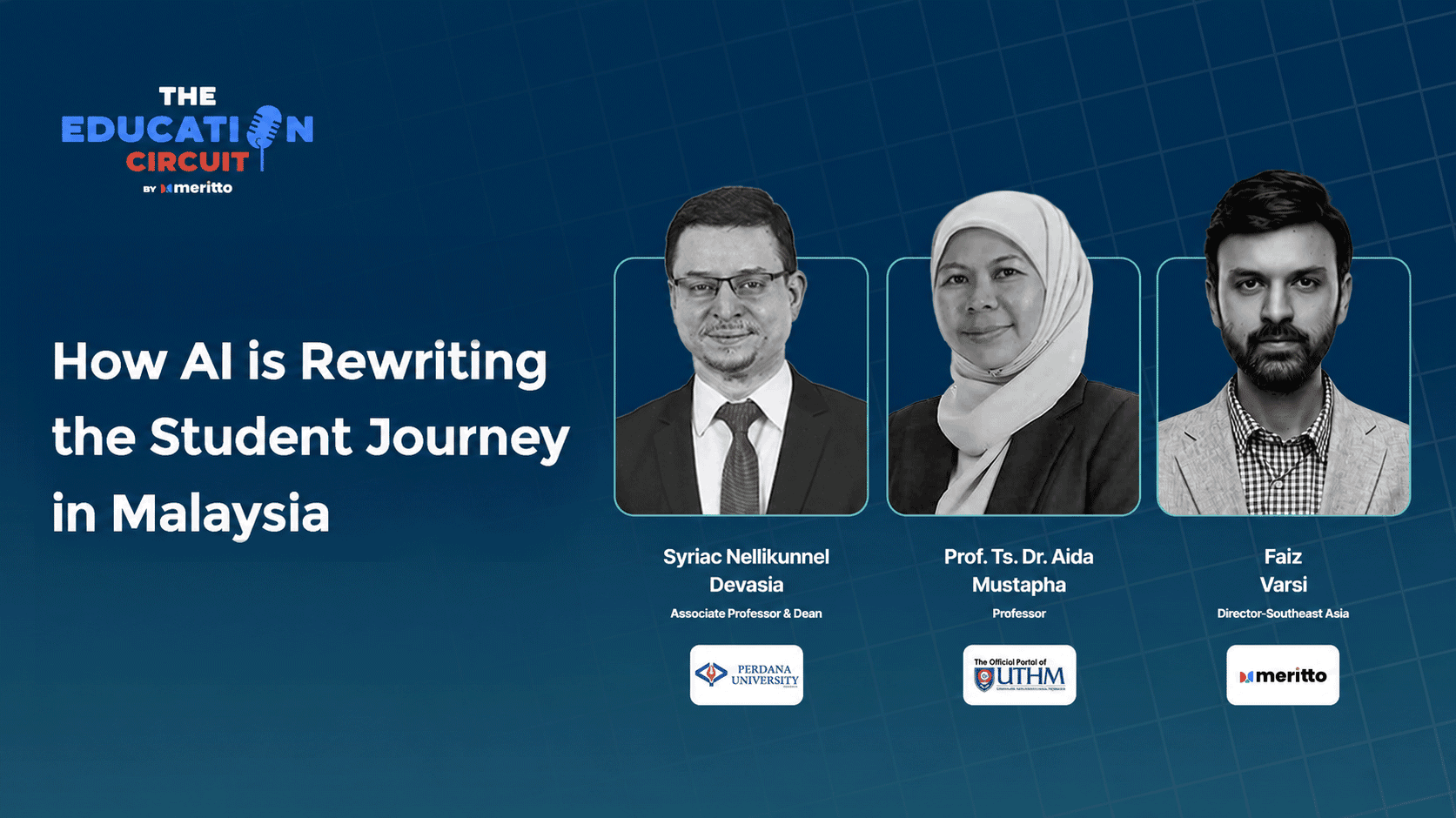
To unpack it, the show brought together two Malaysian education leaders and one enrolment practitioner. Dr. Syriac Nellikunnel Devasia is Associate Professor and Dean at Perdana University, with more than fifteen years inside Malaysian higher education. Prof. Ts. Dr. Aida Mustapha is a Professor at Universiti Tun Hussein Onn Malaysia and an artificial intelligence scholar whose work focuses on responsible AI adoption and AI as institutional infrastructure. Faiz Varsi, Director for Southeast Asia at Meritto, connected the strategic conversation to what it looks like in daily practice. Together they mapped the journey from two angles at once, the academic and the operational.
How are students in Malaysia choosing universities now?
Dr. Syriac opened with the change he has watched up close. A decade ago, prospective students leaned on brochures, education fairs, and word of mouth. Today the journey begins online, often on TikTok or Instagram, then moves to comparison portals, reviews, rankings, and campus tours on YouTube, all before a single form is filled.
“Students compare universities the way they compare smartphones. They check rankings, they check testimonials, and they even go for a TikTok campus tour.”
The most decisive shift, he noted, is who students trust. At Perdana University he saw a surge in MBA inquiries after alumni posted LinkedIn stories about their careers. It was not the glossy brochure that moved them, but relatable, authentic peer content. Students, he argued, now trust the voices of other students more than institutional advertising.
Why does the first interaction decide so much?
If discovery is digital and peer-led, the first direct contact carries enormous weight. Faiz Varsi framed it in terms students would recognise: they now expect the experience they get from Amazon or Netflix, instant, personalised, and available around the clock. An institution that takes hours or days to reply has often already lost that student to a faster competitor.
The point, he stressed, is not simply responding faster. It is making the first touchpoint a meaningful, personalised conversation. When a prospective student reaches out, the questions are specific: eligibility, curriculum, scholarships, placements, alumni outcomes. Answering them in a tailored way at that first moment is often what earns, or loses, the student’s trust.
Where is AI creating the most meaningful impact across the student journey?
Prof. Aida Mustapha reframed the whole question before answering it. The student journey, she argued, does not begin and end at admission. It runs across five stages: access, learning, assessment, belonging and development, and employability. Seen through that lens, AI is doing something more revealing than improving any single step.
“AI is not merely rewriting the student journey. It is actually exposing how fragmented the journey has always been.”
From there she named the two shifts that matter most. The first is from reactive to anticipatory support. Traditionally, universities help a student once that student asks, or once they fail a subject. AI can read patterns earlier, flagging declining participation or results before they become a crisis. The second shift is deeper, and it became the intellectual centre of the episode.
The Continuity Principle
AI’s most valuable contribution to the student journey is not automation, it is continuity. Its power grows when it connects the entire chain, learning, advising, well-being, and skills development, so students never have to restart their story inside isolated tools. As Prof. Aida put it, AI helps universities not only answer students faster, but understand them earlier and support them continuously.
That leads to a conclusion she stated plainly: the future student journey will not be defined by how many AI tools a university buys, but by how intelligently the institution redesigns the use of AI around the learner. The five stages give that redesign a shape.
- Access: Move from a standardised pathway to an adaptive one that reads each student’s readiness, pace, and aspiration.
- Learning: Personalise the experience continuously rather than treating every cohort as identical.
- Assessment: Shift from simple output to evidence of capability, gathered across projects, certifications, and industry problems from the first semester on.
- Belonging and development: Build capability visibly over time, so growth is tracked rather than assumed.
- Employability: Treat career readiness as continuous, not a final-year intervention, moving toward lifelong learning.
Can AI deliver personal attention at scale?
Scale is where good intentions usually break. An institution may field thousands of inquiries across programmes, campuses, regions, and channels, and Dr. Syriac was candid that meeting each one personally is one of the hardest problems in admissions. Today’s applicants want instant replies. A three-day wait, he said, feels like a lifetime to a generation that is often most active online well past midnight.
Basic chatbots help with routine questions but hit a wall on anything nuanced, defaulting to “I don’t understand” when a student asks about scholarship details or course comparisons. Overloading human staff simply moves the problem. The promising middle path he pointed to is more capable, agentic AI that can hold a real conversation and lighten the load without flattening it.
“With the right system, every student can feel heard, even at midnight.”
What changes for students and admissions teams when AI enters enrolment?
Faiz Varsi answered from Meritto’s vantage point across many institutions, and led with a distinction he was careful to make. AI, in this view, is an intelligent co-pilot for the admissions team, not a replacement for counsellors, enrolment officers, or marketers.
What changes, he explained, is that every student interaction becomes a source of insight. AI can read intent, gauge engagement, and recommend the next best action, so teams engage the right student at the right time with the right conversation instead of working in silos. It automates the repetitive load, follow-ups, lead qualification, and engagement tracking, which frees counsellors to spend less time on administration and more on the conversations that actually move a decision. The outcome he described is better conversion and a better student experience at once.
| Dimension | Isolated AI tools | A connected journey |
| View of the student | Fragments held in separate systems | One institutional intelligence across the journey |
| Mode of support | Reactive, triggered when a student asks or fails | Anticipatory, patterns read early |
| Primary value | Task automation at single points | Continuity across the whole chain |
| Role of staff | Overloaded or bypassed | Guided by insight, freed for real conversations |
| Data governance | Often unmanaged across tools | Consent, role-based access, human accountability |
What makes one connected view of the student so powerful, and where are the risks?
Prof. Aida called a connected view “one heck of a tool,” and explained why. Marketing knows a student’s interests, admissions knows their qualifications, academics know their performance, and student affairs knows their engagement. While those systems stay isolated, the university only ever sees fragments. Connect them, and fragmented data becomes institutional intelligence: leadership can decide what kind of graduate it wants to produce and work backward to the data that supports it.
She was equally clear that connection carries responsibility. A unified student view must not become surveillance. It calls for clear consent, proper data governance, role-based access, and firm policies on transparency and human accountability. Her formulation is worth keeping.
“The real power of AI is not about having more student data. It is about connecting the right data for the right purpose, under the right governance.”
How can AI support success and retention after enrolment?
Recruitment, Dr. Syriac reminded everyone, is only the beginning. The expectations set during recruitment have to be met once a student joins, through orientation, learning, engagement, progression, and retention. This is where he sees predictive analytics earning its place.
Many institutions still track student progress manually, or in scattered pieces across a learning management system. Pulled together, signals like attendance trends, learning management activity, quiz completion, and grades let AI predict who is drifting toward the at-risk category well before a term ends. For a lecturer following one small class, that intuition is manageable. For a lecturer facing two hundred students, he noted, it is nearly impossible without help, and an AI assistant handling the pattern detection makes the work far more humane.
The lighter side, as he put it, is personalised nudges: reminders about workshops and assignment deadlines, and suggestions about which electives suit a student’s career path. He reached for a familiar comparison. Think of the recommendations that greet you when you open Netflix, except tuned to an academic journey rather than a watchlist. Done well, those nudges keep students engaged and, ultimately, enrolled.
The bigger picture for Malaysian institutions
The conversation lands at a moment of real momentum. Malaysia’s National Education Plan for 2026 to 2035, launched in January 2026, deepens the country’s commitment to embedding AI and digital literacy across the system, from schools to universities. That national push makes the panel’s central caution more relevant, not less: adoption without a connected design simply digitises the fragmentation. Governance frameworks such as the Personal Data Protection Act give institutions a foundation for the consent and accountability Prof. Aida insisted on.
The throughline across three very different speakers was strikingly consistent. Students now behave like digital consumers and trust their peers. First impressions are made in seconds and expected around the clock. And the institutions that will pull ahead are not the ones that buy the most AI, but the ones that use it to connect a journey that has always been fragmented, responsibly, and with people still at the centre.
Listen to the full episode here
See a connected student journey in action
Bring recruitment, admissions, engagement, and retention into one connected view with Meritto’s enrollment platform.
About Meritto
Meritto is the Operating System for Student Enrollments. It is a unified, AI-powered, modular and automated platform purpose built for educational organizations enabling them to attract, engage, and enroll students. With it, educational organizations can automate the entire enquiry to enrollment process.
About Collexo
Collexo is a vertical SaaS-based embedded payments platform which operates as a unified suite for fee collections and payments. It has been built to automate and streamline the entire fee collection process, from fee payments to reconciliation and invoicing. It is integrated with payment gateways as a software provider on top of licensed payment partners. We empower educational organizations to build various workflows, receipts, automations, and student journeys.
About Mio AI:
Mio AI acts as the core layer that powers both student engagement and team performance, with a suite of purpose-built intelligent agents embedded across the platform. With it, your students get faster, smarter engagement, and your teams get an AI-powered co-pilot that makes every hour more productive.
Mio AI Guide acts as an always-on, multilingual chat agent that assists students with instant, context-aware responses across your website and enrollment portals, from program queries to application support. Mio AI Voice takes it further with autonomous, human-like calling that qualifies inbound leads, re-engages dormant inquiries, and moves students forward, saving your counseling team hours of manual outreach.
About #EducationCircuitByMeritto
#EducationCircuitByMeritto is Meritto’s thought-leadership podcast series that brings forward honest, high-impact conversations with education leaders shaping the future of the industry. From shifting student expectations to smarter recruitment and enrollment strategies, each episode dives into the real challenges institutions face today.
FAQs: What’s new at Meritto
Students now behave like digital consumers. They begin online, often on TikTok, Instagram, or comparison portals, and they weigh rankings, reviews, and YouTube campus tours before ever filling out a form. They compare universities the way they compare smartphones, and they trust the voices of other students more than institutional advertising.
Prospective students expect instant, personalised replies at any hour, and an institution that takes hours or days to respond often loses them to a faster competitor. AI makes 24-hour engagement possible by handling routine questions immediately and holding a real conversation across channels like WhatsApp and social media.
AI is changing how students discover institutions, how quickly they expect to be answered, and how universities support them after enrolment. The deeper shift the panel identified is that AI is exposing how fragmented the student journey has always been, and its real value is continuity: connecting the journey from first inquiry through learning to employability, rather than adding isolated tools at single points.
No. AI works best as an intelligent co-pilot, not a replacement. It automates repetitive work such as follow-ups, lead qualification, and pattern detection, which frees counsellors and lecturers for the mentoring and meaningful conversations that only people can have.
By making support anticipatory instead of reactive. Predictive analytics can read signals like attendance, learning management activity, and grades to flag at-risk students early, so lecturers can step in before a term is lost. Personalised nudges about deadlines, workshops, and electives keep students engaged over time, which supports retention.
A unified view of the student must not become surveillance. Responsible use rests on clear consent, proper data governance, role-based access, and firm policies on transparency and human accountability. The point is connecting the right data for the right purpose, under the right governance.
Recommended Reads
- Connected Intelligence: The Infrastructure Behind Institutional Agility

- More Data, But Less Insight? Inside the Intelligence Era of Education
- How universities can turn AI into real institutional impact
- Which CRMs Can Show Cost per Lead and Cost per Enrollment by Channel?
- How to Track Digital Marketing Agency Performance for Student Recruitment
- Admission Counselor Productivity: Tools to Track Performance Effectively