Your admission agents bring students in. Why is your team still typing them in?
Consider how a typical agent referral reaches an admissions team.
An agent shares a list of interested students over WhatsApp or email. Someone at the institution creates the leads in the CRM. Someone else checks whether the right admission agent has been assigned. And if the same student has already enquired through another channel, there’s another round of verification.
The student is interested. The agent has done their part. But the institution is still doing the administrative work of getting that student into its admissions system.
Here’s the distinction that matters: agent-wise attribution isn’t new. Institutions have been tracking agent referrals for years. What’s overdue is a better way for those referrals to enter the enrollment journey.
And as institutions expand their student recruitment networks, that operational gap deserves far more attention.
The bottleneck isn’t the agent. It’s what happens after the referral.
Admission agents play an important role in connecting institutions with prospective students, particularly across different geographies, programmes, and international markets.
Their relevance is well established. ICEF’s Agent Voice 2025 research, which gathered responses from 1,225 agents across 113 countries, reflects the scale and diversity of the international student recruitment ecosystem.
Yet the process connecting an agent to an institution’s admissions system often remains surprisingly manual.
The issue isn’t necessarily a lack of technology. Many institutions already have an education CRM, application platform, and mechanisms for recording agent attribution.
The issue is that these systems don’t always receive the student directly.
Instead, an agent referral becomes a task for somebody else to complete.
That creates three avoidable problems.
First, teams spend time entering information they shouldn’t need to enter. Student details move from an agent’s message or spreadsheet into the CRM, adding another administrative step before the admissions team can work on the enquiry.
Second, attribution depends on manual action. If Agent Codes are added or updated by different people, the institution must ensure that the right agent remains associated with each student.
Third, acquisition information can become disconnected. The institution may know which agent brought a student but still need to connect that referral with the correct source, medium, and campaign.
These may look like small inefficiencies individually. Across a growing agent network and multiple admission cycles, they create unnecessary work and make consistent tracking harder to maintain.
The better question isn’t simply whether an institution can track its agents.
It’s how much work it takes to keep that tracking accurate.
What if the student entered the system directly?
Think about how students register through an institution’s website or campaign landing page.
They open a link, enter their details, and begin the admission process themselves.
Why should a student referred by an admission agent need a completely different process?
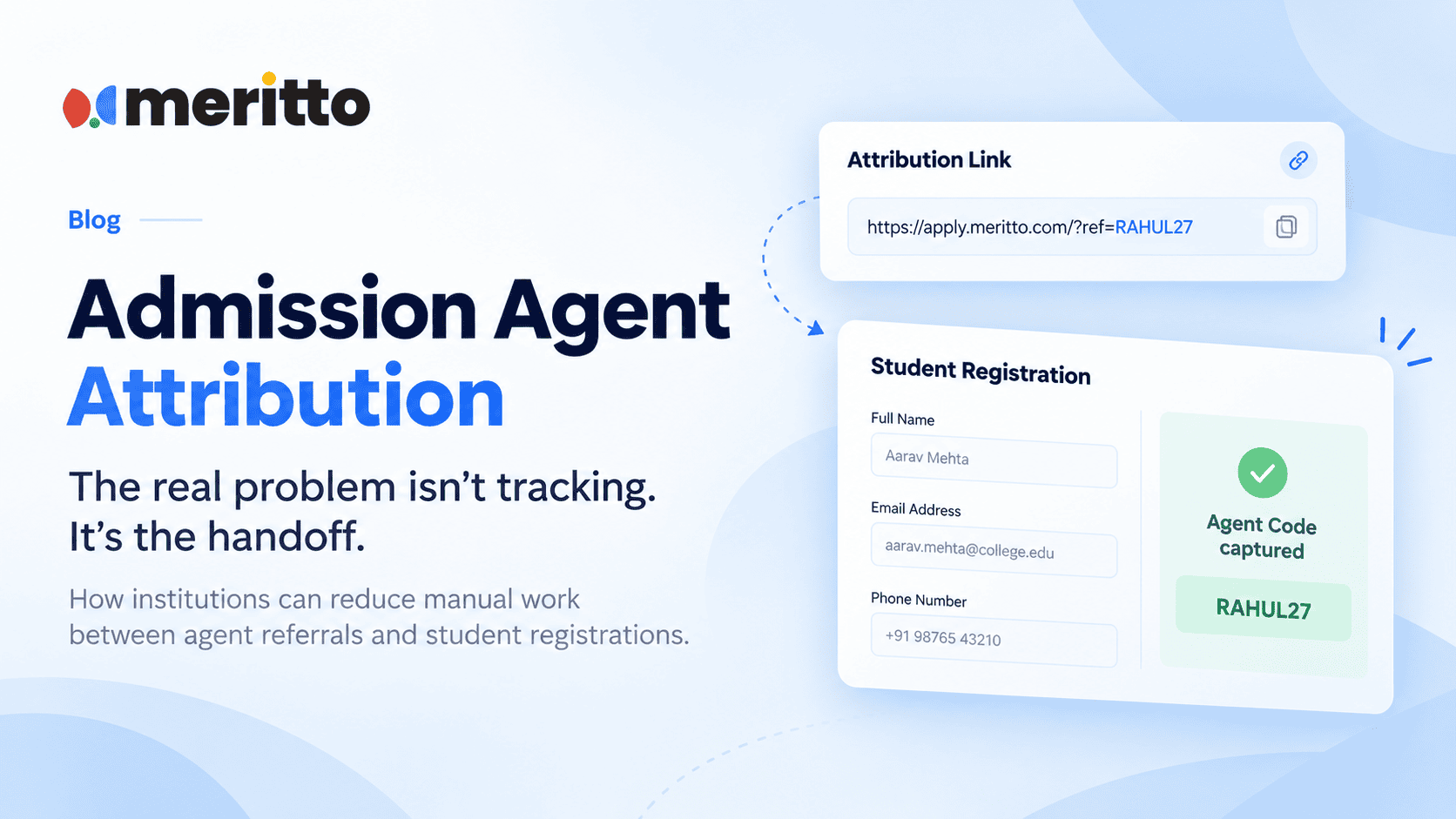
With unique agent registration and application links, institutions can remove much of that manual handoff.
The process is straightforward:
- The institution creates an admission agent and assigns a unique Agent Code.
- The agent receives a registration or application link associated with that code.
- The agent shares the link with prospective students.
- Students register or apply directly, and the institution’s admissions system automatically captures the Agent Code.
The difference is simple but important.
Instead of an agent sending student details to be entered later, the student becomes part of the institution’s enrollment journey directly.
The agent’s attribution is captured as part of that registration, rather than being added through a separate manual step.
This doesn’t eliminate the need for admission agents or counsellors. It removes an administrative handoff that neither should have to manage.
And it gives institutions a more consistent starting point for lead management, application follow-ups, and student engagement.
Good attribution should answer three different questions
When institutions discuss student acquisition, several questions often get grouped under the broad label of attribution.
But they’re not the same question.
Who brought the student?
This is the agent attribution question. The institution needs to know which admission agent is associated with a student’s registration or application.
Where did the student come from?
This is the acquisition question. The institution needs visibility into the source, medium, and campaign associated with that registration.
Who is responsible for the next step?
This is the operational question. The admissions team needs to know who should engage the student, manage follow-ups, and move the application forward.
An institution may have answers to all three, but those answers need to remain connected without being confused with one another.
For example, a student might discover a programme through an online campaign, speak with an admission agent, and later complete a registration.
The agent relationship and the student’s marketing source aren’t necessarily interchangeable.
This is why agent attribution should work alongside broader campaign tracking and source attribution, rather than sitting in a separate spreadsheet.
When agent details and acquisition information are connected within the same system, institutions have a more useful foundation for understanding how students enter and progress through their enrollment journey.
Automatic attribution is useful. Protected attribution is equally important.
Removing manual entry is only one part of improving agent-led admissions.
The other part is making sure the attribution remains reliable as students interact with multiple people and channels.
Consider a student who registers through one agent’s link and later receives another agent’s link.
Should that second interaction automatically replace the original attribution?
Or consider an existing student record that already has an agent associated with it.
Should a new link change the original Agent Code?
These aren’t merely technical questions. They affect how institutions manage partner relationships and how confidently agents can rely on the institution’s records.
A well-designed attribution process needs clear rules about when attribution is captured, whether existing attribution can change, and how long attribution remains applicable.
It also needs appropriate access controls, so agents can work with the students attributed to them without gaining unnecessary visibility into other students.
The importance of responsible agent relationships extends beyond operational efficiency. The British Council’s guidance for education providers working with agents reflects a broader industry focus on strengthening partnerships and improving quality across international recruitment.
Automation cannot replace an institution’s recruitment policies or partner governance.
But it can make those policies easier to apply consistently.
Attribution tells you who brought the student. Performance tells you what happened next.
There’s another distinction institutions need to make.
Knowing which agent is associated with a registration is useful. But that alone doesn’t establish the overall value of the agent relationship.
An agent might generate a large number of enquiries, but how many are genuine prospects? How many students start applications? How many complete them? And how many eventually enroll?
These are different measures of performance.
The distinction matters because lead volume and enrollment contribution aren’t the same thing.
Meritto’s Enrollment Index 2026, based on 4.3 crore aggregated student inquiry journeys, found that higher lead volume does not necessarily translate into better conversion efficiency across acquisition channels.
The report also found that institutions responding to enquiries on the same day converted at twice the rate of those responding after a week.
These findings aren’t specific to agent referrals, but they underline a broader enrollment lesson: generating interest is only the beginning. What happens after an enquiry enters the system matters enormously.
For agent-led admissions, this creates two priorities.
The first is capturing registrations accurately and without unnecessary manual work.
The second is connecting those registrations to subsequent student movement, so institutions can evaluate recruitment quality rather than relying only on the number of leads attributed to an agent.
A reliable Agent Code is the starting point for that analysis. It isn’t the entire analysis.
It records a referral relationship; it doesn’t, by itself, prove that the agent was the sole reason a student enrolled.
Institutions that understand this distinction are better positioned to evaluate partner performance fairly and make more informed recruitment decisions.
Bringing agent-led admissions into one connected system
This is the thinking behind Agent Attribution in Meritto.
Instead of depending on teams to manually create leads and tag agents after a referral, institutions can give each admission agent a unique Agent Code and registration or application link.
When students register or apply through these links, Meritto automatically captures the corresponding Agent Code.
The capability also allows institutions to:
- Protect existing attribution, preventing previously captured Agent Codes from being overwritten.
- Control attribution duration, defining how long agent attribution applies to leads and applications.
- Provide agent-specific visibility, allowing agents to see only students attributed to them and add individual leads manually when needed.
- Connect acquisition details, capturing associated source, medium, and campaign information in Campaign Manager.
These capabilities work within Meritto’s broader Education CRM, where institutions manage student enquiries, admissions activity, campaign attribution, and enrollment workflows.
The goal isn’t to introduce admission agent tracking for the first time.
It’s to reduce the effort involved in doing it consistently.
The institution knows which admission agent is associated with each registration. The agent can work with the students attributed to them. And the admission team no longer needs to manually recreate every agent-sourced lead.
Before your next admission cycle, question the handoff
Institutions spend considerable effort recruiting admission agents, expanding partner networks, and improving the volume and quality of student referrals.
But improving the partner network is only part of the equation.
The process that connects those partners to the institution’s admissions system deserves the same attention.
How are referrals entering the CRM today? Who creates the lead? When is agent attribution captured? What happens when a student has already registered? And how easily can the institution connect agent-sourced registrations to its broader acquisition data?
The answers reveal whether an admission agent-led admission process is genuinely scalable or simply supported by more administrative work.
Your agents should be bringing students in. Your team should be helping those students move forward.
The systems connecting them should take care of the rest.
Explore how Meritto’s Education CRM helps institutions automate agent attribution and manage student recruitment in one connected system.
Frequently Asked Questions
What is admission agent attribution?
Admission agent attribution is the process of associating a student enquiry, registration, or application with the admission agent responsible for the referral. It helps institutions identify which agent brought a student and manage agent-led admissions more consistently.
How can institutions automate agent referral tracking?
Institutions can provide admission agents with unique registration or application links associated with their Agent Codes. When students register through these links, the system captures the corresponding Agent Code automatically, reducing the need for manual lead creation and attribution updates.
Why is Agent Code protection important?
Students may interact with multiple agents or acquisition channels during their admission journey. Protecting existing Agent Codes helps prevent previously recorded attribution from being overwritten and supports more consistent agent records.
Can agent attribution be connected to marketing campaign tracking?
Yes. In Meritto, institutions can associate source, medium, and campaign information with agent-led registrations and capture that information in Campaign Manager. This helps connect agent referrals to broader acquisition tracking.
Does automatic agent attribution replace agent performance management?
No. Automatic attribution establishes a more reliable record of which agent is associated with a student. Evaluating agent performance still requires institutions to examine the quality of referrals, application progression, enrollments, and other relevant outcomes.