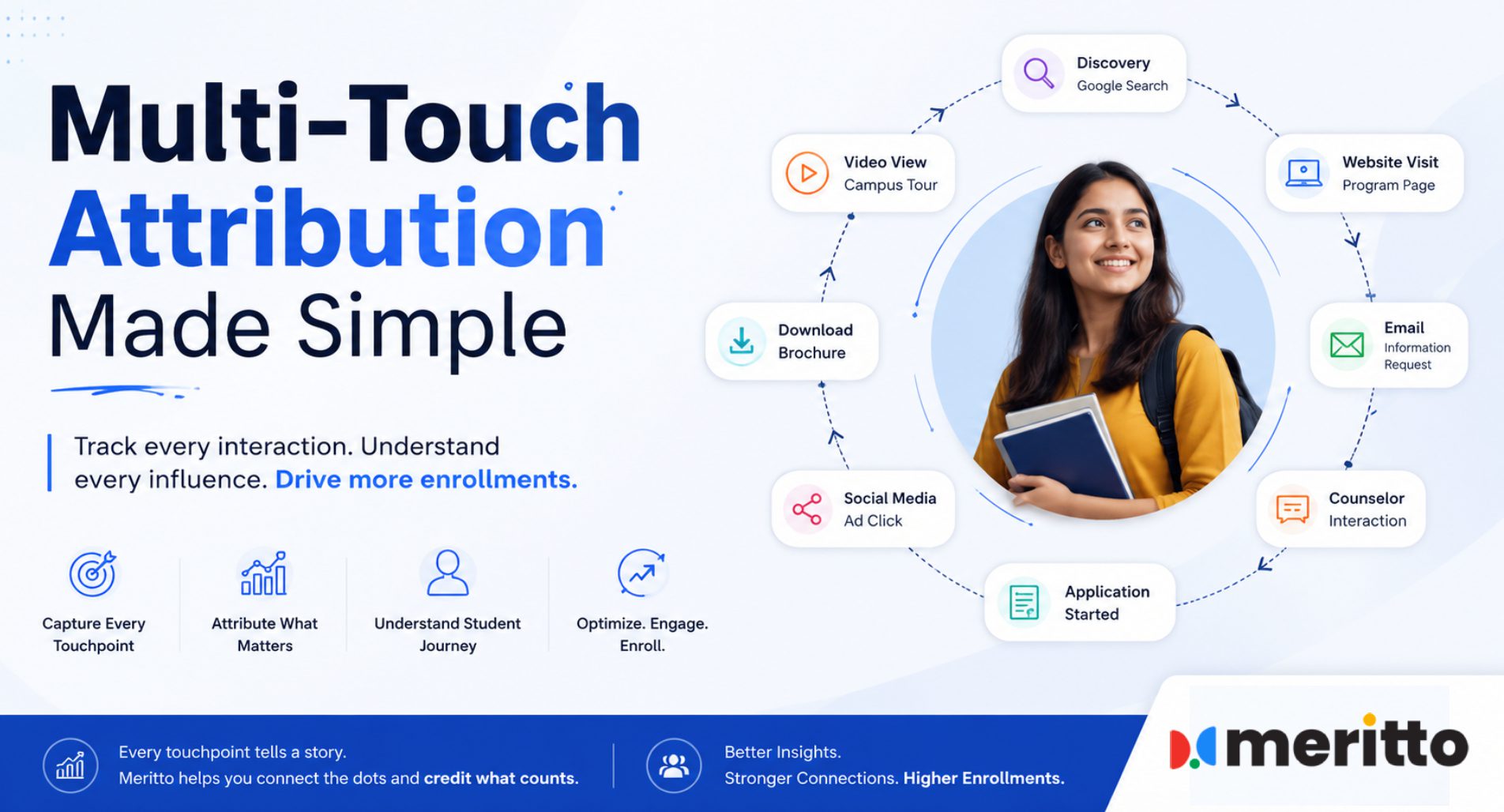
A student’s decision to enroll rarely traces back to one touchpoint. It’s usually a sequence: an Instagram ad that first surfaced the institution, an SEO blog read weeks later, a WhatsApp conversation with a counsellor, and finally a form submitted after a friend’s referral. Multi-touch attribution is the practice of assigning credit across that sequence instead of crediting only the first or last interaction. The model a system uses to do this changes which channels look effective and which don’t, so it’s worth understanding the actual models before evaluating any platform.
The Standard Attribution Models, and What Each one Misses
First-touch attribution credits the very first interaction, the ad or search result that started the journey. It’s simple to calculate but overvalues top-of-funnel awareness channels and ignores everything that happened afterward to actually convert the lead.
Last-touch attribution credits whatever touchpoint came immediately before conversion, often a landing page click or a form submission. It’s the default in many basic CRMs because it’s the easiest to measure, but it systematically overcredits bottom-of-funnel channels like retargeting ads or direct search, while erasing the awareness-stage work that brought the student in originally.
Linear attribution splits credit equally across every touchpoint in the journey. It’s fairer than single-touch models but treats a passing ad impression the same as a 20-minute counsellor conversation, which rarely reflects reality.
Time-decay attribution weights later touchpoints more heavily than earlier ones, on the logic that interactions closer to conversion had more influence. This works reasonably well for shorter sales cycles but can undervalue the first touchpoint that created awareness in a long, multi-month admissions journey.
U-shaped and W-shaped attribution give extra weight to specific milestone touchpoints, typically first touch and the point of lead conversion (U-shaped), or first touch, lead conversion, and a later opportunity stage like application submission (W-shaped). These models were built for exactly this kind of long, multi-stage decision journey, which is why they show up more often in education and other considered-purchase categories than in e-commerce.
Algorithmic or data-driven attribution uses statistical modeling to assign credit based on actual observed patterns across many journeys, rather than a fixed rule. It’s the most accurate in theory but requires enough volume and consistent data to model reliably, which smaller institutions or narrower programs often don’t have.
Why the Admissions Journey Makes this Harder than Typical Marketing Attribution
A student’s path to enrollment often spans weeks or months, crosses multiple devices, and mixes digital touchpoints (ads, search, social) with offline ones (education fairs, walk-ins, a phone call from a counsellor) that don’t naturally generate the tracking data digital-only attribution models rely on. A model built purely for web analytics will miss the counsellor call entirely unless the CRM explicitly logs it as a touchpoint in the same timeline as the digital ones.
This is also where the payment and enrollment stage matters. Attribution stopping at “lead” or “application” tells you what generated interest, not what generated a paying, enrolled student, which is the number that actually matters for budget decisions. A channel that produces a large volume of applications that later fail to convert to payment looks strong under lead-based attribution and weak under enrollment-based attribution, and the two conclusions point to very different budget decisions.
There’s a related trap worth naming directly: attribution models can create the illusion of precision even when the underlying data is incomplete. A time-decay or algorithmic model applied to a dataset that’s missing half the offline touchpoints will still produce a confident-looking number, it just won’t be an accurate one. The model matters less than whether the touchpoint data feeding it is actually complete.
What to Check Before Relying on any Attribution Model
- Does the system log offline touchpoints (counsellor calls, event walk-ins, campus visits) in the same timeline as digital ones, or only what a marketing pixel can see?
- Which model does the platform default to, and can it be changed, since first-touch, last-touch, and multi-touch models will produce meaningfully different answers to “which channel is working”?
- Does attribution extend through to enrollment and payment, or stop at lead or application?
- Is credit assignment auditable, meaning can you see exactly why a touchpoint got the weight it did, rather than a black-box number?
Where Meritto Fits
Meritto’s attribution runs on a mutually exclusive model rather than a single first- or last-touch rule: it tags primary, secondary, and tertiary touchpoints for each lead as they occur, spanning both digital sources and offline ones like agent submissions and walk-ins, all within the same CRM record. The Mutually Exclusive Impact (MEI) score attached to each source tracks contribution through to application and enrollment, not just lead capture, so a channel’s reported impact reflects paying, enrolled students rather than raw inquiry volume.
- Connected Intelligence: The Infrastructure Behind Institutional Agility

- More Data, But Less Insight? Inside the Intelligence Era of Education
- How universities can turn AI into real institutional impact
- Which CRMs Can Show Cost per Lead and Cost per Enrollment by Channel?
- How to Track Digital Marketing Agency Performance for Student Recruitment
- Admission Counselor Productivity: Tools to Track Performance Effectively