Every institution has a version of this story. Marketing generates a strong volume of leads from a campaign. The admissions team works through them and finds a large share are unresponsive or unqualified. Marketing says the numbers were good. Admissions says the quality was not. Neither team has visibility into what the other is seeing, and enrollment targets become a point of friction rather than a shared goal.
This is not a personality problem or a management problem. It is a data architecture problem. When marketing and admissions operate in separate tools, or in the same tool but with no shared view of what matters, they cannot align on a common definition of what is working. The question of whether a campaign performed well does not have a single answer, because each team is measuring a different thing.
This blog looks at what genuine alignment between marketing and admissions actually requires, how it breaks down in practice, and how Meritto’s platform is built to close that gap.
Where Misalignment Actually Comes From
The separation between marketing and admissions is rarely intentional. It tends to accumulate through a series of practical decisions that each made sense at the time: a marketing team uses a campaign management tool that connects to Google and Meta, an admissions team uses a CRM to manage counselor follow-ups, and a shared spreadsheet sits between them as an uneasy compromise.
Each tool is doing its job. The problem is what falls between them.
Marketing sees leads. Admissions sees lead quality. A marketing team measuring campaign performance typically reports on lead volume, cost per lead, and channel attribution. An admissions team managing the same leads is categorising them by intent, responsiveness, and likelihood to enroll. These are different measurements of the same lead, and without a shared system, neither team sees the other’s view.
Counselor behavior is invisible to marketing. Marketing spends to generate leads and hands them to the admissions team. What happens next, which leads were followed up on, how quickly, which responded, which dropped off at the application stage, which enrolled, is data that lives inside the CRM and never makes it back to campaign planning. Marketing makes spend decisions based on volume and source, not on enrollment outcomes by source.
Attribution runs in only one direction. Standard source attribution tells marketing where a lead came from. It does not tell them that leads from one source enrolled at twice the rate of another, or that leads from a particular publisher had high volume but almost no application completions. Without enrollment-stage data feeding back into marketing planning, budget allocation is based on proxies rather than outcomes.
Management has no view across both. A head of admissions or a VP of marketing reviewing their own team’s reports sees their slice. A founder or management team trying to understand where the enrollment target stands has to reconcile two separate pictures, usually in a meeting room, usually at the wrong moment in the cycle.
What Alignment Actually Requires
Fixing this does not require weekly syncs or shared spreadsheets. It requires a platform architecture where marketing data and admissions data live in the same system and surface the same underlying student records. That means:
One database where every lead, from every source, has its full journey visible, from the first inquiry through application, counselor interaction, and enrollment or drop-off.
Marketing reporting that connects campaign spend to enrollment outcomes, not just to lead volume. A campaign that generated 500 leads but 2 enrollments looks very different from one that generated 200 leads and 40 enrollments, and a shared system is the only way to see that difference.
Admissions reporting that gives counselors and admission team leads visibility into pipeline health, follow-up rates, and conversion at each stage, with the ability to flag which sources are generating high-quality leads and which are not.
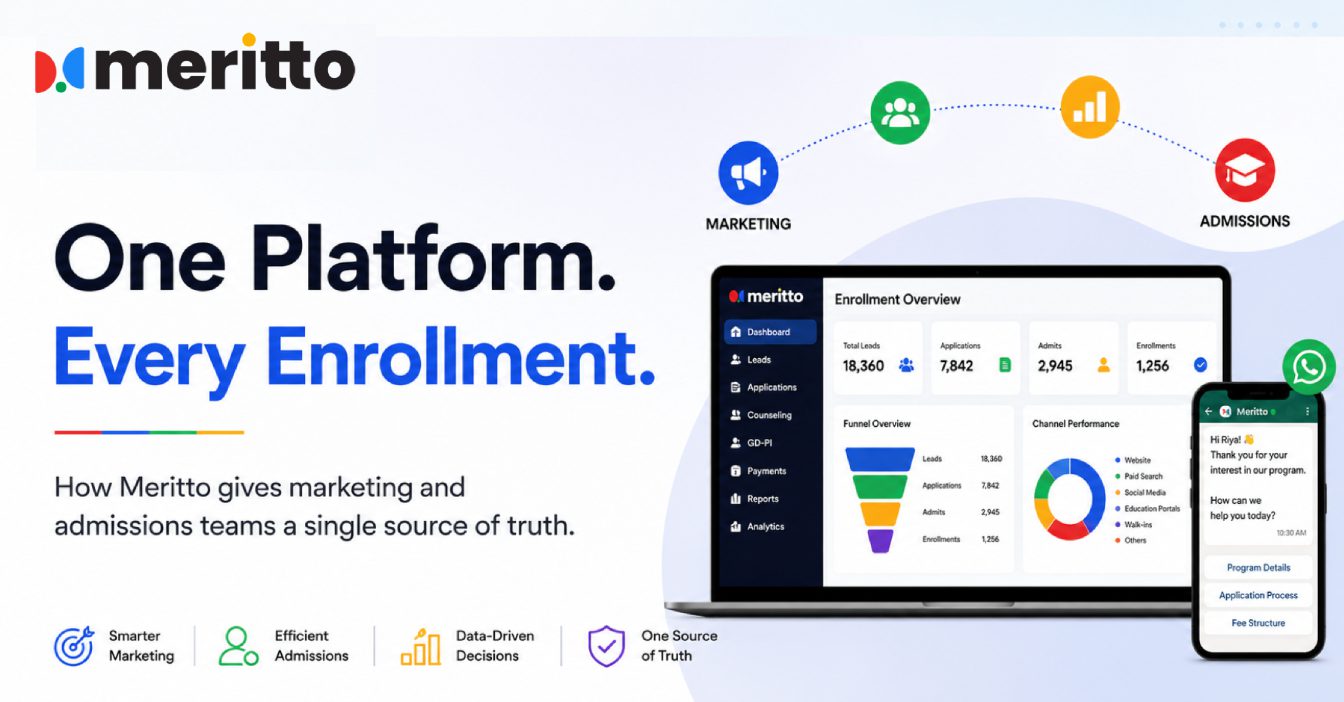
Management dashboards that show the enrollment funnel as a whole, from inquiry to enrollment, without requiring anyone to manually compile data from separate tools.
Closed-loop feedback where what happens at the admissions stage informs what marketing does next.
How Meritto Is Built for This
Meritto® is the AI-powered Operating System for Student Enrollments, purpose-built for education. For institutions working with multiple digital marketing agencies, Meritto connects campaign and source data with counselor activity, application progress, and enrollment outcomes, helping teams identify which agencies generate real student recruitment value, not just more inquiries.
Shared Enrollment Data From the First Touch
All incoming leads, regardless of source, are centralised through Meritto’s Lead Management System. Walk-ins, digital agencies, social media campaigns, website widgets, education fairs, and publisher APIs all feed the same pipeline. Marketing and admissions teams are not looking at different subsets of the same population. They are looking at the same data.
Three-tier source attribution (primary, secondary, and tertiary) captures where each lead came from and is non-editable, so attribution data cannot be altered after the fact. Both teams start from the same record of where leads originated.
What Marketing Needs: Campaign-to-Enrollment Visibility
Marketing teams using Meritto have access to a Campaign Management System that goes beyond tracking lead volume. The Campaign Manager shows:
Conversion rates from lead to enrollment, segmented by source and publisher, so marketing can see which channels are generating students, not just leads. Mutually Exclusive Impact (MEI) analysis that isolates the contribution of each lead source at every stage of the admission process. Publisher benchmarking that shows the full lead journey from each publisher, including quality metrics and downstream conversion. Cost per verified lead and cost per primary verified lead as accountability metrics for publisher and agency relationships.
This is the data marketing needs to make spend decisions based on enrollment outcomes rather than lead volume. A publisher generating high-volume, low-conversion leads is now visible. A channel that costs more per lead but produces enrollments at a higher rate is now legible.
Remarketing is also connected to CRM data directly. Meritto’s Strategic Remarketing connectors automatically update audience segments on Google and Facebook based on where leads are in the enrollment funnel. Students who started an application but did not complete it get a different remarketing message than students who have not engaged at all. Marketing campaigns respond to admissions pipeline data in real time, without any manual audience uploads.
For the Enrollment Marketing Team, the platform also provides a drag-and-drop email builder, drip marketing automation and workflow builder, and communication performance reports all connected to the same lead records the admissions team is working from.
What Admissions Needs: Pipeline Clarity and Counselor Accountability
Admissions teams in Meritto work from a complete view of their pipeline. Lead Nurturing gives counselors access to a one-view lead profile showing the complete engagement history, including source, communication log, application stage, and lead score and strength. They can see which leads have been touched and which have not, which are high-intent and which need further nurturing.
The Counselor and Sales Productivity Dashboard gives admission team leads real-time visibility into individual counselor performance: follow-up rates, conversion rates, response times, and stage-wise lead movement. Bottlenecks at a particular stage in the admission funnel become visible before they become missed targets.
For the Admission Teams specifically, Meritto provides a 360-degree central command for applications, advanced search and filtering across the application pool, and Application Reports and Analytics that let teams benchmark application numbers and identify the Student Quality Index by source.
What Management Needs: The Full Funnel in One View
The Reports and Analytics engine in Meritto is built specifically for management visibility across the complete inquiry-to-enrollment funnel.
The Reporting Engine supports 100+ vertical-specific dashlets that management can configure into custom dashboards without coding. Metrics can be drawn from leads, enrollments, payments, counselor performance, campaign attribution, and program-specific data. Pivot-style reports allow program-wise, source-wise, and locality-wise analysis. Comparative benchmarking lets management track performance against historical cycles.
For Management Teams, the key views are: real-time enrollment funnel health check, marketing campaign ROI optimisation in real time, timeline-based comparisons against historic data, and trend reporting across leads, applications, and communications.
Meritto explicitly describes this as “collaborative analytics” where all teams, whether management, marketing, finance, or student recruitment, take action from the same data source. That is the architecture shift that replaces the weekly alignment meeting.
The Publisher Panel: Holding Sources Accountable Jointly
One source of recurring friction between marketing and admissions is publisher quality. Marketing pays for leads. Admissions handles them. When quality is poor, the two teams often have very different accounts of what is happening.
Meritto’s Publisher Panel gives marketing teams direct visibility into publisher performance at every stage of the funnel, not just at the lead intake stage. It connects what marketing is paying for to what admissions is receiving, removing the information gap that usually produces the blame cycle.
What Changes When Both Teams See the Same Data
The practical effect of shared data across marketing and admissions is not just better reporting. It changes how decisions get made.
Marketing can optimize spend based on enrollment outcomes, not lead volume. When a channel consistently generates leads that drop off before application, that is visible. When a channel costs more per lead but converts at three times the rate, that is also visible. Budget allocation becomes an enrollment decision, not a volume decision.
Admissions can give marketing actionable feedback. When counselors see that leads from a particular source consistently have wrong contact information or show no intent, that observation is already in the same system where marketing reviews publisher performance. The feedback loop closes.
Management can set shared goals with shared metrics. An enrollment target is not just an admissions number or a marketing number. It is a funnel number. When both teams look at the same funnel, they can set and track a goal together.
Where to Start
For institutions where marketing and admissions are currently operating from separate tools or separate views of the same data, the most practical starting point is mapping exactly where the data gap sits.
Meritto’s Admission Management Software overview gives the full picture of how the platform connects the inquiry-to-enrollment funnel. The department-specific pages for Marketing Teams and Admission Teams show what each team sees from the shared platform. For institutions operating across multiple programs or campuses, the Reports and Analytics page covers the dashboarding and reporting capability directly.
To see how this works in practice for your institution’s team structure, schedule a demo.
Meritto is a product of NoPaperForms Solutions Limited. Trusted by 1,000+ educational organizations across India, the UAE, and Southeast Asia. Learn more at meritto.com.
- What’s new at Meritto: Our latest launches to turn more interest into admissions

- Admission Agent Attribution: The Real Problem Isn’t Tracking. It’s the Handoff.
- DPDP compliance for higher education: How universities move from policy to institutional practice
- The new growth playbook for higher education
- How Mio AI Voice helps institutions achieve enrollment outcomes at scale
- Connected Intelligence: The Infrastructure Behind Institutional Agility