When an institution evaluates an admission platform, security rarely leads the conversation. Features, pricing, and ease of use tend to dominate the demo. Security questions, if they come up at all, usually arrive late in the process, often after a procurement or IT review flags them.
This is a problem because the data moving through an admission platform is among the most sensitive an institution handles. Names, dates of birth, contact details, academic records, payment information, and identity documents all flow through these systems. The platform you choose to process this information is ultimately a trust decision.
This guide explains what security and uptime actually mean in the context of an admission platform, the standards that matter, and what institutions should verify before signing a contract. It also covers how Meritto, a purpose-built enrollment automation platform trusted by 1,000+ educational organizations across India, the UAE, and Southeast Asia, approaches each of these areas.
Why Admission Platforms Carry Specific Security Obligations
A generic understanding of cloud security is not enough when evaluating an admission platform. The data profile is fundamentally different.
Admission platforms process personally identifiable information (PII) at scale from multiple sources, including inquiry forms, uploaded documents, payment records, and counseling interactions. Unlike many business applications, this information is directly tied to identifiable students, many of whom are minors or young adults.
Institutions operating in India must consider the Digital Personal Data Protection (DPDP) Act. Those recruiting internationally may also need to comply with regulations such as GDPR in Europe or FERPA in the United States. Admission platforms serving institutions across multiple geographies should be prepared to support these requirements.
There is also a reliability consideration. Application deadlines, counseling campaigns, and fee payment windows create significant traffic spikes. Any downtime during these periods can disrupt admissions operations and impact institutional reputation.
The Security Standards Worth Evaluating
When assessing an admission platform vendor, institutions should evaluate five key areas.
1. Certifications and Independent Audits
Self-declared security claims are not the same as independently verified security practices. Certifications such as SOC 2, ISO/IEC 27001, and ISO 9001 demonstrate that external auditors have reviewed the vendor’s controls and processes.
SOC 2 evaluates a vendor across security, availability, processing integrity, confidentiality, and privacy. Institutions should also understand the difference between SOC 2 Type 1 and Type 2. Type 1 validates the design of controls at a specific point in time, while Type 2 evaluates whether those controls operate effectively over an extended period.
ISO/IEC 27001 focuses on information security management, while ISO 9001 addresses quality management systems. Together, these certifications indicate a structured approach to security and operational excellence.
2. Data Privacy Framework and Compliance Coverage
Institutions should understand which privacy regulations the vendor actively supports. DPDP compliance is important for Indian institutions, while GDPR readiness may be relevant for institutions handling international student data. Vendors should clearly explain how their policies and practices align with these frameworks.
3. Infrastructure and Operational Security Controls
Key questions include where data is hosted, who manages the infrastructure, and what safeguards are in place. Institutions should review the vendor’s approach to encryption, backups, disaster recovery, vulnerability management, and ongoing monitoring.
4. Access Control and Data Governance
Security extends beyond infrastructure. Institutions should evaluate how access is managed within the platform itself. Features such as role-based access control, multi-factor authentication, IP restrictions, audit logs, session tracking, and data masking help ensure that sensitive information is only accessible to authorized users.
5. Business Model and Data Usage Policies
A vendor’s business model can influence how data is handled. Institutions should ask whether customer data is sold, shared, monetized, or used for advertising purposes. Vendors whose revenue is based solely on service fees typically avoid the conflicts of interest associated with data monetization.
How Meritto Approaches Each of These Areas
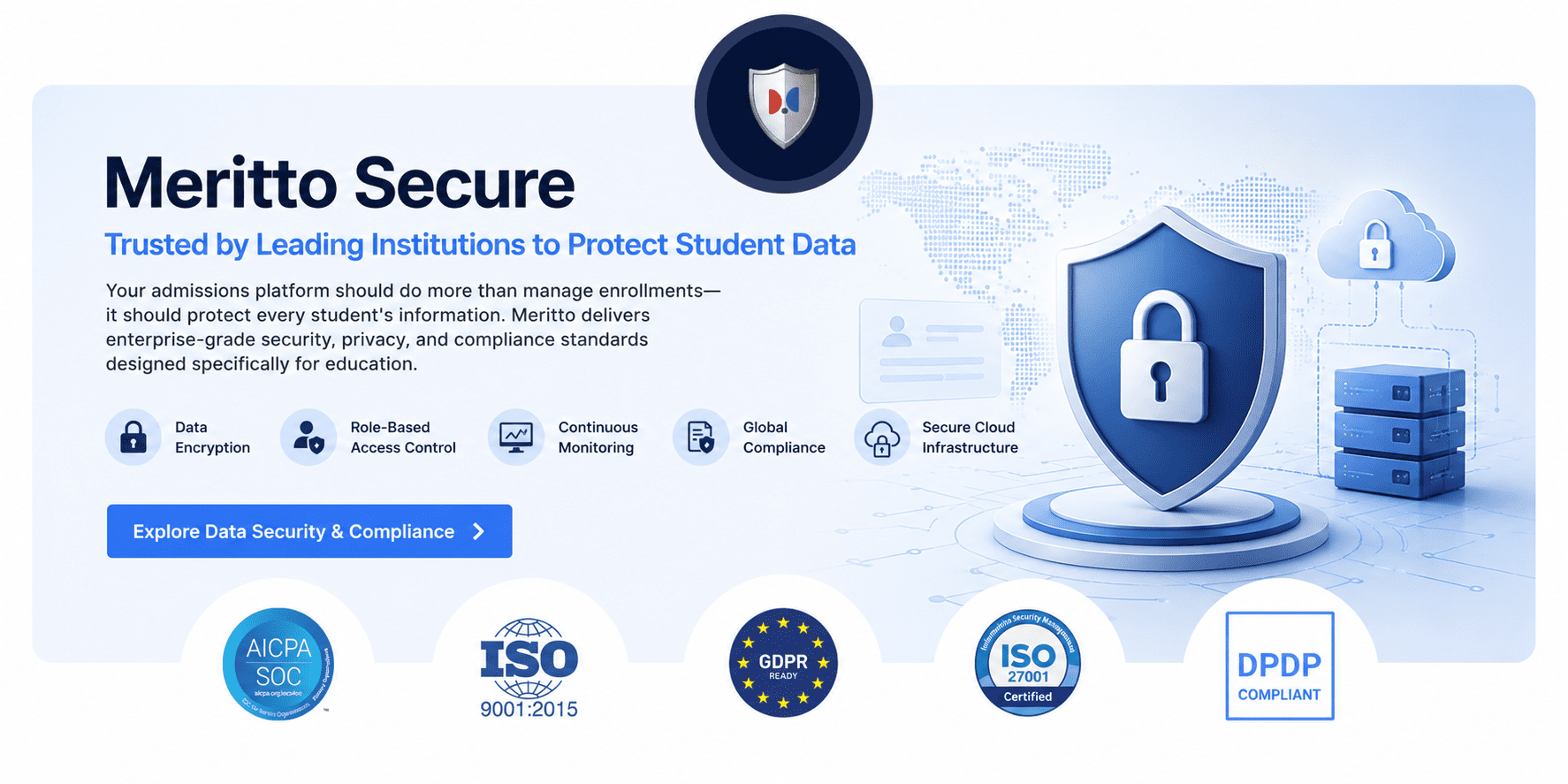
Meritto follows a structured security and compliance framework designed for educational institutions. Its approach includes independently verified certifications, secure cloud infrastructure, role-based access controls, privacy-focused data policies, and operational processes that support both security and platform reliability throughout the enrollment lifecycle.
Certifications and Independent Audits
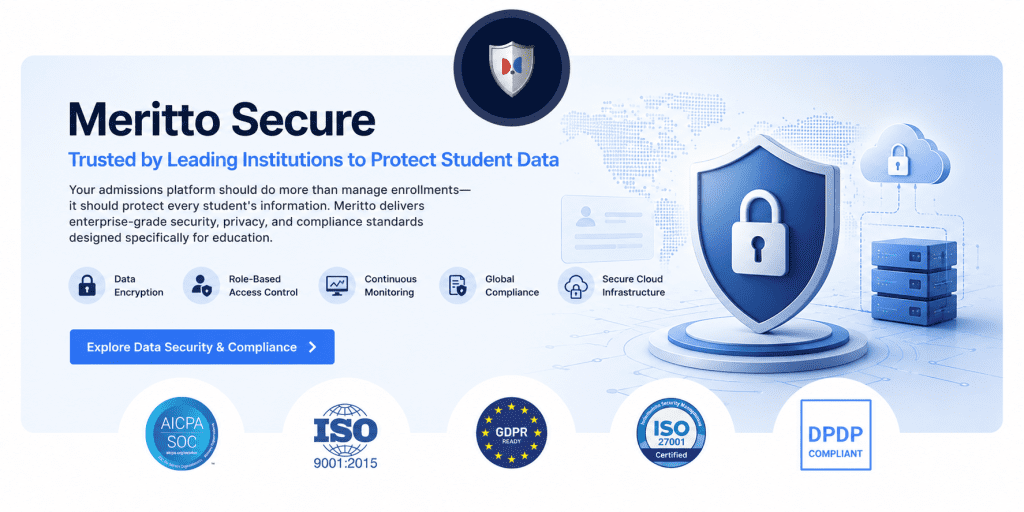
Meritto holds the following certifications, each independently verified and documented in its Trust Centre:
ISO/IEC 27001 for Information Security Management. This covers Meritto’s systematic approach to managing sensitive institutional and student data against unauthorised access and breaches, through a continuously maintained ISMS. Both the ISO/IEC 27001 and ISO 9001 pages state “Compliant” with a direct link to request certificates.
ISO 9001 for Quality Management Systems, establishing rigorous quality controls and continuous improvement processes across Meritto’s services.
SOC 2 Type 1 — Compliant. This validates that Meritto’s security controls are appropriately designed.
SOC 2 Type 2 — Ready. Meritto’s own documentation describes its status as “SOC 2 Type 2 Ready,” meaning the operational effectiveness assessment process is underway or in progress. Institutions with strict requirements for Type 2 confirmation should confirm current status directly with Meritto at the time of evaluation.
DPDP — Meritto has a dedicated compliance page for India’s Digital Personal Data Protection Act, covering consent management, data security, and privacy practices aligned with its requirements.
GDPR — Meritto has a dedicated GDPR page and describes itself as “GDPR Ready,” having taken active steps across its data protection strategy to align with GDPR principles including lawfulness, purpose limitation, data minimisation, accuracy, storage limitation, and integrity and confidentiality. Meritto’s documentation states it “has also acted on many fronts to adhere to GDPR.”

The precise language matters here. Where Meritto says “Compliant” (ISO/IEC 27001, ISO 9001, SOC 2 Type 1), that reflects independently verified status. Where it uses “Ready” (SOC 2 Type 2, GDPR), institutions should treat that as active preparation and confirm the current state of progress directly. All certifications are verifiable through the Meritto Trust Centre.
The full detail on each is documented on the Meritto Security and Compliance page.
Infrastructure and Operational Security
Meritto is hosted on AWS (Amazon Web Services). This brings with it AWS’s multi-layered physical and logical security infrastructure, including AWS’s default DDoS protection and Access Control Lists for traffic restriction. Meritto’s own operational security layer adds continuous logging and monitoring, data backup and restoration, vulnerability assessment and remediation, a change management process, and a disaster recovery capability.
Server hardening is part of Meritto’s infrastructure security posture. The platform uses data encryption and data isolation to protect information at rest and in transit. Data masking is available for sensitive fields.
These controls address the two practical concerns that matter most during an admission cycle: protection against external threats, and reliable availability when application volumes peak.
Access Control and Data Governance Inside the Platform
The User Management module within Meritto’s Education CRM gives institutions granular control over who can see and act on data. Role-based access controls determine what each user can view or edit. Permission-driven module access means counselors only see what is relevant to their role and their assigned leads. Real-time user activity and session logs provide an audit trail of every action taken on the platform.
IP-based access restriction is available, allowing institutions to limit platform access to specific networks. Multi-factor authentication adds an additional authentication layer. Single Sign-On (SSO) is supported for institutions that manage identity centrally.
For institutions with large or distributed teams, particularly those with multiple campuses, branch-level data isolation means that data from one campus does not automatically flow to another unless permission structures allow it.
Business Model and Data Policy
Meritto’s business model is service-fee based. The platform does not run advertising, does not operate an ad-supported tier, and states directly on its security page that it does not sell or share customer data. The policy statement is explicit: Meritto positions itself as a custodian of institutional and student data, responsible for its safety, confidentiality, and integrity, not a participant in data markets.
This is worth noting because it removes a structural conflict of interest that exists in platforms whose revenue is tied to data reach rather than service quality.
The Questions to Ask Any Admission Platform Vendor
Whether evaluating Meritto or any other platform, the following questions should be part of every security review:
Which certifications does the vendor hold, and what is the current status of each? Are certificates available to review? SOC 2 Type 1 and Type 2 are different things. “In progress” and “certified” are different things. Get the precise status of each.
Where is data hosted, and who manages the infrastructure? What are the uptime SLA terms, and what recourse exists if those terms are not met?
What operational security controls are in place: encryption, backups, disaster recovery, vulnerability management?
How does access control work inside the platform? Can institutions configure role-based access, branch-level isolation, and audit trails?
Does the vendor’s business model involve any monetisation of customer data, advertising, or data sharing with third parties?
How does the vendor align with the privacy regulations relevant to the institution’s jurisdiction and student population?
Why Security Should Move Earlier in the Evaluation
By the time a procurement team or IT department raises a security concern, an institution’s admission team is often already committed to a platform emotionally. The demo went well. The features fit. The pricing works. Re-evaluating at that stage is painful.
The practical fix is to move security review earlier. Ask for the Trust Centre link, the compliance documentation, and the data policy at the same time as you ask for the product demo. The platforms that cannot answer promptly and precisely are telling you something.
Meritto publishes its security documentation publicly at meritto.com/security, with individual pages for each certification and a Trust Centre that provides verifiable certificate access. The Education CRM for IT Teams page covers the technical controls relevant to institutional IT governance teams specifically.
For institutions ready to evaluate how Meritto’s security posture fits their requirements alongside its enrollment capabilities, schedule a demo.
Meritto is a product of NoPaperForms Solutions Limited. Trusted by 1,000+ educational organizations across India, the UAE, and Southeast Asia. Full security and compliance documentation is available at meritto.com/security and the Trust Centre
FAQs About Admission Platform Security
1. How can institutions verify an admission platform’s security certifications?
Institutions should request access to the vendor’s Trust Centre, compliance documentation, and certification records. Security certifications such as ISO 27001, ISO 9001, and SOC 2 should be independently verifiable.
2. What is the difference between “Compliant” and “Ready” in security claims?
“Compliant” generally indicates independently verified adherence to a standard, while “Ready” usually means the organization has implemented controls and is preparing for certification or assessment.
3. Why is cloud infrastructure security important for admission platforms?
Admission platforms handle sensitive student information. Secure cloud infrastructure helps protect against cyber threats, unauthorized access, data loss, and downtime.
4. What security features should an admission platform provide?
Key security features include data encryption, role-based access control, multi-factor authentication, audit logs, backups, disaster recovery, vulnerability management, and secure cloud hosting.
5. How does role-based access control protect student data?
Role-based access control restricts access to data based on user responsibilities, ensuring users only access information relevant to their role.
6. What is branch-level or campus-level data isolation?
Branch-level data isolation prevents users from one campus or department from automatically accessing data from another campus, supporting stronger governance and privacy.
7. Why are audit trails and activity logs important?
Audit trails record user actions within the platform, improving accountability, supporting compliance, and helping investigate security incidents.
8. Should institutions review how vendors use student data?
Yes. Institutions should understand whether a vendor sells, shares, or monetizes customer data and review privacy policies before selecting a platform.
9. How can institutions evaluate privacy compliance in an admission platform?
Institutions should review compliance with regulations such as DPDP, GDPR, and other relevant privacy laws, along with supporting documentation.
10. When should security be evaluated during admission platform selection?
Security should be evaluated early in the selection process, alongside feature and pricing assessments, to avoid risks later in procurement.
- What’s new at Meritto: Our latest launches to turn more interest into admissions

- Admission Agent Attribution: The Real Problem Isn’t Tracking. It’s the Handoff.
- DPDP compliance for higher education: How universities move from policy to institutional practice
- The new growth playbook for higher education
- How Mio AI Voice helps institutions achieve enrollment outcomes at scale
- Connected Intelligence: The Infrastructure Behind Institutional Agility