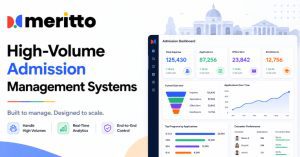

When an admission team is handling hundreds of leads a week, every counselor faces the same silent problem: the pipeline looks full, but who actually intends to enroll?
Without a way to answer that question, teams default to first-in, first-out. The counselor who called earliest gets followed up with. The student who hasn’t responded in a week gets the same priority as one who just visited the campus and opened your last three emails. Time and effort distribute evenly across a pool of people with very different levels of intent, and conversion rates reflect that inefficiency.
Lead scoring exists specifically to solve this. Done well, it tells your team which students are genuinely moving toward a decision and which need more time, more nurturing, or a different kind of engagement. This blog explains how lead scoring works in an education CRM, what to look for in a platform’s scoring capability, and how Meritto goes further than standard lead scoring with features built specifically for enrollment.
What Lead Scoring Actually Means in Enrollment
Lead scoring is the practice of assigning a numerical value to each prospect based on signals that indicate their likelihood of enrolling. The higher the score, the more sales-ready the lead is considered to be.
In generic CRMs designed for sales or marketing, those signals tend to be things like email opens, website visits, and form fills. In an enrollment context, the relevant signals are more specific: did the student verify their contact details? Did they attend a counseling call and stay on for more than three minutes? Did they start an application and then stop halfway? Did they respond to a WhatsApp message within minutes, or leave it on delivered for a week?
The distinction matters because enrollment intent does not look like purchase intent. A student exploring program options is not the same as a student who has already asked about fee installment plans. A lead scoring model that does not distinguish between these behaviors will surface the wrong people at the wrong time.
What you need is scoring that is calibrated to the specific actions and behaviors that predict enrollment in your institution’s context, not a generic formula carried over from a software sales pipeline.
The Gap Between Scoring a Lead and Understanding Intent
Most CRMs that claim to support lead scoring do so at a basic level: track a few engagement events, add up some points, display a number. That number tells you how active a lead has been. It does not tell you how that activity compares to the rest of your funnel, whether that pattern is heading toward enrollment or stalling, or what the counselor should actually do next.
There is a meaningful difference between knowing that a lead scored 74 out of 100 and knowing that this lead is in the top 15% of your current inquiry pool in terms of intent signals, that they have been inactive for 11 days despite a payment commitment, and that WhatsApp at 5 PM is the channel that gets a response.
The first is a number. The second is actionable intelligence. This is the distinction that separates lead scoring as a feature from lead intelligence as a capability.
How Meritto’s Education CRM Approaches Lead Scoring
Meritto is a purpose-built enrollment automation platform trusted by 1,000+ educational organizations across India, the UAE, and Southeast Asia. Its Lead Nurturing module includes several distinct mechanisms for evaluating and acting on lead intent. Each addresses a different layer of the problem.
Student Intent Verification
Before scoring can be meaningful, the lead pool itself needs to be clean. Meritto’s Lead Management System automatically verifies all incoming leads via email or SMS as they enter the platform. This verification step filters out low-quality or unresponsive inquiries, so counselors are not burning time on leads who never confirmed their contact details. The platform labels verified leads who have not yet been contacted as “untouched verified leads,” making it straightforward for teams to identify and prioritize genuine prospects who have not received attention yet.
This is not a scoring mechanism in itself, but it is the precondition that makes scoring useful. A scoring model running on unverified data will consistently surface false positives.
Lead Score
Meritto’s Lead Score is a configurable numerical score assigned to each lead based on their activity, behavior, and properties. Teams can define the criteria that matter to them: a campus visit might carry more weight than an email open; completing an application form might score higher than responding to an SMS. As leads interact with your institution across channels, their score updates automatically.
This is described in detail in Meritto’s existing guide on how lead scoring works, which covers configuration and the key benefits for enrollment teams.
The practical application: counselors can filter their pipeline by lead score to surface the highest-scoring leads first, and marketing automation workflows can be triggered based on score thresholds, so students who reach a certain engagement level automatically receive a different communication sequence.
Lead Strength: Relative Intent Compared to the Full Pool
This is where Meritto goes beyond standard lead scoring. Lead Strength is what Meritto describes as an industry-first feature, and the distinction from Lead Score is important.
Lead Score tells you how engaged a single student has been in absolute terms. Lead Strength tells you how that student’s intent compares to all other leads currently in your pipeline. It is a relative measure, not an absolute one.
Why does this matter in practice? Consider two students who both have a Lead Score of 60. In isolation, they look equivalent. But if the current pool has an average score of 40, both are above average. If the average is 75, both are below the curve and probably not ready for high-effort outreach. Lead Strength gives counselors that context. It answers the question: among everyone I am looking at right now, who is most likely to move forward?
This is particularly valuable during peak admission cycles when a team is managing hundreds of active leads simultaneously. Sorting by Lead Strength rather than raw score helps counselors make better decisions about where to invest their most limited resource: focused call time.
Dynamic Lead Allocation Based on Signals and Interest Area
Scoring is only useful if it connects to action. Meritto’s Lead Management System allocates leads to counselors dynamically, either in a round-robin manner or based on custom logic tied to the lead’s signals and interest area. An inquiry about an engineering program routes to the counselor best positioned to handle engineering conversations. A high-intent lead from a particular geography routes to the team covering that region.
This allocation can be automated across branch level and group level, and it can be reconfigured without developer support. When a lead’s situation changes, reallocation can happen automatically based on stage, disposition, or updated scoring data.
Dynamic Lead Flow Algorithm for Publisher-Sourced Leads
For institutions that acquire a significant volume of leads through publishers and digital agencies, lead quality is uneven. Some sources reliably deliver high-quality, verified inquiries. Others send volume without intent. Meritto’s Dynamic Lead Flow Algorithm addresses this at the source level.
Teams set a minimum verification rate as a quality benchmark. The algorithm then monitors the quality of leads coming in from each publisher API in real time and adjusts the volume of leads admitted from each source based on whether that source is meeting the benchmark. Rather than reviewing lead source quality manually after the fact, the system manages it automatically, so the leads entering the pipeline are already filtered for a baseline level of intent before counselors ever see them.
Mio AI Coach: Intent Intelligence at the Individual Lead Level
The features described above operate at the pipeline level: they help teams organize, prioritize, and route leads. Mio AI Coach, the AI-powered coaching agent built natively into Meritto CRM, operates at the individual lead level.
Mio AI Coach analyzes each lead’s complete journey in the CRM: their registration data, communication history, engagement logs, stage progression, payment activity, and channel behavior. From this, it produces:
An AI Score out of 10 with a conversion readiness level (High, Medium, or Low), and the reasons behind that assessment. An intent signal breakdown, separating what is working (payment commitment, WhatsApp responsiveness, inbound contact initiation, email engagement within 24 hours) from what needs attention (days of inactivity, missed calls, stalled applications, payment failures). A channel and time window recommendation based on that specific student’s actual response history, not generic best practices. And a prioritized action list specifying what to do, which channel to use, when to do it, and what context to bring to the conversation.
The practical effect: a counselor who used to spend five to ten minutes reading through a lead’s activity timeline before a call can now open the lead profile, see the AI Score, read the signal summary, and begin the conversation already knowing where the student stands and what the most likely path to enrollment looks like. The intelligence that used to require experience and pattern recognition to develop is now available to every counselor, including new team members.
What This Looks Like in the Counselor’s Actual Workflow
These mechanisms work in combination. Here is a representative sequence:
A student submits an inquiry via a publisher API. The Dynamic Lead Flow Algorithm has already established that this publisher’s leads meet the quality benchmark, so the lead enters the pipeline without manual review. The Student Intent Verification process automatically sends a verification prompt. The student confirms, and is now tagged as a verified, untouched lead.
Within the CRM, the lead is allocated to a counselor based on their interest area and the counselor’s current capacity. As the student interacts with communication, visits the website, responds to messages, and progresses through the funnel, their Lead Score updates automatically. Their Lead Strength is calculated relative to the current pool, so the counselor can see not just the absolute score but where this student ranks.
Before making a follow-up call, the counselor opens the lead profile and reads the Mio AI Coach summary: AI Score 8/10, conversion readiness High, best channel WhatsApp at 5 to 7 PM, key risk is a pending payment that has been stalled for 11 days. The counselor reaches out on WhatsApp at 5 PM with a message referencing the partial payment and offering an installment plan option.
At every stage, the decision was informed by data from the student’s actual behavior, not intuition.
The Admissions Team Perspective vs. the Marketing Team Perspective
It is worth separating how these features serve different roles.
For counselors and sales teams, Lead Score, Lead Strength, and Mio AI Coach reduce the time spent deciding who to call next and what to say. The CRM for Sales and Counseling Teams is designed to keep teams focused on high-intent prospects and give them the context for a relevant conversation.
For marketing teams, the source-level data from three-tier source attribution and the Dynamic Lead Flow Algorithm answers a different question: which channels are generating leads that actually convert, and how much is each lead source actually worth? The Publisher Panel and Strategic Remarketing tools let teams retarget leads based on their score and stage, so ad spend concentrates on the students most likely to respond.
For management, the Reports and Analytics engine gives a real-time view of pipeline quality and counselor productivity, including how leads at different score levels are converting across programs, campuses, and intake periods.
What to Look for When Evaluating CRMs for Lead Scoring
If you are comparing education CRMs on this capability, here are the questions worth asking:
Is lead scoring configurable to your institution’s specific engagement signals, or is it a fixed formula? Does the platform distinguish between absolute score and relative intent across the current lead pool? How does the platform handle lead quality at the source level, before leads even reach counselors? Does the scoring system connect to automated workflows, or is it just a display number? Is there any layer of per-lead intelligence that tells counselors what to do next, not just how engaged a lead has been?
Most CRMs will answer yes to some of these. What separates Meritto’s approach is that it addresses all of them inside a single platform purpose-built for education, with no generic sales CRM logic adapted to fit enrollment workflows.
See It in Action
To explore how Meritto’s Education CRM handles lead scoring, intent verification, and counselor intelligence in your institution’s context, schedule a demo.
For more context on how lead scoring connects to broader enrollment strategy, read Meritto’s existing guide on what lead scores are and how they work, and explore the Lead Nurturing module to see how scoring feeds into automated multi-channel engagement.
Meritto is a product of NoPaperForms Solutions Limited. Trusted by 1,000+ educational organizations across India, the UAE, and Southeast Asia. Learn more at meritto.com.
FAQs
What is lead scoring in an Education CRM?
Lead scoring is the process of assigning numerical values to student inquiries based on their engagement, behavior, and likelihood of enrolling. It helps admission teams identify high-intent students and prioritize follow-ups, improving counselor productivity and conversion rates.
How does lead scoring help admission teams improve enrollments?
Lead scoring enables counselors to focus on the most engaged and enrollment-ready students instead of treating all leads equally. By prioritizing high-intent prospects, institutions can improve response times, personalize outreach, and increase admission conversions.
What is the difference between Lead Score and Lead Strength in Meritto?
Lead Score measures a student’s engagement based on activities such as application progress, communication responses, and campus interactions. Lead Strength compares a student’s intent level against the entire lead pool, helping counselors identify the most promising prospects at any given time.
How does Meritto identify high-intent student leads?
Meritto combines Student Intent Verification, configurable Lead Scoring, Lead Strength analysis, and Mio AI Coach to evaluate student behavior, engagement patterns, and conversion readiness. This helps admission teams identify and prioritize students who are most likely to enroll.
Can lead scoring be automated in Meritto’s Education CRM?
Yes. Meritto automatically updates lead scores based on student interactions across channels, triggers workflow automations based on score thresholds, dynamically allocates leads to counselors, and provides AI-powered recommendations through Mio AI Coach.
- What is Lead Scoring in Education CRMs? How Meritto Helps You Identify and Prioritize High-Intent Students

- Can One Admission Platform Handle Both Domestic and International Student Enrollments?
- What to Look for in an Admission Platform If Your Institution Has Limited Tech Expertise
- High-Volume Admission Management Systems for Large Group Institutions
- Which Higher Education CRMs Give Directors and Deans Live Analytics on Leads, Applications, and Enrollments?
- The Predictive Admissions Funnel: How to Forecast University Enrollments via CRM Data