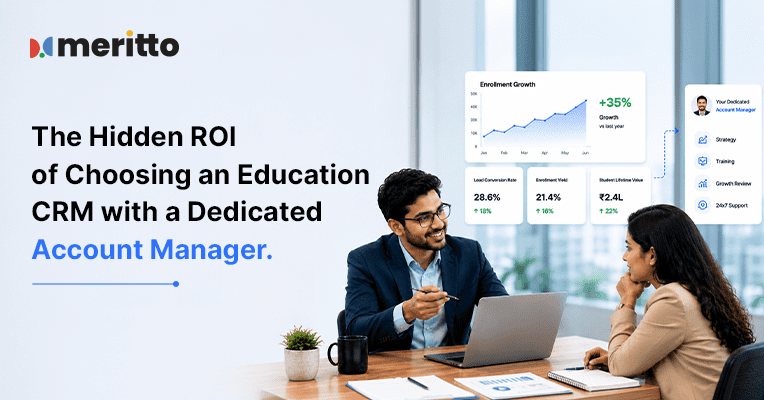
Most institutions evaluate CRMs on features. The ones that get the most out of their platform evaluate them on what happens after go-live.
When an admissions team signs up for a new CRM, they are focused on the demo. The dashboards look clean, the automation flows make sense, and the sales rep answers every question well. What nobody talks about in the demo is what happens six weeks after deployment when the counselor who led the implementation leaves, the enrollment cycle is in full swing, and something in the lead routing is not working the way it should.
That is where the real support model gets tested. And that is where most platforms quietly reveal what they actually offer.
The Question Nobody Asks During Evaluation
“Who is our point of contact after we go live?”
It sounds like a procurement question. It is actually a strategy question. Because the answer determines whether the platform becomes a strategic asset or just another system the team works around.
Most education institutions evaluate CRMs on five things: feature depth, pricing, implementation timeline, integrations, and reference customers. Post-sale support rarely makes the shortlist. It should be first on it.
How Generic CRMs Handle Support for Education Institutions
Zoho CRM
Zoho is one of the most widely deployed CRM platforms in the world and has been adopted by a number of Indian educational institutions as a general-purpose tool for managing inquiries.
The support model follows a tiered structure. Every paying customer gets Classic support by default, which covers email, phone, and chat access to the support team. Beyond that, dedicated account management is a paid add-on.
Zoho’s Premium support plan adds priority onboarding and 24/5 access with a dedicated onboarding specialist. The Enterprise support plan goes further, assigning a dedicated Technical Account Manager and providing quarterly usage reports, 24/7 multichannel support, and a one-hour response time SLA. But it is available only to customers with more than 50 user licenses, and it is priced at 25% of the annual license fee on top of what you are already paying.
In practice: an institution paying for Zoho at scale can expect to pay roughly a quarter of their license cost again just to get a named person who knows their account.
Salesforce Education Cloud
Salesforce operates a three-tier Success Plans model. The standard plan, included with every license, gives access to self-service resources, Trailhead learning paths, and community forums. A dedicated Customer Success Manager is part of the Signature Success Plan, which Salesforce positions as its highest tier.
Salesforce’s Signature plan includes proactive monitoring, a 15-minute response time for critical issues, and a named CSM who serves as the single point of accountability for the account. For education institutions, this is genuinely valuable. The catch is that Salesforce’s Signature plan pricing is not published publicly. It is quoted separately and has historically added a significant percentage to the total cost of ownership.
Salesforce also offers Premier Success Plans as a middle tier, with expert guidance and 24/7 support for critical issues. But a dedicated, named CSM is exclusive to Signature. For most Indian private universities, that tier sits well beyond what the budget allows.
LeadSquared
LeadSquared’s support model is similar to the horizontal SaaS standard: tiered plans with faster response times and more structured onboarding at higher price points. Dedicated account management for ongoing strategic support is typically reserved for enterprise contracts, not standard mid-market plans. Institutions on smaller deployments generally interact with a shared support pool, not a named partner.
The pattern across all three is consistent: the more valuable the support, the more it costs. A dedicated human being who knows your institution, your workflows, and your enrollment calendar is a premium feature, not a default one.
What Meritto Does Differently
Meritto includes a dedicated account manager for every institution, from day one, as part of the standard engagement. Not as a paid tier. Not as a 30-day onboarding window that expires. As an ongoing, named partnership throughout the contract.
This is not a minor operational detail. It reflects a fundamental difference in how Meritto thinks about what an enrollment platform is for.
A generic CRM is built to be self-serve once configured. The assumption is that your team will learn the product, adapt their workflows to it, and reach out to support when something breaks. The relationship ends at the contract.
Meritto is built around the enrollment cycle, which means the product team, the implementation team, and the account management team all operate with an awareness of when your peak cycle is, what your conversion targets are, and what it means when something is off. A dedicated account manager who knows your institution can tell the difference between a feature request and a sign that something in your funnel is leaking.
What Dedicated Account Management Actually Looks Like
When you work with Meritto, your account manager is not a rotating support agent. They are a consistent point of contact who:
Tracks your enrollment cycle and checks in proactively before peak periods, not just when you raise a ticket. Knows your campus structure, your team hierarchy, and which features you actually use versus which ones you have not yet activated. Brings recommendations based on what is working for similar institutions, not just generic best practice documents. Connects you to product updates, beta features, and training resources from the Academy by Meritto that are relevant to your specific use case. Escalates internally when something is not working, with the context of your account already loaded in.
For a multi-campus institution running thousands of leads across parallel cycles, that context is worth more than a faster ticket response time.
The Real Cost of Not Having This
Consider what typically happens at an institution that has deployed a generic CRM without ongoing account support:
The platform is configured well at launch. But over the next two cycles, teams start creating their own workarounds because they cannot get a timely answer on how to configure something properly. Lead routing rules that should have been updated when a new campus launched are not, because nobody flagged the change. Campaign performance data sits in the platform but nobody knows how to build the cross-campus report the Head of Admissions is asking for.
None of this shows up in a ticket. It shows up in enrollment numbers.
The hidden cost of unsupported CRM deployment is not the hours wasted on workarounds. It is the leads that fell through a routing gap nobody caught. It is the counselor who stopped using the lead nurturing workflows because they were too hard to modify. It is the conversion that did not happen because the follow-up sequence was misconfigured and nobody noticed for six weeks.
The Enrollment Calendar Problem
One thing that distinguishes education CRMs from generic CRMs is seasonality. An admissions team does not have a flat, predictable calendar. They have a spike in November, another in March, a quieter stretch in between, and a completely different pattern for postgraduate versus undergraduate programs.
Generic platforms are not built around this. Their support models are not either. Premium onboarding is offered for the first 30 to 60 days after go-live. But what happens when your biggest cycle starts 90 days after implementation? Or when you are running a parallel intake for a new campus and need to restructure your lead allocation rules mid-cycle?
Meritto’s account management is cycle-aware. Your dedicated partner knows that your peak is coming, knows what you need to have in place before it starts, and is actively working with you on readiness rather than waiting for you to raise a support request. The reports and analytics layer is reviewed together, not left for the institution to interpret alone.
Why This Matters More for Higher Education Than Other Verticals
In most B2B software categories, a customer can take six months to figure out a new platform, run some experiments, and optimise gradually. In admissions, you have one cycle per year. Two if you are running both July and January intakes. Missing one cycle because your CRM was not properly configured is not a recoverable situation for the academic year.
This is precisely why purpose-built means more than just having the right features. It means the entire post-sale experience, including support, account management, and product guidance, is structured around how education institutions actually operate. Meritto’s Higher Education CRM is built with that operational reality embedded in the product and in the service model around it.
What to Ask Before You Sign
When evaluating any enrollment platform, here are the support questions that should be on every checklist:
Is a dedicated account manager included in the standard contract, or is it a paid add-on?
What is the tenure of the account manager relationship? Is there a named person or a rotating support pool?
How does the platform handle configuration changes mid-cycle? Is there a self-serve layer, or does it require a support ticket?
What does the onboarding window look like, and what happens after it closes?
Does the account team have visibility into your enrollment metrics, or are they purely reactive to requests?
Is there a structured review cadence, or only ad-hoc support?
For generic horizontal platforms, honest answers to these questions will typically reveal a paid tier sitting between you and the support you actually need. For Meritto, the answers are already built into the standard engagement.
The Compounding Effect
Institutions that have a dedicated success partner do not just have fewer support problems. They consistently extract more value from the same platform. They activate features that otherwise sit unused. They catch funnel issues before they compound into missed enrollments. They have someone who brings them toward what is new, including Mio AI capabilities across voice, coaching, and student engagement, rather than waiting for the institution to discover it on their own.
Over a three-year contract, the difference between a supported and unsupported CRM deployment is not measured in support tickets resolved. It is measured in enrollment outcomes. That is the hidden ROI that never appears on a feature comparison chart, and it is the one that matters most.
Meritto’s dedicated account management is included as part of every engagement, not as an upgrade. To see how it works alongside the platform, schedule a demo.
FAQs
1. Why is a dedicated account manager important for educational institutions using a CRM?
A dedicated account manager provides ongoing strategic support beyond implementation. They understand your institution’s enrollment cycles, workflows, and goals, helping teams optimize platform usage, resolve issues quickly, and improve enrollment outcomes.
2. Do all education CRMs include a dedicated account manager?
No. Many CRM platforms offer dedicated account management only as part of premium support plans or enterprise packages. In contrast, Meritto includes a dedicated account manager as part of its standard engagement for every institution.
3. How does a dedicated account manager help during peak admission cycles?
A dedicated account manager proactively reviews enrollment readiness, helps optimize workflows, monitors platform performance, and ensures admissions teams are prepared for high-volume periods. This reduces the risk of missed leads and operational bottlenecks during critical enrollment windows.
4. What are the risks of using a CRM without ongoing account management support?
Without dedicated support, institutions may face configuration issues, inefficient workflows, underutilized features, reporting challenges, and missed enrollment opportunities. Small problems can go unnoticed and negatively impact admissions performance over time.
5. How does Meritto’s account management approach differ from generic CRM providers?
Meritto assigns a dedicated account manager who works closely with the institution throughout the partnership. They provide proactive guidance, enrollment-focused recommendations, product training, performance reviews, and strategic support tailored to the institution’s admission goals.
- The Predictive Admissions Funnel: How to Forecast University Enrollments via CRM Data

- Which Enrollment Management System is Most Popular Among Private Universities in India?
- Which Admission Management Systems Have Natively Integrated Online Fee Payment Solutions?
- Which Higher Ed CRMs Provide Real-Time Enrollment Dashboards for University Leadership?
- The Hidden ROI of Choosing an Education CRM with a Dedicated Account Manager
- How India’s Largest Group of Institutions Manage Cross-Campus Admissions Using Meritto