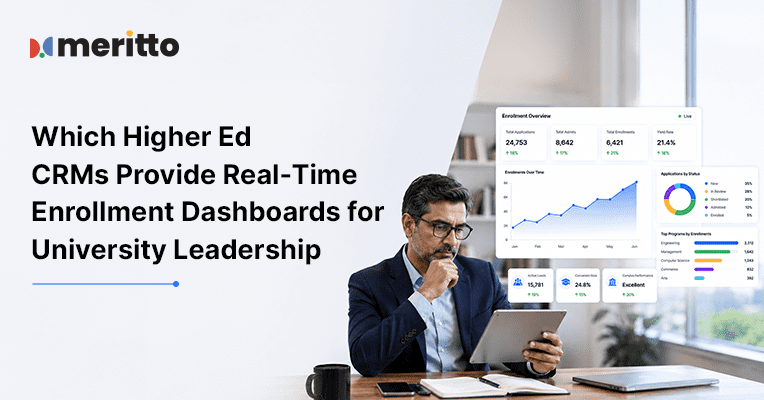
The gap between what leadership asks and what the data shows has always been a timing problem. Most institutions are making enrollment decisions on information that is 48 hours old.
A Vice Chancellor reviewing admissions performance on a Monday morning should not be looking at Friday’s export. A Pro-Vice Chancellor for Academic Affairs planning a course intake mid-cycle should not have to wait for the admissions head to compile a report. And a Registrar trying to understand why applications for one campus are tracking 18% behind target should not have to cross-reference three spreadsheets to find out.
Real-time enrollment dashboards for university leadership are not a luxury. They are the operational infrastructure that allows senior teams to intervene early, redirect resources, and close a cycle with confidence rather than hope.
The question is which platforms actually deliver this, and what separates a real-time enrollment analytics tool from a CRM that just happens to have a reporting tab.
Why University Leadership Teams Need Real-Time Enrollment Dashboards
University leadership operates at a different altitude than admissions counselors. The Head of Admissions needs to know which counselor missed three follow-ups. The VP-Academics needs to know whether the MBA intake is on track to hit target. The Chancellor needs to know whether total enrollment for the academic year is moving in the right direction across all programs.
These are different questions. They require different views of the same data. And they require that data to be current.
The problem most institutions face is that their reporting infrastructure was designed for counselors and team leads, not for management. Data gets entered at one level, summarized at another, and eventually surfaces in a weekly email or an export that someone has cleaned up in Excel. By the time the Vice Chancellor sees it, it is not a real-time enrollment dashboard. It is a historical record.
The enrollment cycle is unforgiving. A 10-day delay in spotting a conversion drop can mean 200 fewer applications before the deadline. No amount of reactive effort at the end of the cycle recovers what was lost in the middle.
What a Real-Time Admission Analytics Dashboard Should Actually Track
Before evaluating platforms, it helps to define what leadership actually needs to see. A real-time enrollment analytics dashboard for university leadership should cover at minimum:
Funnel health in real time. Total leads captured today, this week, this cycle. Movement from inquiry to application to enrollment, with drop-off rates at each stage visible at a glance.
Program-level and campus-level breakdowns. A university group running five programs across three campuses cannot operate on aggregate numbers. Leadership needs to see which programs are tracking ahead and which need attention, without drilling through six screens to find it.
Campaign ROI and source attribution. Which lead sources are producing applications that convert, not just leads. Cost per enrollment by channel, not just cost per lead.
Counselor and team performance. Response time averages, follow-up completion rates, conversion ratios by team member. This sits at the boundary between operational and strategic visibility, but it informs resource decisions leadership has to make.
Year-on-year and target-versus-actual comparisons. Not just where you are today, but how today compares to the same point last year, and how it tracks against the cycle target.
Predictive enrollment trajectory. Given the current pace, where will the cycle end? This requires running application averages and trend modeling, not just a static count.
Most platforms offer some version of these. The differences lie in how current the data is, how configurable the views are, and how much analyst time is required to build the reports management actually needs.
How Generic BI Tools Fall Short for Higher Education Analytics
Several institutions have attempted to solve the dashboard problem with general-purpose business intelligence tools like Tableau, Power BI, or Looker connected to their CRM data.
This approach works in theory. In practice, it creates three persistent problems.
The first is data latency. Most CRM-to-BI integrations run on scheduled syncs, not live connections. Leadership ends up with dashboards that are hours or a full day behind. During peak admission periods, that matters.
The second is maintenance overhead. Every time the CRM schema changes, or a new field is added, or a new program is created, the BI connector breaks or the dashboard needs to be rebuilt. This creates a dependency on IT or a data analyst that admissions leadership typically does not have.
The third is context loss. Generic BI tools do not understand enrollment funnels, publisher attribution, Student Quality Index, or the difference between a form submission and a completed application. Building that logic from scratch, in a tool designed for e-commerce or financial reporting, produces dashboards that look sophisticated but require a glossary to interpret.
The better answer is an analytics layer that is built on the same data model as the enrollment platform itself.
How Leading Enrollment CRMs Approach Real-Time Enrollment Analytics
Salesforce Education Cloud
Salesforce has robust reporting infrastructure through its native analytics tools and the Einstein Analytics layer. For institutions with the technical resources to configure it, the reporting depth is genuine.
The limitation for most Indian higher education institutions is identical to the broader Salesforce challenge: the configuration cost is high, the timeline is long, and the default reports are built for a Western higher ed context that does not map directly onto India’s enrollment model. Custom dashboards for a university VP in an Indian institution require configuration work that most admissions teams are not positioned to manage independently.
LeadSquared
LeadSquared provides dashboards covering lead pipeline, counselor performance, and campaign attribution. For institutions using it as a lead management tool, the reporting is functional.
The gap shows up at the management layer. LeadSquared’s reporting was designed primarily for sales team visibility. Cross-campus aggregation, program-level funnel tracking, and the kind of benchmarking against historical data that a Vice Chancellor or Registrar needs are not native to the platform. They require customisation that pushes the tool toward its limits.
Tableau / Power BI (as standalone layers)
As discussed above: genuine analytical power, genuine maintenance overhead. Appropriate for institutions with a dedicated data team. Not appropriate as a front-line tool for admissions leadership who need answers in real time without filing a report request.
How Meritto’s Real-Time Enrollment Analytics Platform Works for University Leaders
Meritto’s Reports and Analytics layer is built on the same data model as the enrollment platform, which means every action taken in the CRM, every lead captured, every application stage updated, every fee payment recorded, is immediately reflected in the management dashboard. There is no sync lag. There is no export-and-clean step.
The Management Team dashboard is purpose-designed for institutional leadership, not team leads. It gives a bird’s eye view across all verticals that matter: lead volume, application conversion, campaign performance, counselor productivity, and fee collection status. Leadership can stay at the aggregate view or drill down to a specific program, campus, or date range with the same dashboard.
This matters because most CRM reporting tools give leadership the same interface as the operations team, just with more data visible. Meritto separates the management view structurally: what a Vice Chancellor needs to see every morning is not the same as what a counseling head needs, and the dashboards reflect that.
Admission Performance Metrics University Executives Can Track in Meritto
The Admission Reports and Analytics module in Meritto gives university leadership direct access to:
Real-time enrollment funnel health. The lead funnel shows the complete journey from inquiry to enrolled student, with movement across every critical stage visible in real time. Leadership can see where the funnel is healthy and where leads are stalling, without asking anyone to compile a report.
Timeline-based comparisons. Historical benchmarking built into the interface. Track how this week’s applications compare to the same week last year, or how a specific program is trending versus its target. These comparisons are built into the dashboard, not a separate analysis request.
Student Quality Index. An aggregated view of applicant profiles including academic background, geography, board-wise distribution, and demographics. This gives academic leadership visibility into the quality of the incoming class, not just the volume.
Running Application Average and predictive trajectory. Track year-on-year performance, check the Running Application Average, and use built-in predictive analytics to see the projected final enrollment count. For a Registrar managing intake targets, this is the number that drives every mid-cycle decision.
Campaign manager and publisher benchmarking. Tie marketing spend directly to applications and enrollments, not just to leads. Track which digital campaigns, publishers, and lead aggregators are generating admissions value, and redirect budget in real time based on that data. The Campaign Management module and Publisher Panel feed directly into this view.
Counselor performance analytics. Track response time, follow-up rates, and conversion ratios across the counseling team. This is operational data, but it surfaces at the management layer because it directly explains funnel performance.
Cross-campus and cross-program visibility. For group institutions, the dashboard supports multiple entities and campuses within a single view, with the ability to filter down to any level of granularity. A Pro-Vice Chancellor overseeing both the engineering and management schools can see a consolidated picture, or isolate either program, with no additional configuration.
AI-Powered Enrollment Insights with Mio AI Assist and Mio AI Filters
The analytics layer in Meritto goes beyond static dashboards through two Mio AI capabilities that change how leadership interacts with enrollment data.
Mio AI Assist is a conversational analytics layer embedded directly in the platform. Instead of navigating to a report and interpreting it, leadership can ask a question: “How many applications did we receive from Delhi this week compared to last year?” or “Which program has the highest drop-off between form submission and payment?” and get an answer directly. For a Vice Chancellor who does not have time to become fluent in dashboard navigation, this is the difference between using the analytics and not using them.
Mio AI Filters let any user query and segment data using natural language. Describe what you need, and the system applies the right filters across Lead Manager and Application Manager instantly. No filter logic to set up manually, no IT request to pull a custom segment.
Together, these capabilities mean the analytics are not just real-time. They are accessible in real time to anyone in leadership, regardless of their comfort level with the platform.
What to Look for in a Real-Time Enrollment Dashboard for Higher Education
If you are evaluating analytics capabilities as part of an enrollment platform decision, here are the questions that separate useful real-time dashboards from reporting tabs that happen to exist:
Is the data truly live, or does it sync on a schedule? For management decisions during peak cycles, hourly syncs are not real-time.
Can leadership access a purpose-built view, or do they see the same interface as counselors with more permissions? Institutional leaders and admissions counselors need fundamentally different windows into the same data.
Does the platform support multi-campus, multi-program reporting natively, or does every cross-entity comparison require a custom export?
Is year-on-year benchmarking built in, or does it require building custom comparison reports from scratch?
Can the platform project final enrollment numbers based on current trajectory, or does it only show where things stand today?
Does the analytics layer integrate marketing spend and ROI directly, or does enrollment performance and campaign performance live in separate systems?
Is there an AI layer that makes the data accessible conversationally, or does the platform require users to know exactly which report to run?
The Higher Education CRM page and the Management Teams product page outline how Meritto addresses each of these, with the Mobile App extending the same real-time visibility to leadership teams that need to track enrollment health away from their desks.
The Decision Institutions Keep Delaying
The most common reason institutions delay upgrading their enrollment analytics is that they have workarounds in place. Someone runs the report every Monday. Someone built a reasonable Excel model that gets updated weekly. Someone checks the CRM and sends a summary to leadership by WhatsApp.
These workarounds persist because they work well enough most of the time. The problem is not the steady state. It is the moments where catching a trend three days earlier would have made a material difference to the cycle outcome. Those moments are invisible until after the cycle closes and the final numbers are in.
For university leadership teams that want to operate on current information rather than periodic summaries, the move to a purpose-built, real-time enrollment analytics platform is not a technology upgrade. It is a change in how decisions get made.
Meritto is built for exactly that. Over 1,000 institutions across India, UAE, and Malaysia use it to give their leadership teams the visibility they need, when they need it, without waiting for anyone to compile a report.
See Meritto’s real-time enrollment analytics dashboard in action. Schedule a demo for your institution.
FAQs
1. What is a real-time enrollment dashboard for higher education?
A real-time enrollment dashboard provides university leaders with live visibility into admissions performance, application trends, enrollment funnels, campaign ROI, counselor productivity, and fee collection status. It enables faster, data-driven decision-making throughout the enrollment cycle.
2. Why do university leadership teams need real-time enrollment analytics?
University leaders need current data to identify enrollment challenges early, monitor program performance, track admissions targets, and allocate resources effectively. Real-time analytics help institutions respond to trends before they impact enrollment outcomes.
3. What metrics should a university enrollment dashboard track?
A comprehensive enrollment dashboard should track inquiry-to-enrollment conversion rates, application volumes, campaign performance, counselor productivity, year-on-year comparisons, enrollment targets, student quality metrics, and predictive enrollment forecasts.
4. How does Meritto help universities with real-time enrollment reporting?
Meritto provides a purpose-built analytics platform that updates in real time as leads, applications, and payments move through the enrollment process. University leaders can access live dashboards, cross-campus reporting, performance benchmarking, and predictive enrollment insights without relying on manual reports.
5. How does AI improve enrollment analytics for university management?
Meritto’s Mio AI enables leadership teams to interact with enrollment data using natural language. Users can ask questions, generate insights, apply filters, and analyze admissions performance instantly without requiring technical expertise or custom report creation.
- Connected Intelligence: The Infrastructure Behind Institutional Agility

- More Data, But Less Insight? Inside the Intelligence Era of Education
- How universities can turn AI into real institutional impact
- Which CRMs Can Show Cost per Lead and Cost per Enrollment by Channel?
- How to Track Digital Marketing Agency Performance for Student Recruitment
- Admission Counselor Productivity: Tools to Track Performance Effectively