Every educational organisation collects more student data today than it did five years ago. Enquiry details, application documents, fee records, communication history. As this data grows, so does a quieter question that admissions and IT leaders are starting to ask out loud: who inside our own team can actually see all of this, and should they?
This is where access control stops being a technical checkbox and starts becoming a governance decision.
The real risk isn’t outside your organisation
Most conversations about student data security focus on external threats: hacking, phishing, breaches. Important, certainly. But a large share of exposure inside institutions comes from something far less dramatic: broad, undifferentiated access. A counsellor who can edit fee records. A support executive who can export the entire lead database. A former team member whose access was never fully revoked.
Meritto’s Education CRM was built around a simple premise: education admissions have their own rhythm, their own teams, and their own risk points, and a generic CRM was never going to account for that.
What detailed access control actually looks like
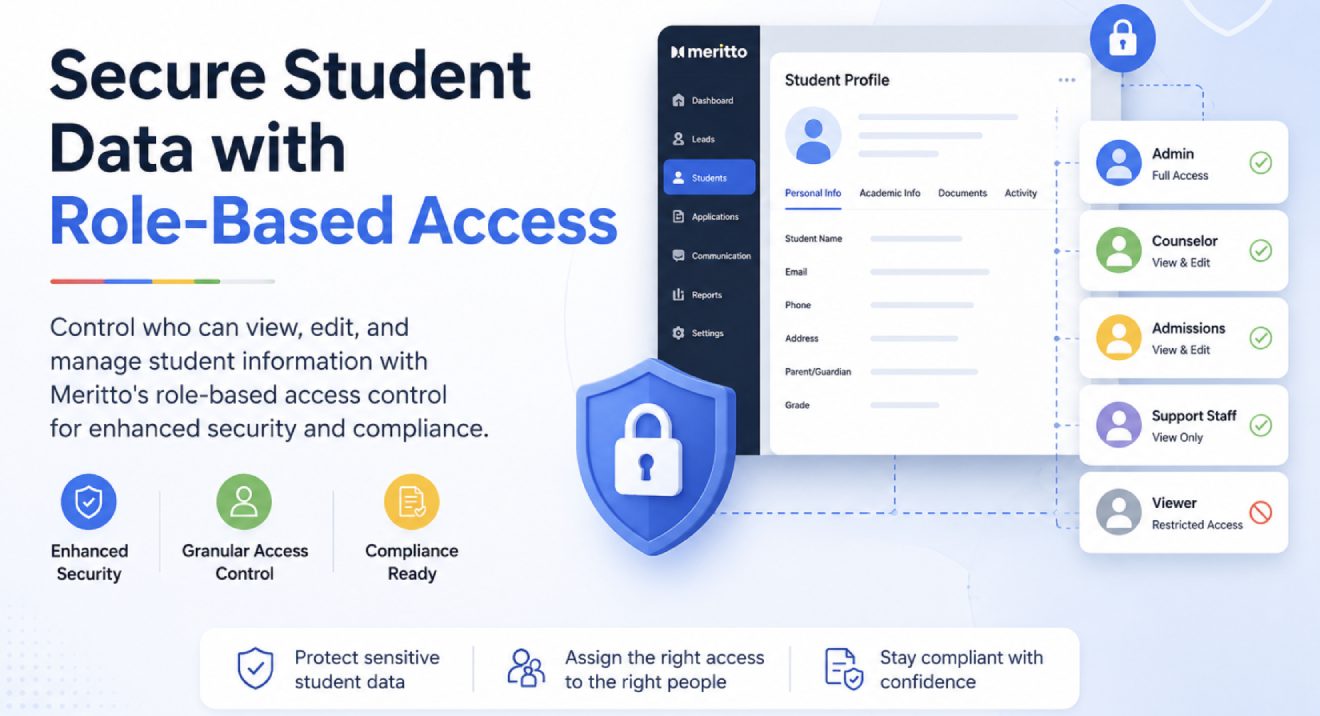
Role-based access control means every user sees only what their role requires, nothing more. In an admissions environment, this typically plays out across a few dimensions:
Module-level permissions. Sales counsellors work within lead and application modules. Finance teams operate within fee and payment modules. Neither needs standing access to the other’s workspace.
View versus edit rights. Being able to see a record and being able to change it are two different permissions, and they should be configured that way.
Activity visibility. Every action inside the system, a field edit, a status change, a data export, leaves a trace that a compliance or IT lead can review.
Meritto’s platform for IT teams is built around exactly this logic. Permission-driven modules let institutions configure who views or edits specific data, and real-time user activity and session logs mean every action is tracked, not assumed.
Why this matters more as institutions scale
A five-person admissions team can often get away with loose access controls. A 50-person team, spread across campuses, working with third-party partners and seasonal staff, cannot. This is usually the exact point where institutions start to feel the gap between what their existing system allows and what their operations actually require.
Scale doesn’t just mean more data. It means more people touching that data, more often, from more places. A regional counsellor onboarded for one intake cycle. A partner agency with temporary lead access. A campus-level admin who should only see their own campus, not every campus across the group. Each of these is a legitimate use case, and each one becomes a liability the moment access is broader than the role demands.
Access control is what keeps that growth from turning into risk. Done well, it also removes a layer of manual oversight: instead of an IT team manually tracking who has access to what, the system enforces it by design.
Access control also makes audits easier
Institutions working with international students, particularly across UAE and Malaysia, often need to demonstrate data handling practices to regulators, partner universities, or internal governance boards. When access is role-based from the start, answering “who can see this student’s data” becomes a straightforward lookup rather than a manual investigation.
This is also where activity logs earn their place. A permission structure tells you what someone is allowed to do. An activity log tells you what they actually did. Together, they give an institution a defensible answer during any audit or compliance review, without needing to reconstruct history after the fact.
Where this fits into the bigger picture
Access control is one layer. It sits alongside encryption, secure cloud infrastructure, and compliance with frameworks like GDPR and SOC 2. Meritto’s approach to security is built on the idea that privacy and access aren’t add-ons bolted onto a platform after the fact. They’re part of how the system is designed from the ground up, including SOC 2 aligned data security practices that institutions can review directly.
For institutions that also manage fee collection through Collexo, the same logic extends to financial data: who can view a fee record is a different question from who can process a refund, and the two shouldn’t be governed by the same permission.
A question worth asking your current platform
If your team is currently working with a system that doesn’t let you configure access by role, or one where you’re not entirely sure who has visibility into what, it may be worth a closer look. Not because something has gone wrong. Because the earlier this is addressed, the fewer records there are to audit later.
Meritto is the enrollment automation platform trusted by 1,000+ educational organisations across India, UAE, and Malaysia, with Mio AI for intelligent student engagement and Collexo for embedded fee payments.
- Connected Intelligence: The Infrastructure Behind Institutional Agility

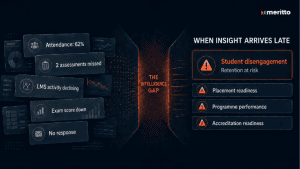
- More Data, But Less Insight? Inside the Intelligence Era of Education
- How universities can turn AI into real institutional impact
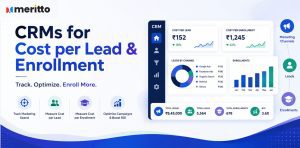
- Which CRMs Can Show Cost per Lead and Cost per Enrollment by Channel?
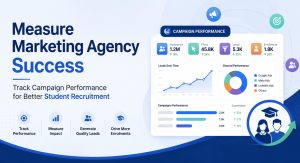
- How to Track Digital Marketing Agency Performance for Student Recruitment
- Admission Counselor Productivity: Tools to Track Performance Effectively