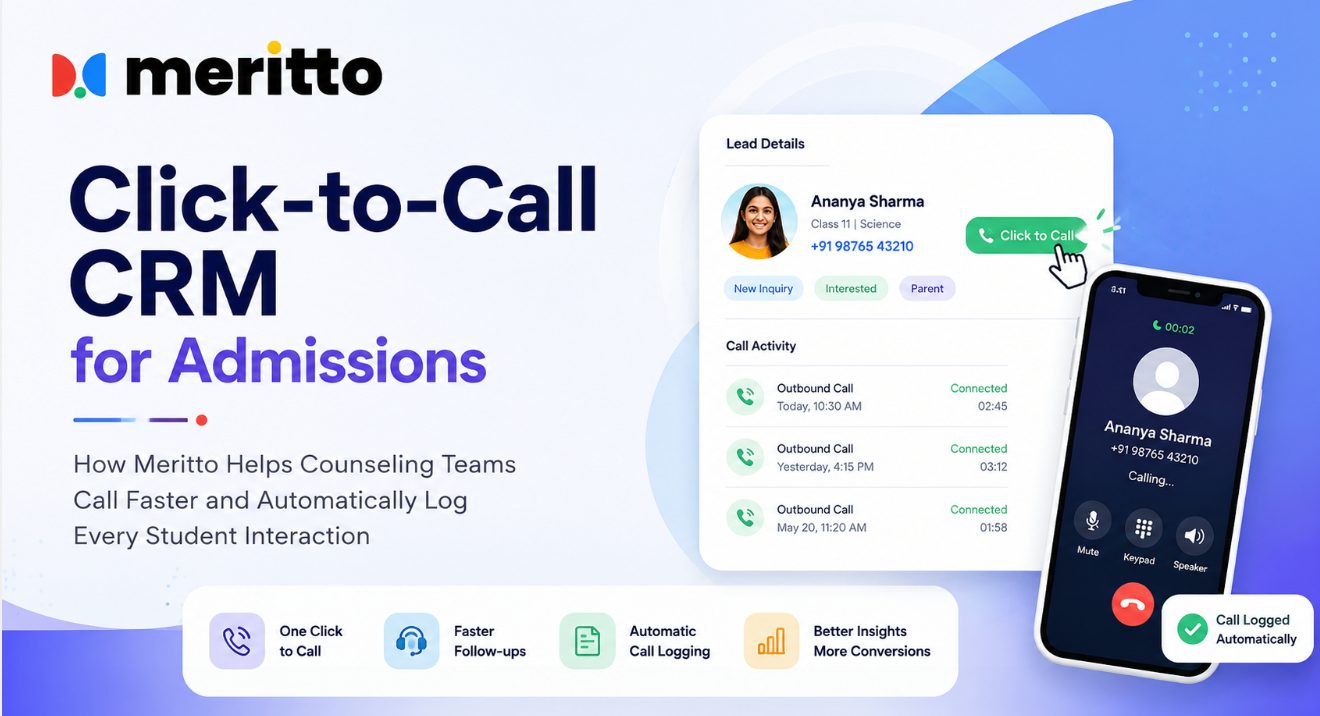
Click-to-call sounds like a small convenience, dial without typing a number, but the underlying integration determines whether a counsellor’s call history is actually usable data or just a line item in a phone bill. The real question isn’t whether a CRM “supports calling.” It’s whether the telephony layer and the CRM record are actually the same system, or two systems awkwardly stitched together.
What computer telephony integration (CTI) actually involves
Number masking. Most cloud telephony setups route calls through a virtual number rather than exposing a counsellor’s or a student’s actual phone number to the other party. This protects both sides’ privacy and means a counsellor leaving the institution doesn’t take a personal number relationship with them.
Click-to-call via API, not a dialer app. A genuine integration lets a counsellor click a number inside the lead profile, and the CRM triggers the call through a telephony provider’s API, connecting the counsellor’s phone and the student’s number without either party dialing manually. Without this, “click-to-call” just opens a separate app and the CRM has no idea the call happened.
Automatic call logging via webhook, not manual entry. When a call ends, the telephony provider needs to send call metadata, duration, timestamp, outcome, recording link, back to the CRM automatically and attach it to the correct lead record. If a counsellor has to manually note “called at 3pm, no answer,” the log is only as reliable as whether they remembered to do it.
Call recording with consent handling. Recording calls for quality and training purposes is standard practice, but it needs to account for consent requirements, which vary by jurisdiction, and needs the recordings actually accessible against the right lead record rather than sitting in a separate telephony dashboard nobody checks.
IVR and routing logic. For inbound calls, routing to the right counsellor based on program interest, language, or existing lead ownership determines whether a student calling in reaches someone with context, or a random available agent starting from zero.
Two ways this gets built, and what each means in practice
Native telephony inside the CRM. Some education CRMs build calling directly into the platform, meaning click-to-call, logging, and recording all live in one system by default with no separate configuration.
Third-party cloud telephony connected via integration. Providers like Exotel, Ozonetel, and Knowlarity offer telephony infrastructure (virtual numbers, IVR, recording) that connects to a CRM through REST APIs and webhooks. This is common and works well, but it means the quality of the integration, whether logs attach automatically and reliably, whether click-to-call actually fires through the API rather than just displaying a number, depends on how well that specific connector was built, not just on the CRM or the telephony provider individually.
Neither approach is inherently better. The distinction that matters is whether the connection, however it’s built, actually delivers automatic, reliable logging without manual work, and whether a failed webhook silently drops call records or surfaces the gap.
This is also where mobile matters more than it does for most CRM features. Admissions counselling teams are frequently on the move, education fairs, campus visits, field recruitment, and a click-to-call integration that only works from a desktop browser misses a large share of actual calling activity. A mobile app that carries the same click-to-call and auto-logging behavior as the desktop CRM, rather than a stripped-down version, keeps the call record complete regardless of where the counsellor is working from.
What to check before relying on this for a counselling team
- Does clicking a number in the CRM place the call directly, or does it just copy the number for a separate dialer app?
- Are call logs attached to the lead record automatically, including outcome and duration, or does a counsellor need to log the call manually afterward?
- Is call recording stored and accessible against the specific lead record, and does the consent flow meet local requirements?
- Can inbound calls route based on existing lead ownership or program interest, so a returning caller reaches someone with their history, rather than restarting the conversation from zero?
- What happens when the telephony provider’s webhook fails, does the call simply go unlogged, or is there a reconciliation process?
Where Meritto fits
Meritto’s App Telephony lets counsellors trigger calls directly from a lead or application profile, on web or through the Meritto mobile app, without manual dialing. Calls are logged automatically against the lead record, including connected call counts and duration, so counsellor productivity and follow-up history are visible without relying on manual notes.
- Connected Intelligence: The Infrastructure Behind Institutional Agility

- More Data, But Less Insight? Inside the Intelligence Era of Education
- How universities can turn AI into real institutional impact
- Which CRMs Can Show Cost per Lead and Cost per Enrollment by Channel?
- How to Track Digital Marketing Agency Performance for Student Recruitment
- Admission Counselor Productivity: Tools to Track Performance Effectively