Every educational institution has a version of the same recurring problem. An applicant pays their application fee. The payment lands in the institution’s bank account. Someone in finance now needs to match that transaction to the correct applicant record, confirm the amount, update the application status, generate a receipt, and make sure the settlement figure in the system matches what actually arrived in the bank.
When this process works, it is invisible. When it breaks, which it does regularly during peak admission cycles, it produces a backlog that slows down application processing, delays enrollment confirmations, and sometimes results in eligible students being turned away because their fee payment was not matched in time.
The question institutions should be asking is not “how do we manage reconciliation better” but “why is our system making us manage reconciliation manually at all?”
This blog explains what automated payment reconciliation means in the context of an education CRM, where manual processes tend to break down, and how Meritto and its embedded payments platform Collexo are built to handle this automatically.
Where the Manual Reconciliation Problem Comes From
Most institutions that struggle with payment reconciliation are not doing anything wrong operationally. The problem is structural: their admission system and their payment processing system are separate.
The admissions team tracks applications in a CRM. Finance manages payments through a bank portal, a separate payment gateway dashboard, or manually updated spreadsheets. When a payment comes in, someone has to bridge the two systems: look up the transaction reference, find the corresponding application, match the amount, update the status in the CRM, and log the confirmation.
At low volume, this is manageable. During the two weeks before an application deadline when hundreds of transactions are arriving simultaneously across multiple payment modes, credit cards, debit cards, UPI, net banking, and demand drafts, it becomes the bottleneck that every department is aware of and no one has a clean solution for.
Three specific problems follow.
Suspense entries. When a payment arrives but cannot be immediately matched to an application, it sits in a suspense account. These entries require manual investigation and resolution. Institutions with high application volumes accumulate suspense entries throughout an admission cycle and spend significant staff time resolving them.
Settlement timing mismatches. Payment gateways settle funds on T+1 or T+2 cycles, and different gateways have different settlement timelines. Matching what the institution received to what was supposed to be collected requires either an automated reconciliation system or regular manual export-and-compare exercises.
GST and surcharge complexity. Application fees may include GST components, payment gateway surcharges, or processing fees that need to be split and accounted for separately. Manual calculation of these components per transaction is error-prone and time-consuming.
None of these problems require more staff to solve. They require a different architecture.
What Automated Reconciliation Requires
Genuine payment-to-application reconciliation requires that the fee collection system and the application management system operate as a single connected infrastructure, not as two systems that talk to each other occasionally.
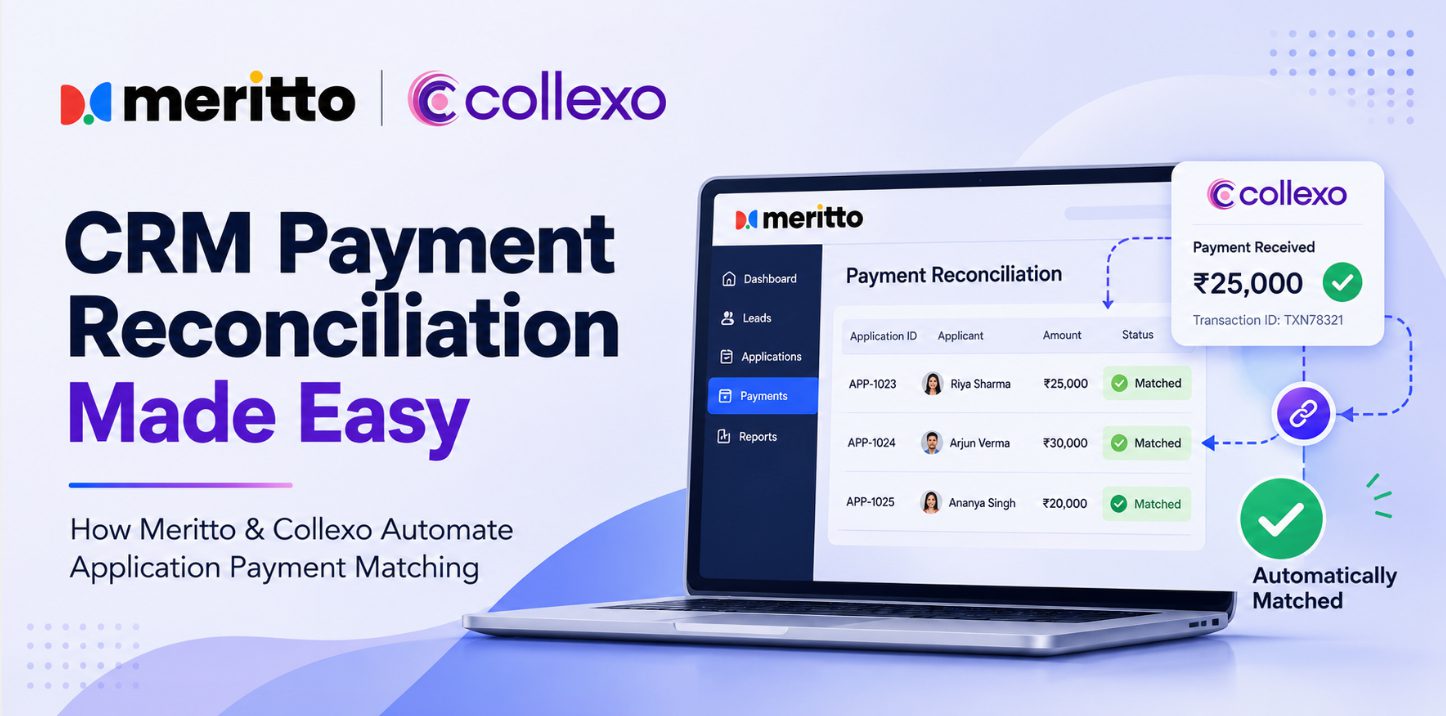
When payment and application data are unified, every incoming transaction is automatically matched to the student record it belongs to. The application status updates in real time when payment is confirmed. Settlement reports are generated automatically rather than compiled manually. Suspense entries are eliminated because every transaction has an application to match against. GST and surcharge calculations happen without manual intervention.
The institution’s finance team shifts from doing reconciliation work to reviewing reconciliation reports. The work does not go away, but it moves from daily manual matching to exception handling, which is a much smaller and more manageable task.
How Meritto and Collexo Are Built for This
Meritto is the enrollment automation platform. Collexo is the embedded payments platform built by the same company, NoPaperForms Solutions Limited, and natively integrated with Meritto. Together they form the end-to-end enrollment and fee management system that institutions use to run the full cycle from application submission to enrolled student.
The architecture matters: because Meritto and Collexo share the same underlying student data, every payment processed through Collexo is automatically connected to the application record in Meritto. There is no bridge to build and no periodic sync to schedule. The data is unified by design.
Automatic Payment Matching and the Elimination of Suspense Entries
Collexo Central, the SaaS layer that sits underneath all of Collexo’s payment products, describes its reconciliation approach precisely: it “automatically tracks every fee payment and matches it directly to students, eliminating suspense entries.”
This is the operational statement that matters most. When a student pays their application fee through any channel supported by Collexo, the transaction is matched to their record immediately. Finance does not need to look up the payment reference and find the corresponding application. The system does it automatically.
Settlement Reports That Provide Transaction-Level Visibility
Collexo Central’s settlement reports give finance teams complete visibility into each student’s transactions: what was collected, what is due, and how settlements break down by account and transaction count.
These reports are generated by the system, not compiled by a finance officer from multiple sources. The Collexo Central page describes them as providing the ability to “track payments and ensure all accounts are accurate” whether for daily reconciliations or audit preparation.
Automated Payment Routing to Multiple Bank Accounts
For institutions that collect fees into multiple bank accounts, whether for different departments, different campuses, or different fee categories, Collexo Central automates the routing of payments to the appropriate account based on collection requirements.
This removes a class of manual work entirely: the institution does not need to manually allocate incoming payments across accounts. The routing logic is configured once and applied automatically to every transaction.
Automatic Split Payment at the Application Stage
Meritto’s Payment Manager within the Application Automation layer handles a specific reconciliation challenge at the application fee stage: the automatic split between the institution’s share of an application fee, Meritto’s processing fee, and payment gateway charges.
The page describes this directly: “Meritto allows a seamless Auto Split Payment option. The candidate makes the payment of the application fee, the system directly deducts the processing and payment gateway charges and remits the funds directly to your bank account.”
This means the institution receives the correct net amount directly, without having to track gross amounts, calculate deductions, and manually reconcile the difference. The split is handled in the transaction itself.
Dynamic Fee Collection by Course and Preference
Not every applicant pays the same amount. A student applying for multiple course preferences may pay a higher fee. A student in an early-bird window may receive a discount. A student who pays in installments has a different collection schedule than one who pays in full.
The Payment Manager’s Dynamic Fee Collection handles this through conditional logic: different fee types can be configured for different courses, and preference-based fee collection can be set up without any code. An applicant who selects multiple course preferences automatically sees the correct combined fee. The system collects the right amount and matches it to the right record. No manual adjustment is needed post-payment.
Automated GST and Surcharge Compliance
Collexo Central handles the GST calculation that typically creates manual work for finance teams: automatically splitting taxes into SGST, CGST, and IGST based on the institution’s and the student’s location, and configuring surcharges and convenience fees.
The Collexo Central page describes this as eliminating “the hassle of manually calculating taxes” and reducing “the risk of manual errors, ensuring compliance and accuracy every step of the way.”
For institutions handling high application volumes during peak cycles, this automation removes a recurring source of errors that only surface during reconciliation.
Automated Recurring Fee Collection Through AutoDebit
For institutions that collect fees in installments across a semester or academic year, Collexo AutoDebit automates the debit process entirely. Using an eNACH-based system, fees are debited on due dates from UPI, debit cards, and net banking automatically, with automated alerts sent via WhatsApp, email, and SMS ahead of each debit date.
Finance does not chase payments. The platform collects them on schedule and records them against the correct student record. The reconciliation work reduces to reviewing the automatic collection report rather than manually processing each installment.
Finance Team View Within Meritto
For institutions where finance teams work directly within Meritto, the Finance Teams page describes run-time settlement reports, one-click payment automation, fee forecasting, and finance dashboards. These are scoped to what finance needs to do their job, without requiring them to navigate the broader CRM interface.
Multi-Currency Support for International Students
For institutions recruiting internationally, Collexo supports transactions in multiple currencies including INR, USD, AED, MYR, SGD, GBP, EUR, PHP, ZAR, NPR, GHS, NGN, BDT, SLE, LKR, and LRD. Reconciliation across currencies is handled within the same platform, without requiring separate tools for different student populations.
The Collexo Numbers Worth Knowing
Collexo processes $1 billion in fees annually, manages payments for 3 million students, and serves 700+ educational institutions. These are not projections. They are confirmed on the Collexo homepage and reflect the scale at which the reconciliation and settlement infrastructure actually operates.
One institution’s testimony from the Collexo Central page captures the operational shift accurately: “Human input in the accounts reduced drastically, data mapping is very well configured. Automated receipt generation is also a huge benefit to us.”
That is what the shift from manual to automated reconciliation looks like in practice: finance staff stop doing data entry and start reviewing reports.
Where This Fits in the Broader Meritto Platform
The payment and reconciliation infrastructure is one layer of a platform that covers the full enrollment funnel. The Admission Management Software overview shows how the Payment Manager connects to Application Automation, the Education CRM, and Post-Application Automation in a single system.
For institutions evaluating this specifically from a finance perspective, the Finance Teams page covers the complete view. For the Collexo infrastructure specifically, Collexo Central is the right starting point for understanding how reconciliation, settlement, and reporting work.
To see how this works in the context of your institution’s fee structure, payment volume, and current finance workflow, schedule a demo with Meritto or schedule one directly with Collexo.
Meritto and Collexo are products of NoPaperForms Solutions Limited. Meritto is trusted by 1,000+ educational organizations across India, the UAE, and Southeast Asia. Collexo processes $1 billion in fees annually across 700+ institutions. Learn more at meritto.com and collexo.com.
- Connected Intelligence: The Infrastructure Behind Institutional Agility

- More Data, But Less Insight? Inside the Intelligence Era of Education
- How universities can turn AI into real institutional impact
- Which CRMs Can Show Cost per Lead and Cost per Enrollment by Channel?
- How to Track Digital Marketing Agency Performance for Student Recruitment
- Admission Counselor Productivity: Tools to Track Performance Effectively