
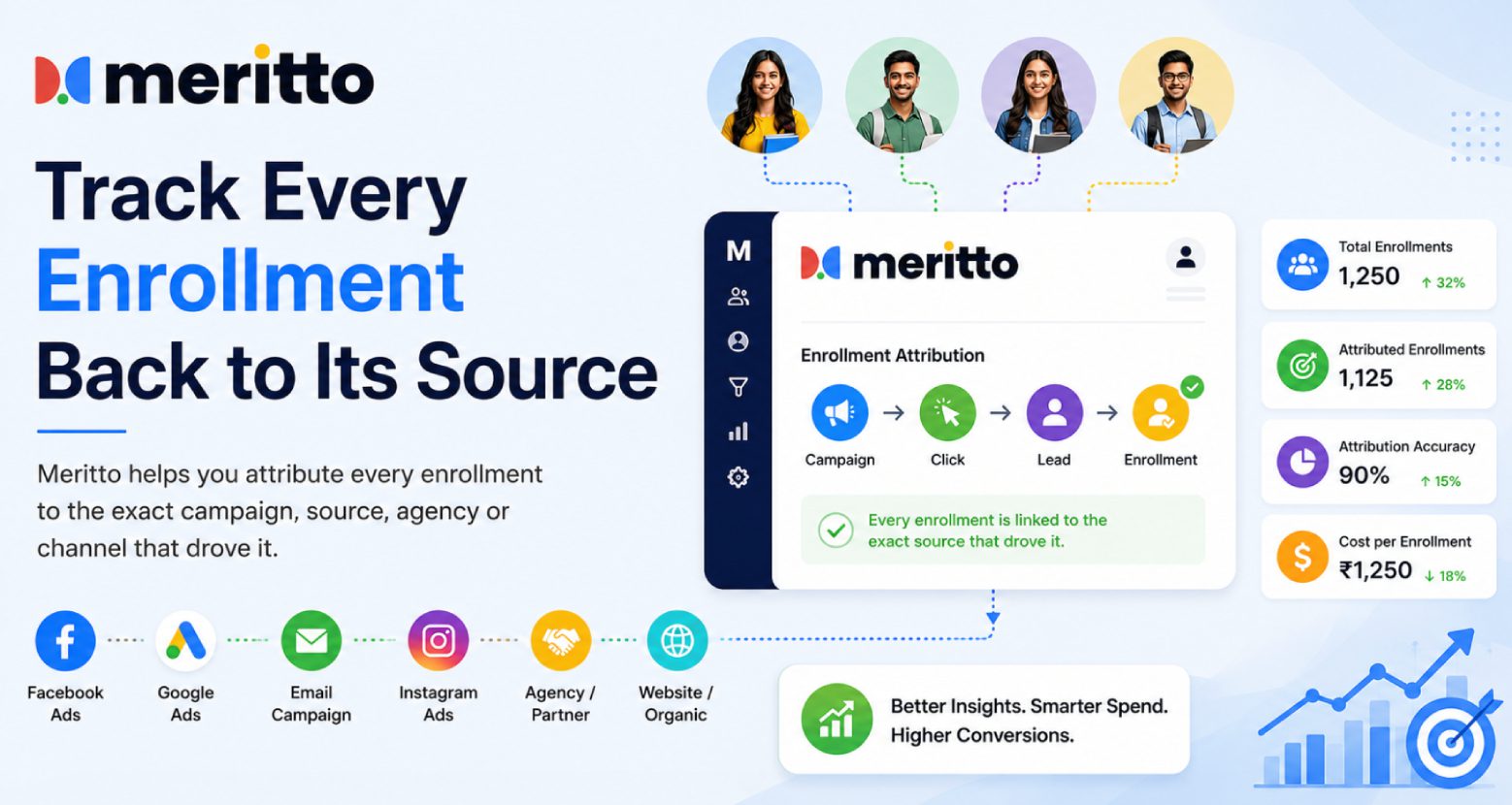
Ask a marketing manager at any educational institution how they decide which agencies to renew and which campaigns to scale, and the honest answer is usually some version of: by feel, by past experience, or by volume numbers that do not tell the full story.
The data problem is structural. Most institutions track where leads come from. Very few track where enrollments came from. The gap between those two measurements is where the marketing budget disappears.
An agency that delivers 800 leads a month looks like a strong partner. Until you ask how many of those 800 leads started an application, how many completed it, how many paid the fee, and how many actually enrolled. If the answer is three, the cost per enrolled student from that agency is catastrophic. But without a system that tracks the full journey from lead to enrolled student and attributes it back to the originating source, that calculation cannot be made.
This blog breaks down the attribution problem in enrollment marketing, what a CRM needs to do to actually solve it, and how Meritto’s Campaign Manager, MEI framework, Publisher Panel, and Dynamic Lead Flow Algorithm address each layer.
The Attribution Gap in Enrollment Marketing
Most educational institutions run lead generation through a mix of sources: digital agencies, education portals, social media campaigns, direct website traffic, walk-ins, and education fairs. Each source operates on its own terms and delivers leads through its own channels, whether as API integrations, bulk uploads, or form submissions.
The attribution problem has three distinct layers.
Volume versus outcome attribution. Standard lead tracking tells you how many leads each source delivered. It does not tell you how those leads performed downstream. An agency is typically paid on a cost-per-lead basis, but the institution’s actual cost is better measured in cost per enrolled student. Without connecting lead source to enrollment outcome, those two numbers are calculated in completely different systems and never reconcile.
Duplicate lead attribution. The same student appears across multiple sources constantly. They inquired on a portal, then responded to a Google ad, then also came through a university fair. If all three sources claim credit for that lead, the institution is paying three times and the attribution data is distorted. Which source actually drove the decision matters for future budget allocation.
Lead dumping. Some agencies, when they know volume is the primary metric they are being judged on, send high quantities of low-quality or unverifiable leads to meet targets. Without a mechanism that automatically penalizes poor-quality lead flow, the institution absorbs counselor time and marketing budget on contacts that were never going to enroll.
None of these is solvable with a spreadsheet. Each requires architecture built into the CRM.
How Meritto Is Built for Enrollment Attribution
Meritto‘s Campaign Management System is the part of the platform where campaign tracking, source attribution, publisher accountability, and enrollment-back attribution all converge. The features below are each verifiable from Meritto’s live product pages.
Three-Tier Non-Editable Source Attribution
Meritto captures every lead’s source history at up to three levels: primary, secondary, and tertiary. The primary source is the first touchpoint that generated the lead. The secondary and tertiary sources capture subsequent instances of the same lead appearing through other channels.
Critically, this attribution is non-editable. No one inside the institution or on the agency side can alter source records after the fact. Attribution data is fixed at the moment the lead enters the system, which means the historical record of where each lead came from is accurate and tamper-proof.
This resolves the duplicate attribution problem. The same student appearing through three different sources is recorded once, with all three source instances stored, but credit for the enrollment is assigned to the primary source that first generated the lead. Agencies cannot claim credit for leads they did not originate.
Mutually Exclusive Impact (MEI)
MEI is the feature that closes the loop between lead source and enrollment outcome. Where standard attribution shows which source sent how many leads, MEI shows which source drove how many applications, how many fee payments, and how many enrollments.
Each publisher or agency gets a unique MEI number and MEI percentage that measures their exclusive contribution at each stage of the admission funnel: from lead to application, application to payment, and payment to enrollment. The measurement is mutually exclusive, meaning if a student came in through Agency A as primary source and Agency B as secondary, Agency A gets the MEI credit for that enrollment. There is no double-counting.
The practical effect: for the first time, an institution can see not just “Agency X sent 800 leads” but “Agency X’s leads produced 12 applications, 9 fee payments, and 7 enrollments, giving them a lead-to-enrollment rate of 0.9%.” That number, compared across all agencies in the same dashboard, is the basis for genuine performance management rather than relationship-based renewal decisions.
MEI is visible on the Campaign Management page as a core feature, described as giving “absolute transparency, accountability, and merit-based attribution of your publishers.”
Cost Per Verified Lead and Cost Per Primary Verified Lead
Meritto surfaces two distinct cost metrics that change how institutions hold agencies accountable.
Cost Per Verified Lead (CPVL) measures what the institution pays for each lead that has been verified as genuine (confirmed contact details, responsive to outreach). This filters out unverifiable or ghost leads from the cost calculation.
Cost Per Primary Verified Lead (CPPVL) goes further, measuring cost against only the leads where the agency was the primary source, stripping out leads where the agency was secondary or tertiary. This gives the most accurate measure of what an agency’s original lead generation actually costs.
These two metrics together give marketing teams the vocabulary to negotiate with agencies on outcome-based terms, not volume terms. An agency claiming strong lead delivery can be measured against their CPPVL, which may tell a very different story.
Dynamic Lead Flow Algorithm
The Dynamic Lead Flow Algorithm is Meritto’s automated mechanism for controlling lead quality at the source level. Institutions set a minimum verification rate as a quality benchmark. Each day, the algorithm monitors the verification rate of leads delivered by each agency through API. If an agency’s verification rate drops below the benchmark, the system automatically reduces the number of leads it accepts from that agency per day, in real time.
This is the technical answer to lead dumping. An agency cannot flood the system with unverifiable leads to meet volume targets, because the system detects the quality drop and throttles the inflow automatically. The institution does not need to manually intervene or wait for a monthly report to discover the problem.
Meritto has a dedicated Quick Read on this topic: How to Control Lead Dumping through Dynamic Lead Algorithm, which describes this as addressing an “industry-wide challenge” and an “industry-first feature.”
The Publisher Panel
The Publisher Panel gives agencies and education portals their own view into campaign performance, without giving them access to student data the institution has not approved for sharing.
Inside the Publisher Panel, each publisher sees four dashboards:
The Lead Dashboard shows their lead delivery performance in real time, with Relative Benchmarking that lets them compare their delivery against other publishers for the same institution. Comparative Benchmarking tracks growth over days, weeks, or months.
The Application Dashboard lets publishers track the journey of their leads from inquiry to application submission. Student data visibility on this dashboard is controlled entirely by the institution: if the institution does not want publishers seeing applicant data, that dashboard is not visible to them.
The Campaign Dashboard shows which of the publisher’s campaigns are performing, using Meritto’s multi-level tracking system to identify duplicate lead attempts and their respective sources.
The Geographical Dashboard shows state and city-level breakdowns of leads, with Relative Benchmarking for geographic performance, helping publishers optimize their campaigns toward the catchment areas that convert.
The practical effect of the Publisher Panel is that agencies and institutions are looking at the same data simultaneously. When a performance conversation happens, both sides are working from an identical record rather than arguing from separate spreadsheets. This changes the dynamic of agency relationships from adversarial to collaborative.
Campaign Dashboard Customization
The Campaign Manager also allows institutions to customize how traffic channels, publishers, and lead sources are grouped and labelled in their dashboard view. Institutions can organize attribution by how their teams actually work, reflecting their campaign strategy rather than forcing data into a default taxonomy. This removes the dependency on a data team or IT to produce campaign performance reports in a useful format.
What Changes When Attribution Is Actually Working
When lead-to-enrollment attribution is accurate and visible, four things happen that most institutions currently cannot do.
Performance-based agency contracts become possible. Instead of paying agencies per lead, institutions can negotiate contracts with milestones tied to application completion, fee payment, or enrollment. MEI data is the evidence base for those conversations.
Budget allocation follows outcomes, not volume. A channel that delivers fewer leads but higher enrollment conversion rates should receive more budget. Without enrollment attribution by source, that reallocation cannot be justified. With it, the math is explicit.
Lead dumping has an automatic deterrent. Agencies know that the Dynamic Lead Flow Algorithm monitors quality in real time. Sending unverifiable leads does not inflate their volume numbers; it reduces the daily cap on what they can send. The incentive shifts from volume to quality.
Counselor time is protected. Every counselor hour spent on an unverifiable or duplicate lead is an hour not spent on a genuine inquiry. Accurate attribution and quality controls at the source level mean the pipeline counselors work from is cleaner, which affects their conversion rates and morale.
Frequently Asked Questions
What is MEI in Meritto?
MEI stands for Mutually Exclusive Impact. It is a metric in Meritto’s Campaign Management System that measures the exclusive contribution of each publisher or marketing agency at every stage of the admission funnel, from lead to application, application to payment, and payment to enrollment. It assigns a unique MEI number and MEI percentage to each source, ensuring that credit for an enrollment goes to the source that originally generated the lead rather than being split across multiple sources.
Can Meritto track which agency drove an enrollment?
Yes. Meritto’s three-tier source attribution captures the primary, secondary, and tertiary source for every lead. MEI then connects each primary source to downstream outcomes including application completion, fee payment, and enrollment. An institution can view, in real time, how many enrollments each agency or campaign generated, not just how many leads.
How does Meritto prevent lead dumping?
Meritto’s Dynamic Lead Flow Algorithm monitors the verification rate of leads shared by each publisher through API. Institutions set a minimum verification rate as a quality benchmark. If an agency’s leads fall below that benchmark on any given day, the algorithm automatically reduces the number of leads the system accepts from that agency on a per-day basis. The throttling happens automatically without manual intervention.
What is Cost Per Primary Verified Lead?
Cost Per Primary Verified Lead (CPPVL) is a metric in Meritto’s Campaign Manager that measures the cost of leads where the agency or publisher was the primary source, after filtering out unverified contacts. It gives institutions the most accurate view of what an agency’s original lead generation activity actually costs, stripped of the distortion caused by duplicate leads where the agency was a secondary or tertiary touchpoint.
What does the Publisher Panel give agencies?
The Publisher Panel is a dedicated view inside Meritto that gives agencies and education portals real-time visibility into their own campaign performance. It includes four dashboards covering lead delivery, application conversion, campaign performance, and geographic distribution. Access to student-level data in the Application Dashboard is controlled by the institution and can be restricted. Both the institution and the agency see the same underlying data, which removes the information asymmetry that typically causes disputes.
Where to Go Next
For institutions currently managing agency and campaign performance outside their CRM, the starting point is seeing the Campaign Manager, Publisher Panel, and MEI framework in the context of your actual channel mix.
Meritto’s Campaign Management System page covers the full attribution and analytics capability. The Publisher Panel page covers the agency-facing dashboard in detail. The Lead Management System page covers how three-tier attribution and Dynamic Lead Flow operate at the lead intake layer.
To see the full enrollment attribution workflow for your institution’s agency setup, schedule a demo with Meritto.
Meritto is a product of NoPaperForms Solutions Limited. Trusted by 1,200+ educational organizations across India, the UAE, and Southeast Asia. Learn more at meritto.com.
- Connected Intelligence: The Infrastructure Behind Institutional Agility

- More Data, But Less Insight? Inside the Intelligence Era of Education
- How universities can turn AI into real institutional impact
- Which CRMs Can Show Cost per Lead and Cost per Enrollment by Channel?
- How to Track Digital Marketing Agency Performance for Student Recruitment
- Admission Counselor Productivity: Tools to Track Performance Effectively